
Understanding the I-751 Filing Deadline
Conditional permanent residents must file Form I-751 during a specific 90-day window before their green card expires (8 CFR § 216.4(a)(1)). How that window works:
The window opens exactly 90 days before the expiration date printed on your conditional green card. It closes on the expiration date itself. So if your card expires on June 15, 2026, you can file starting March 17, 2026, and your filing must be received by USCIS (not just postmarked) by June 15, 2026.
This "received by" distinction matters. If you mail your I-751 on the last day and USCIS doesn't get it until the next week, that counts as a late filing. Many people get caught by this, especially when mailing close to the deadline.
There is one exception for certain military cases: INA § 216(g) tolls the 90-day filing period during any time the conditional resident or petitioning spouse is a member of the U.S. Armed Forces serving abroad on active duty (though the petition may be filed during active-duty service after the 90-day period begins). USCIS policy guidance also addresses situations where the CPR or petitioning spouse/stepparent is stationed or deployed overseas on official military or government orders.
For everyone else, if the deadline has passed and you haven't filed, you're in late-filing territory. But that doesn't mean all is lost.
What Happens If You Miss the I-751 Deadline
Missing the I-751 deadline has consequences. Here's what happens:
Your conditional permanent resident status can be terminated if you fail to file the required petition. Under INA § 216(c)(2)(A), if no petition is filed as required, DHS shall terminate conditional permanent resident status as of the second anniversary of the alien's lawful admission for permanent residence (which corresponds to the expiration date on the 2-year card).
USCIS can then initiate removal proceedings against you under INA § 237(a)(1)(D), which makes conditional residents deportable if their status has been terminated.
Since February 28, 2025, USCIS has significantly expanded its use of Notices to Appear (NTAs) under updated guidance. USCIS reported on June 12, 2025 that it had initiated removal proceedings against more than 26,700 people since issuing that guidance.
What most people don't realize: your status terminating does not mean you'll be deported tomorrow, and it does not mean you can't fix this. USCIS has approved late I-751 filings that were months or even years overdue. The key is filing as soon as possible with proper documentation.
Can You Still File I-751 After Your Green Card Expires?
Yes. Federal law specifically allows late I-751 filings. INA § 216(d)(2)(B) states that a petition may be considered if filed after the deadline, as long as you establish "good cause and extenuating circumstances" for the failure to file on time.
The regulation at 8 CFR § 216.4(a)(6) requires you to explain the good cause in writing. This is where your explanation letter comes in (covered in detail below).
There is no explicit cutoff date in the statute after which USCIS must automatically refuse a late joint Form I-751 filing; however, a late filing is only excused if you establish good cause and extenuating circumstances. In practice, longer delays are harder to justify and should be addressed with a detailed written explanation and strong supporting evidence.
Once USCIS accepts your late I-751 filing, you'll receive a receipt notice (Form I-797C) that extends your conditional status for 48 months beyond the card's original expiration date. This extension was implemented in January 2023 and is a significant improvement over the old 24-month extension. During this period, you can continue to work and travel.
What Is "Good Cause" for Late I-751 Filing?
The USCIS Policy Manual (Vol. 6, Part I, Ch. 3) lists specific examples of circumstances that may constitute good cause:
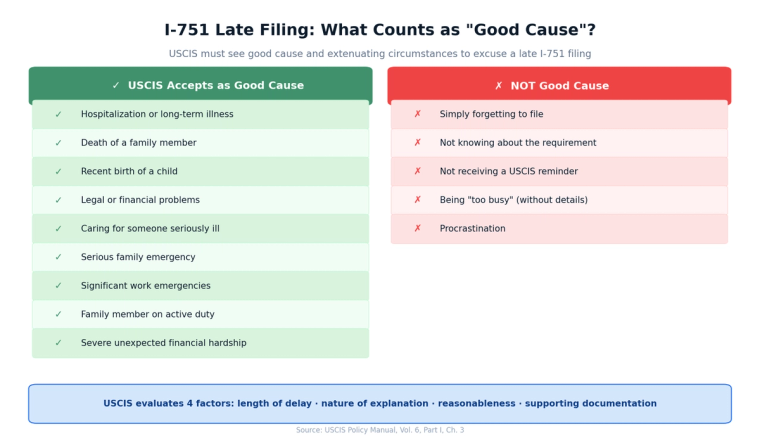
Circumstances USCIS recognizes as good cause:
- Hospitalization or long-term illness
- Death of a family member and bereavement
- Recent birth of a child
- Legal or financial problems
- Providing care for someone with a serious illness
- Serious family emergency
- Significant work commitments or emergencies
- Family member on active duty with U.S. armed forces
- Severe and unexpected financial situations that prevented paying the filing fee
What does NOT qualify as good cause:
- Simply forgetting to file (the Policy Manual explicitly says this "generally does not constitute good cause" absent other factors)
- Not knowing about the filing requirement
- Not receiving a reminder notice from USCIS
- Being "too busy" without specific extenuating details
- Procrastination
USCIS evaluates late filings using four criteria. First, they look at the length of the delay, since a filing that's two weeks late is very different from one that's two years late. Second, they assess the nature of your explanation and whether the circumstances were extraordinary and beyond your control. Third, they consider whether the delay was reasonable given the circumstances. And fourth, they review your supporting documentation (USCIS Policy Manual, Vol. 6, Part I, Ch. 3).
If you truly did forget, all is not lost, but you'll need to pair that explanation with other factors. For example, if you forgot because you were dealing with a difficult pregnancy, a family crisis, or a period of extreme work pressure, lead with those circumstances and explain how they contributed to the oversight.
Evidence Requirements by Good Cause Category
Your explanation letter alone isn't enough. You need supporting documentation that backs up your claims. Here's what to gather based on your situation:
Medical emergency or illness:
- Hospital admission and discharge records
- Doctor's letters confirming treatment dates and severity
- Prescription records covering the filing period
- Documentation of follow-up care
Death of a family member:
- Death certificate
- Obituary or funeral program
- Proof of your relationship to the deceased
- Travel records if you left the country for the funeral
Financial hardship:
- Layoff or termination notice from employer
- Bank statements showing depleted funds
- Documentation of unexpected major expenses (medical bills, emergency repairs)
- Unemployment benefit records
- If the filing fee was the barrier, explain what changed to allow filing now
Work emergency:
- Letter from employer confirming the emergency and your required involvement
- Travel records showing work-related absence
- Project documentation showing critical deadlines
Caring for a family member:
- Medical records of the person you were caring for
- Letter from their treating physician
- Documentation showing you were the primary caregiver
Regardless of your reason, also include all the standard bona fide marriage evidence required for any I-751 filing: joint tax returns, shared bank account statements, lease or mortgage documents, insurance policies listing both spouses, and photos together over time.
For details on payment methods for the filing fee, see our guide on how to pay USCIS filing fees. As of 2026, USCIS only accepts credit/debit cards (Form G-1450) or ACH bank transfers (Form G-1650) for paper filings. Checks and money orders are no longer accepted (USCIS Fee Schedule).
How to Write a Late Filing Explanation Letter
Your explanation letter matters - and most resources don't provide templates. Here's what to include:
Your letter should cover:
- Your full name, A-Number (your alien registration number), and date of birth
- Your conditional green card receipt number and expiration date
- The specific reason you missed the filing deadline
- A timeline of events that prevented timely filing
- What steps you took once you realized the deadline had passed
- A reference to the supporting documentation you're including
Tone and format:
- Write in a professional and honest tone
- Be specific about dates, events, and circumstances
- Don't exaggerate or fabricate. USCIS officers review these regularly and can tell when something doesn't add up
- Keep it to one page if possible, two at most
- Address it to the USCIS Director at the service center where you're filing
Sample Letter: Medical Emergency
[Your Full Name]
[Your Address]
[Date]
U.S. Citizenship and Immigration Services
[Service Center Address]
Re: Late Filing of Form I-751 - Good Cause Explanation
A-Number: [Your A-Number]
Conditional Green Card Expiration Date: [Date]
Dear USCIS Director,
I am writing to explain why my Form I-751, Petition to Remove Conditions on Residence, was not filed within the required 90-day period before my conditional green card expired on [expiration date].
On [date], approximately [X weeks/months] before my filing deadline, I was hospitalized at [hospital name] for [medical condition]. I was admitted on [date] and discharged on [date]. Following my discharge, I required [describe follow-up care: ongoing treatment, physical therapy, bed rest, etc.] for approximately [duration].
During this period, I was unable to manage my immigration paperwork due to [specific limitations: immobility, medication side effects, cognitive impairment, etc.]. Once I recovered sufficiently and became aware that my filing deadline had passed, I took immediate steps to prepare and submit this petition.
I am enclosing the following documentation to support this explanation:
- Hospital admission and discharge records from [hospital name]
- Letter from Dr. [Name] confirming my diagnosis and treatment timeline
- Prescription records for [relevant period]
I respectfully request that you accept this late filing based on the good cause and extenuating circumstances described above, as provided under 8 CFR § 216.4(a)(6).
Sincerely,
[Your Signature]
[Your Printed Name]
Sample Letter: Death in the Family
[Your Full Name]
[Your Address]
[Date]
U.S. Citizenship and Immigration Services
[Service Center Address]
Re: Late Filing of Form I-751 - Good Cause Explanation
A-Number: [Your A-Number]
Dear USCIS Director,
I am writing to explain the late filing of my Form I-751. My conditional green card expired on [date], and I was unable to file during the required 90-day window due to the death of my [relationship, e.g., father/mother/sibling], [Name], on [date of death].
My [relative] passed away in [City, Country], and I traveled there on [date] to handle funeral arrangements and support my family during this difficult time. I remained in [location] until [return date] to [settle estate matters / care for surviving family members / complete mourning customs].
Upon returning to the United States, I needed additional time to address [describe any related issues: grief counseling, settling affairs, returning to normal routine]. I began preparing my I-751 petition as soon as I was able to focus on my immigration matters.
Supporting documentation enclosed:
- Death certificate for [Name]
- Travel records showing departure on [date] and return on [date]
- [Any additional documentation]
I respectfully request acceptance of this late filing under 8 CFR § 216.4(a)(6).
Sincerely,
[Your Signature]
[Your Printed Name]
Sample Letter: Financial Hardship
[Your Full Name]
[Your Address]
[Date]
U.S. Citizenship and Immigration Services
[Service Center Address]
Re: Late Filing of Form I-751 - Good Cause Explanation
A-Number: [Your A-Number]
Dear USCIS Director,
I am writing to explain the late filing of my Form I-751. My conditional green card expired on [date]. During the 90-day filing window, I was experiencing severe financial hardship that prevented me from paying the $750 filing fee.
On [date], I [was laid off from / lost my position at] [Employer Name], where I had worked as [position] since [date]. This sudden loss of income, combined with [describe other factors: unexpected medical bills, spouse also unemployed, supporting family members], left me unable to afford the filing fee during the required period.
I [describe what changed: secured new employment on X date, received financial assistance, saved enough from reduced income] and am now filing as soon as I am financially able to do so.
Supporting documentation enclosed:
- Termination or layoff notice from [Employer Name] dated [date]
- Bank statements for [relevant months] showing depleted funds
- [Unemployment benefit records / new employment verification]
I respectfully request acceptance of this late filing under 8 CFR § 216.4(a)(6).
Sincerely,
[Your Signature]
[Your Printed Name]
Step-by-Step Guide to Filing I-751 Late
What to do if you've missed the deadline:
1. Write your explanation letter. Use the templates above as a starting point. Be specific, honest, and concise. Reference the supporting documents you'll include.
2. Gather your good cause documentation. Collect every piece of evidence that supports your explanation, organized chronologically.
3. Complete Form I-751. Use the current edition (04/01/24). The filing fee is $750 for paper filing. For payment methods and online filing options, see our I-751 guide.
4. Compile your bona fide marriage evidence. Even though you're filing late, you still need to prove your marriage is genuine. Include joint tax returns, shared financial accounts, lease or mortgage documents, insurance policies, photos, and affidavits from people who know your marriage. See our I-751 guide for the complete evidence list.
5. Submit everything together. Your package should include the completed I-751, your explanation letter, good cause documentation, bona fide marriage evidence, and the filing fee.
6. Track your case. After USCIS accepts your filing, you'll receive a receipt notice (Form I-797) extending the validity of your Green Card for 48 months beyond the card's expiration date. For current processing times, check the USCIS Processing Times page for Form I-751.
7. Respond promptly to any RFE. Late filings are more likely to receive a Request for Evidence. USCIS may ask for additional documentation about your good cause or additional marriage evidence. Respond within the deadline stated on the RFE notice.
You'll also need to attend a biometrics appointment after filing. The biometrics fee is included in the I-751 filing fee since April 2024, so there's no separate charge.
What If USCIS Denies Your Late I-751?
If USCIS decides your good cause explanation isn't enough and denies your late I-751, you'll usually be placed in removal proceedings, where you can ask the immigration judge to review the denial (Matter of H. N. Ferreira, 28 I&N Dec. 765 (BIA 2023)). That review is a real second chance: the judge must consider new evidence, and if the judge rules in your favor, removal proceedings end and you remain a permanent resident with the conditions removed. For all four recovery options, including motions to reopen and refiling, see our guide to what happens after an I-751 denial.
Special Cases: When Good Cause Isn't Required
There's one major exception to the late-filing rules that many people don't know about. If you're filing an I-751 with a waiver of the joint filing requirement under 8 CFR § 216.5, you can file at any time. No 90-day window. No good cause explanation.
Waiver filings are available when:
- Your marriage ended in divorce or annulment
- Your U.S. citizen spouse has died
- You or your child were subject to battery or extreme cruelty by your U.S. citizen or permanent resident spouse
- Deportation would result in extreme hardship to you
If any of these apply to your situation, you don't need to worry about proving good cause for late filing. You do still need to prove that your marriage was genuine when it began.
If you're going through divorce, Immiva can help with the waiver process. See how Immiva works and check our pricing to understand what's involved.