
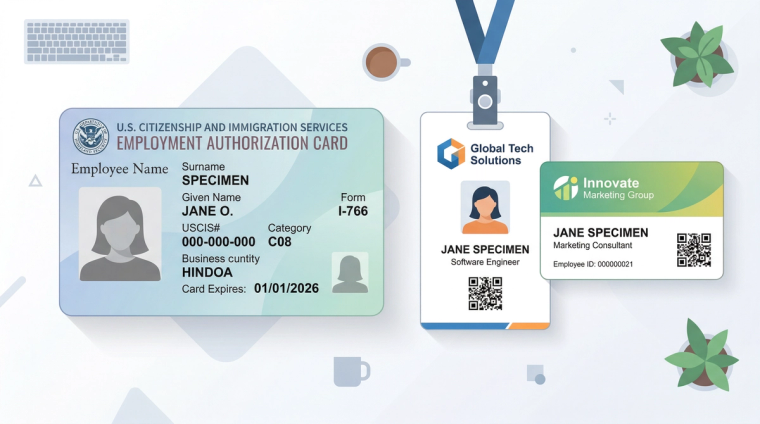
The short answer: yes, no restrictions
If you hold a valid J-2 EAD, you may work for more than one employer and can combine full-time and part-time jobs. USCIS policy generally does not restrict the type or location of employment after EAD approval, but your employment is only authorized while you maintain J-2 status and while your EAD is valid. Also, employment will not be authorized if the income is needed to support the J-1 principal.
The USCIS Policy Manual, Volume 10, Part A, Chapter 2 says it plainly: upon EAD approval, "the alien's type and location of employment is unrestricted." The regulation governing your EAD, 8 CFR § 274a.12(c)(5), says nothing about limiting you to one employer, a specific industry, or a set number of hours.
For a full overview of J-2 work authorization and how to get your EAD, start with our complete guide. Haven't applied yet? Check your J-2 EAD eligibility first.
Why J-2 EAD is an open-market work permit
Federal employment authorization rules split EADs into three categories under 8 CFR § 274a.12:
Category (a): People authorized to work incident to status (often without restrictions on type or location of employment), and some of them must apply for an EAD as evidence of that authorization. Category (b): People authorized to work incident to status for a specific employer (employer-specific work authorization), such as H-1B or L-1 workers. Category (c): People who must apply for an EAD; once USCIS approves the EAD, the type and location of employment is generally unrestricted.
J-2 dependents fall under category (c)(5). Your work authorization is not tied to any specific employer, industry, or location once the EAD is approved. However, H-4 spouses generally file under (c)(26), and L-2 spouses are employment authorized incident to status (and may optionally apply for an EAD as evidence), so they are not all in the same I-765 eligibility category as J-2.
What types of multiple employment are allowed
Here's what you can do simultaneously on a valid J-2 EAD:
Two or more W-2 jobs. Full-time salaried position plus a part-time hourly gig. Two part-time jobs. Three. No cap.
W-2 plus 1099 contract work. Work as a regular employee for one company while taking freelance projects for another. Each employer handles I-9 verification separately.
Gig economy and freelance. Rideshare, food delivery, freelance design, tutoring are all fair game. More on freelance rules in our guide on whether J-2 visa holders can freelance.
Self-employment plus a regular job. Run your own business while holding a W-2 position. See our J-2 EAD self-employment guide for LLC and tax details.
Jobs in different states. Hold a job in New York while doing remote contract work for a company in California. No geographic restriction.
Remote work for foreign companies. Allowed if you're physically in the U.S. while working. See J-2 EAD remote work rules for foreign companies.
The one rule you must follow
A key restriction on J-2 employment is that employment will not be authorized if the income is needed to support the J-1 principal exchange visitor (8 CFR § 214.2(j)(1)(v)(A)). In addition, J-2 employment authorization is only valid while the J-1 is maintaining status and is generally limited in duration (8 CFR § 214.2(j)(1)(v)(B)).
In practice, this is a declaration you make when applying. You include evidence the J-1 has sufficient independent funding (program stipend, savings, etc.). USCIS doesn't monitor your bank accounts or track how your household splits expenses.
This rule doesn't cap your earnings or limit how many jobs you hold. It just means the J-1's program must be independently funded. The J-2 work authorization overview covers the income rule in detail.
Common myths about J-2 EAD work limits
"There's a 20-hour-per-week limit." That's for F-1 students working on-campus during the school year. Nothing to do with J-2.
"The EAD is tied to one employer." That's category (b). J-2 is category (c), which is unrestricted.
"There's an income cap." There isn't.
"J-2 dependents don't pay U.S. taxes." J-2 dependents with work authorization are generally liable for U.S. federal income tax on their U.S.-source earnings, and the IRS generally treats J-2 spouses and children as not exempt from Social Security and Medicare (FICA) taxes on U.S. wages (even when the J-1 principal may qualify for a FICA exemption). Multiple W-2s or mixed W-2/1099 income? Standard IRS rules apply.
What happens when your EAD expires
This is where multiple jobs get tricky. J-2 EAD holders filing under category (c)(5) are not currently listed among the categories eligible for USCIS's automatic EAD extension policy. When your EAD expires, you must stop working at every job unless you have other valid evidence of continuing work authorization for I-9 purposes (which is uncommon for J-2).
Each employer will need to reverify your work authorization through I-9 when you get a new EAD. Plan your J-2 EAD renewal well ahead and check the USCIS Case Processing Times tool for the most current estimates for Form I-765, because timelines vary by category and workload and can change frequently.
Stuck waiting and it's causing financial hardship? You may be able to request an expedite. Approval isn't guaranteed.
Practical tips for working multiple jobs on J-2 EAD
Get your Social Security Number first. Every employer's payroll needs it. No SSN yet? See our J-2 EAD Social Security Number guide.
Each employer does a separate I-9. New job means new I-9 verification. Show your valid EAD. Your other employers don't need to know about each other.
Track your EAD expiration. Multiple employers depending on your work authorization means an expired EAD creates problems everywhere. Set reminders to renew early.
Watch the J-1's status. Your work authorization depends on the J-1 maintaining valid status. If their program ends, DS-2019 isn't extended, or they leave permanently, your EAD becomes invalid regardless of the printed expiration date. More on this in J-2 EAD validity period explained.
Start your J-2 EAD application with Immiva for a fraction of what attorneys charge. Or check our pricing page.