
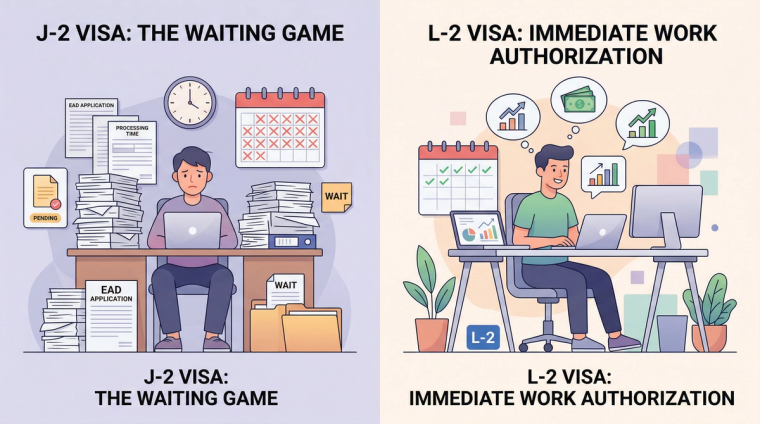
If you're comparing J-2 and L-2 work authorization in 2026, you're looking at two very different systems. J-2 work authorization requires filing Form I-765 and waiting for USCIS to adjudicate the application (processing times vary by workload and are posted on USCIS's Processing Times tool). By contrast, L-2 spouses are employment authorized incident to status and may begin working upon admission in L-2 spouse status (typically shown as "L-2S" on the I-94). Understanding the difference between J-2 EAD and L-2 work authorization matters because it affects when you can earn income, how much the process costs, and whether you'll face gaps in employment when your authorization expires.
What is a J-2 EAD?
A J-2 EAD is an Employment Authorization Document issued to spouses and minor children of J-1 exchange visitors. It falls under category (c)(5) in the federal regulations (8 CFR § 274a.12(c)(5)). You file Form I-765, pay the Form I-765 filing fee (currently $520 if filing by paper), and wait for approval.
One important restriction: the income you earn cannot be used to support the J-1 principal's activities (8 CFR § 214.2(j)(1)(v)(A)). You must include a written statement confirming this when you file.
J-2 employment authorization may be granted for the duration of the J-1 principal's authorized stay (as indicated on the Form I-94) or a period of 4 years, whichever is shorter. And because category (c)(5) is not among the categories eligible for an automatic EAD extension, a J-2 dependent generally must stop working when the EAD expires and wait for the new EAD to be approved and issued before resuming work.
Important: You cannot start working until you physically receive your EAD card AND the start date on it has arrived. Working before that point is unauthorized employment.
What is L-2 work authorization?
Since January 30, 2022, L-2 spouses have had work authorization "incident to status." That means you're automatically authorized to work simply by being admitted to the U.S. in L-2 status.
USCIS updated policy guidance to treat certain E and L dependent spouses as employment authorized incident to status (effective Nov. 12, 2021). As of Jan. 30, 2022, USCIS and CBP began issuing Forms I-94 with new spouse-specific class-of-admission codes (including "L-2S") to distinguish spouses from children (USCIS Policy Manual, Vol. 10, Part B, Ch. 2).
In practice: an L-2 spouse may show an unexpired I-94 with the "L-2S" class of admission as evidence of employment authorization for Form I-9 purposes. Filing Form I-765 for a physical EAD is optional (and would require the Form I-765 fee if filed).
Warning: If your I-94 does not reflect an L-2 spouse code (for example, it does not show "L-2S"), you may encounter Form I-9 documentation issues. If this happens, you can request an I-94 correction through a CBP Deferred Inspection site.
J-2 EAD vs L-2 EAD: side-by-side comparison
| Feature | J-2 EAD | L-2 Work Authorization |
|---|---|---|
| Authorization type | Must file I-765; discretionary | Automatic "incident to status" |
| Regulatory basis | 8 CFR § 274a.12(c)(5) | USCIS Policy Manual; category (a)(18) |
| Statutory authority | Regulatory only (no statute) | 8 U.S.C. § 1184(c)(10) |
| Filing fee | $520 (paper only) | $0 (no filing needed) |
| Processing time | 3 to 5 months | Immediate upon admission |
| When work can begin | After receiving physical EAD card | Immediately with L-2S I-94 |
| Validity period | Up to 4 years or DS-2019 end date | Coterminous with L-2 status (up to 5 to 7 years) |
| Renewal process | New I-765 + full fee each time | No renewal needed while in status |
| Auto-extension eligible | No (never qualified) | N/A (incident to status) |
| Employment restrictions | Any employer; income must NOT support J-1 | No restrictions |
| Employment gap risk | High | Low |
| Premium processing | Not available | N/A |
| Who is covered | Spouses AND minor children | Only spouses (not children) |
| Green card pathway | Complicated by 212(e); not dual-intent | Dual-intent; no 212(e) barrier |
For the J-2 vs H-4 comparison, see our separate comparison guide.
Why the gap keeps growing
The difference between J-2 and L-2 work authorization comes down to how USCIS administers the categories. J-2 work authorization requires filing Form I-765 under category (c)(5). L-2 spouses are employment authorized incident to status under USCIS policy guidance (effective Nov. 12, 2021), with spouse-specific I-94 codes (including "L-2S") used as evidence beginning Jan. 30, 2022. The April 2024 USCIS fee rule increased the Form I-765 fee from $410 to $520 for paper filing ($470 if filed online in eligible categories). Over a 3-year stay, a J-2 dependent who must renew annually could spend $1,560+ on Form I-765 filing fees (paper).
Switching between J-2 and L-2
Some families transition between these statuses when the primary visa holder moves from a J-1 research position to an L-1 intracompany transfer.
J-2 to L-2: a significant upgrade. Once admitted in L-2S status, you can work immediately without filing an EAD. The main hurdle: if the J-1 is subject to the 212(e) two-year home residency requirement, they'll need a waiver before changing to L-1. Effective December 9, 2024, the Department of State published a revised Exchange Visitor Skills List that removed many countries, including China, India, South Korea, and Brazil. Nationals of a removed country are no longer subject to 212(e) based on the Skills List, even if they entered before that date. Note that 212(e) can still apply through other routes, such as J-1 government funding or graduate medical training.
L-2 to J-2: a significant downgrade. You'd lose incident-to-status work authorization and need to apply for a J-2 EAD by filing Form I-765 (currently $520 if filing by paper), then wait for USCIS processing before working again (processing times vary and should be checked on USCIS's Processing Times tool).
Important: When switching statuses, your previous EAD becomes invalid immediately. Plan for an employment gap by starting the new application as early as possible.