
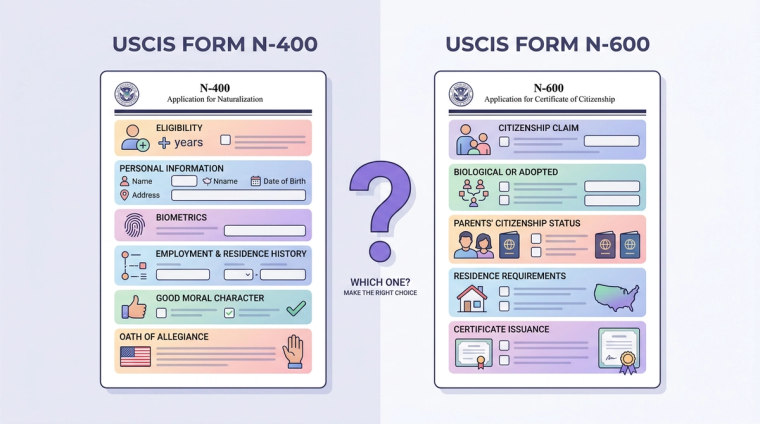
The difference between Form N-400 and Form N-600 comes down to one question: are you already a U.S. citizen? N-400 is the form you file to become a citizen. N-600 is the form you file to prove you already are one. Mix them up and USCIS will deny your application and keep your filing fee. This guide covers who needs which form, what each costs, and how to avoid an expensive mistake. If you're starting the naturalization process with Immiva, understanding this distinction is the first step.
The key difference between N-400 and N-600
N-400 is like taking a driving test to get your license for the first time. N-600 is like requesting a replacement copy of a license you already earned.
Form N-400 (Application for Naturalization) is for lawful permanent residents (green card holders) who want to become U.S. citizens. You're not a citizen when you file. You become one only after USCIS approves your application and you take the Oath of Allegiance (USCIS Policy Manual, Vol. 12, Part D, Ch. 2). The process may include a biometrics appointment, an English and civics test, and an in-person interview. For a step-by-step walkthrough of the naturalization process, see our complete N-400 guide.
Form N-600 (Application for Certificate of Citizenship) is for people who already are U.S. citizens by law and need an official document to prove it. Filing N-600 doesn't make you a citizen. It documents citizenship that already exists, either because you were born abroad to a U.S. citizen parent or because you automatically derived citizenship when a parent naturalized before you turned 18 (USCIS Policy Manual, Vol. 12, Part H).
How to know which form you need
Common scenarios and the correct form for each:
You need N-400 if:
- You have a green card and want to become a U.S. citizen
- You've been a permanent resident for at least 5 years (or 3 years if married to a U.S. citizen)
- You meet the continuous residence and physical presence requirements
You need N-600 if:
- You were born outside the U.S. to at least one U.S. citizen parent (acquired citizenship under INA Section 301)
- Your parent became a U.S. citizen while you were under 18, you had a green card, and you were living in the U.S. in their custody (derived citizenship under the Child Citizenship Act, INA Section 320)
N-400 vs N-600: side-by-side comparison
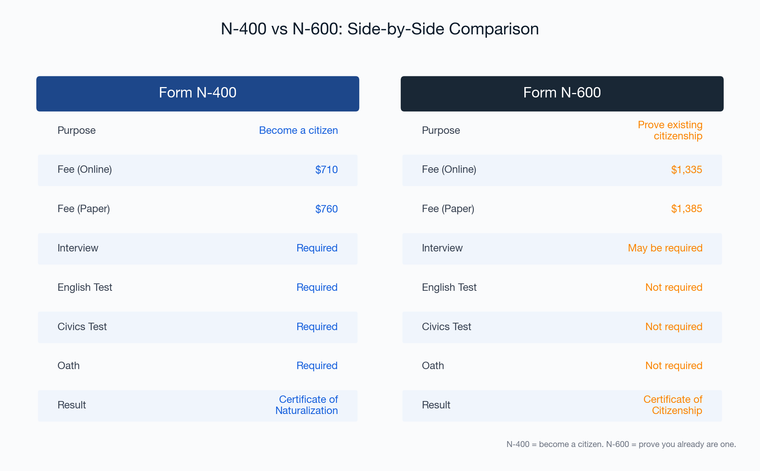
The two forms compared across the factors that matter most:
| Feature | N-400 (Naturalization) | N-600 (Certificate of Citizenship) |
|---|---|---|
| Purpose | Become a U.S. citizen | Prove you already are a citizen |
| Who files | Green card holders | People who acquired or derived citizenship |
| Online filing fee | $710 | $1,335 |
| Paper filing fee | $760 | $1,385 |
| Reduced fee | $380 (income 150-400% FPG) | Not available |
| Fee waiver | Yes, via Form I-912 | Yes, via Form I-912 |
| English test | Yes | No |
| Civics test | Yes (2025 test: 12 of 20 correct) | No |
| Interview | Always required | Sometimes required |
| Oath of Allegiance | Mandatory | May be waived |
| Good moral character | Required | Not required |
| Median processing time | ~5.5-8 months | ~8-14 months |
| Document received | Certificate of Naturalization | Certificate of Citizenship |
Both certificates are equally valid proof of citizenship. Either works for passport applications, voter registration, and employment verification (USCIS Policy Manual, Vol. 12, Part K, Ch. 2).
The Child Citizenship Act and why it matters
The Child Citizenship Act of 2000 (Public Law 106-395) is the reason many people qualify for N-600 without realizing it. Under this law, a child born outside the U.S. automatically becomes a citizen when all of the following are true at the same time before the child turns 18 (8 CFR Section 320.2):
- At least one parent is a U.S. citizen (by birth or naturalization)
- The child is under 18
- The child has a green card
- The child lives in the U.S. in the legal and physical custody of the citizen parent
Citizenship under this law is automatic. No form needs to be filed for it to take effect. But N-600 lets you get official documentation of that citizenship.
Do you even need N-600?
Something a lot of people don't realize: you don't have to file N-600 to prove your citizenship. A U.S. passport serves as proof of citizenship and is usually much cheaper. For example, a first-time adult passport book costs $165 total ($130 application fee + $35 acceptance fee), while an adult passport book renewal costs $130. By comparison, Form N-600 costs $1,335 online or $1,385 by paper.
So when does N-600 make sense?
- You may want USCIS-issued proof that can help when a government agency verifies citizenship through DHS systems such as SAVE. SAVE can use a Naturalization or Citizenship Certificate number, but it cannot verify citizenship using only a U.S. passport number.
- You need a document that never expires. Passports expire every 10 years. A Certificate of Citizenship is valid for life.
- You want to sponsor a relative. A Certificate of Citizenship can simplify family-based immigration petitions.
For most people who just need to prove citizenship for employment or travel, a passport is faster and cheaper. Learn more about how USCIS fees work and what the N-400 costs if naturalization is your path.
What about N-600K?
There's a third form most people have never heard of: Form N-600K. This is for children of U.S. citizens who live outside the United States and don't qualify for automatic citizenship under INA Section 320.
N-600K is actually a naturalization procedure (not just documentation like N-600). It generally requires the U.S. citizen parent to have at least 5 years of physical presence in the U.S. (2 years after age 14), but if the parent doesn't meet that requirement, the child may be able to rely on the physical presence of a qualifying U.S. citizen grandparent instead. The child must be temporarily present in the U.S. for the interview and oath (USCIS Policy Manual, Vol. 12, Part H, Ch. 5). The filing fee is $1,335 online or $1,385 by paper.
Common mistakes to avoid
Filing N-400 when you're already a citizen. This happens more often than you'd think. If your parent naturalized while you were a minor with a green card, you may already be a citizen and not know it. Filing N-400 wastes $710 or more, and USCIS won't refund fees between forms.
Missing the age-18 cutoff for derived citizenship. All conditions under the Child Citizenship Act must be met before the child turns 18. If your parent naturalized the day after your 18th birthday, you don't qualify for derived citizenship and need to file N-400 instead.
Assuming N-600 is required to "activate" citizenship. Derived and acquired citizenship happen automatically by operation of law. N-600 is documentation, not activation. You can file it at any age, and there's no deadline.
For more on common filing errors, see our guide on N-400 mistakes that get citizenship applications denied.