

Yes, you can travel internationally while your I-751 is pending. Federal regulations explicitly allow it. But you need the right documents, and there are situations where leaving the country is risky. Below: the legal basis, the documents you need, trip length limits, and what changed in 2025-2026.
If you haven't filed your I-751 yet, start with our complete guide to removing conditions on your green card. If you've already filed and want to understand your travel options, keep reading.
The legal basis for I-751 pending travel
The right to travel during a pending I-751 isn't based on USCIS goodwill. It's written in federal law.
8 CFR § 216.4(a)(4) states that once your I-751 has been properly filed, you may travel outside the United States and return, as long as you carry the proper documentation under 8 CFR § 211.1(b)(1) and comply with any interview requirements.
In plain terms: file your I-751, get your receipt notice, and you're legally allowed to leave and come back.
A few things this regulation makes clear:
- Your I-751 must be "properly filed" before you travel. If USCIS rejected your petition (wrong fee, missing signature, etc.), you don't have a pending case and should not travel on an expired conditional green card.
- You do NOT need advance parole. This is a common misconception. Advance parole is for people with pending I-485 adjustment of status applications. You already have permanent resident status, even if it's conditional. The rules are different (USCIS Travel Documents).
- Travel does NOT abandon your I-751 petition. INA § 216 contains no prohibition on travel while your petition is pending.
Required travel documents for I-751 filers
You need three documents every time you travel. No exceptions.
1. Your conditional green card (even if expired)
Your physical card is still your primary proof of permanent resident status. Don't leave it at home, even though the expiration date has passed. CBP officers and airline staff need to see it. Your alien registration number (A-Number) is on this card, and it ties directly to your immigration record.
2. Form I-797C receipt notice
This is the receipt notice USCIS sent after accepting your I-751. It serves two purposes: it proves your petition is pending, and it automatically extends your green card validity for 48 months from the expiration date printed on your card (USCIS 48-Month Extension Alert).
Carry the original, not a photocopy. Some airlines and CBP officers won't accept copies.
3. A valid passport from your home country
Your passport must be valid for the duration of your trip. Some countries enforce the six-month passport validity rule, so check your destination's requirements before you go.
Optional but recommended:
- An I-551 stamp (ADIT stamp) in your passport from a USCIS field office. This is the strongest proof of status and can prevent issues at the airline counter.
- A printed copy of your filed I-751 petition.
- Proof of US ties (lease, employment letter, utility bills) in case you're questioned about abandonment of residence.
The 48-month green card extension explained
When USCIS accepts your I-751, the receipt notice automatically extends your conditional green card's validity. Since January 25, 2023, this extension is 48 months from the expiration date on your card (USCIS Policy Manual, Vol. 6, Part I, Ch. 3).
Before this policy, the extension was shorter: 18 months initially, then 24 months starting September 2021, and finally 48 months starting January 25, 2023, to keep up with longer processing times.
What if 48 months passes and your I-751 is still pending? Contact the USCIS Contact Center to request an ADIT (I-551) stamp. USCIS may schedule a field office appointment or mail you a Form I-94 as temporary proof of lawful permanent resident status.
If you filed a while ago and originally received a shorter extension notice (18 or 24 months), USCIS should have sent you an updated I-797C reflecting the 48-month period. If you never got one, check your USCIS online account for a digital copy.
How long can you stay outside the US?
The law doesn't set a hard limit on trip length during a pending I-751, but there are practical thresholds you should know.
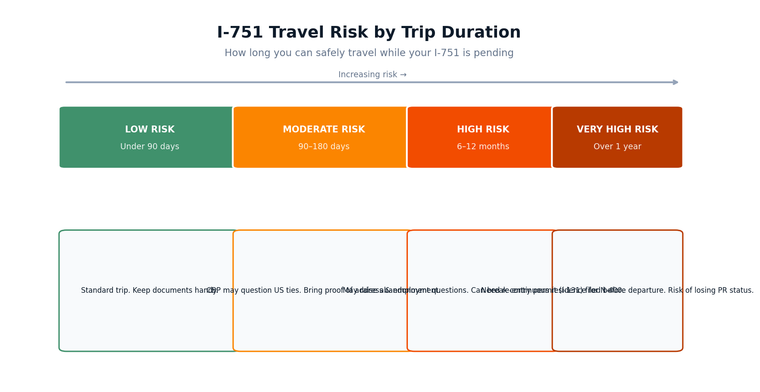
Under 90 days: Low risk. This is a standard trip. Keep your documents handy and you should have no issues at the border.
90 to 180 days: Moderate risk. CBP may ask questions about your ties to the US. Bring evidence of a US address, employment, or other connections.
6 to 12 months: Higher risk. Extended absences can raise questions about whether you've abandoned your US residence. If you're also planning to apply for citizenship through marriage, a trip over 6 months can break your continuous residence requirement.
Over 1 year: You need a reentry permit (Form I-131) filed before you leave. Without it, CBP can treat you as having abandoned your permanent residence (USCIS Travel Documents).
What happens at the airport and border
At the airline counter, show your conditional green card, I-797C receipt notice, and passport. Some airline staff aren't familiar with the 48-month extension. If questioned, CBP issued a carrier information notice (AILA Doc. No. 23080403) specifically instructing airlines to accept these documents. Having a printed copy can help, though most airlines have been briefed.
When you land back in the US, a CBP officer will review your documents. In most cases, this takes a few minutes and you're cleared. But you may be sent to secondary inspection, where an officer will verify your I-751 is actually pending in the system. This is routine and doesn't signal a problem with your case.
Starting December 26, 2025, a new CBP rule requires non-U.S. citizens to be photographed when entering or leaving the country. This now applies at all ports of entry, not just pilot locations (Federal Register, 90 FR 48604).
Travel risks by filing situation
Your risk level depends partly on how you filed your I-751.
Joint filing with your spouse: This is the lowest-risk scenario. You filed together, your case is straightforward, and travel is well-supported by 8 CFR § 216.4(a)(4).
Divorce waiver: If you filed an I-751 waiver after divorce, the same travel rules apply legally. But waiver cases receive more scrutiny from USCIS, and extended travel could raise questions about your ongoing ties to the US. Keep trips short and bring extra evidence of US ties.
Abuse or battery waiver: The legal framework allows travel. If your case involves sensitive circumstances, consult an attorney before traveling.
Late filing: If you filed your I-751 after the 90-day window closed, your case is already under extra scrutiny. Travel adds another variable. Make sure your receipt notice clearly shows USCIS accepted your petition before you book anything.
When you should NOT travel
There are specific situations where staying in the US is the safer choice.
Before receiving your I-797C receipt notice. Without this document, you have no proof your I-751 is pending and no green card extension. Do not travel.
Before completing biometrics. Missing your biometrics appointment can cause processing delays. If you must travel, reschedule your biometrics before you leave.
During an RFE response period. If you've received a Request for Evidence, you typically have 87 days to respond. Missing this deadline can result in denial. Travel during this window is risky unless you have someone who can submit the response on your behalf.
If you have an upcoming I-751 interview. Missing an interview can result in termination of your conditional resident status (8 CFR § 216.4(b)).
If you're concerned about current travel restrictions. Presidential Proclamation 10998, effective January 1, 2026, restricts entry for certain nationals in specific situations, but does not apply to lawful permanent residents. If you're unsure how current restrictions affect your travel, consult an attorney before booking.
What if something goes wrong abroad
You lose your green card while traveling. Contact the nearest US Embassy or Consulate and request a boarding foil (Form I-131A). The fee is $575 (USCIS Fee Schedule). You can also request a temporary I-551 stamp if an embassy offers this service. For information on how to pay USCIS filing fees, check our guide.
Your I-751 is denied while you're abroad. A denial doesn't automatically mean deportation. You still have rights, including the ability to appeal or file a motion to reopen. But getting back into the US becomes significantly harder without valid immigration status. This is one of the strongest reasons to keep your trips short.
You miss a biometrics appointment or interview. USCIS may reschedule it automatically, or you may need to request rescheduling through your online account or by contacting the USCIS Contact Center. Have someone monitor your mail while you're away, or set up informed delivery through USPS so you don't miss any notices.
You get an RFE while abroad. If you have a trusted person (attorney, spouse, or family member) with access to your documents, they can prepare and submit the response. Check your USCIS online account regularly for updates.