

The wait for I-751 approval has worsened since mid-2025. After briefly improving in 2025, processing times are climbing again. The average reached 26.3 months in February 2026, driven by a persistent gap between the number of petitions USCIS receives and the number it can approve each month. The queue is out of your hands, but a clean petition is not: Immiva's I-751 preparation checks every field and document before you file.
Current I-751 Processing Times in 2026
As of February 2026, USCIS reports processing times for jointly filed I-751 petitions between 13 and 33 months (USCIS Processing Times). The average reached 26.3 months as of February 2026, up from 20.6 months in September 2025.
If you're filing with a waiver (because you divorced, experienced abuse, or your spouse passed away), expect longer. Waiver cases typically take 26 to 33 months due to additional scrutiny, and these timelines are likely increasing as the overall backlog grows.
Processing Times by Service Center
USCIS is moving toward consolidated "Service Center Operations" (SCOPS) reporting, but processing times still vary by location:
| Service Center | Current Processing Time | Notes |
|---|---|---|
| Nebraska (LIN) | 17 to 18 months | Historically fastest |
| Potomac (YSC) | 13 to 19 months | Moderate |
| Texas (SRC) | 18 to 24 months | Moderate |
| California (WAC) | 24 to 30 months | Slower |
| Vermont (VSC) | 30 to 33 months | Slowest |
You can't choose which service center handles your case. USCIS assigns it based on where you live and current workload distribution.
How Processing Times Have Changed Over Time
The I-751 backlog didn't happen overnight. Here's how we got here:
| Year | Median Processing Time |
|---|---|
| 2020 | 13.8 months |
| 2021 | 13.6 months |
| 2022 | 18.2 months |
| 2023 | 20.8 months |
| 2024 | 23.5 months (peak) |
| 2025 | 21.8 months |
| 2026 | 26.3 months (Feb 2026 data, rising) |
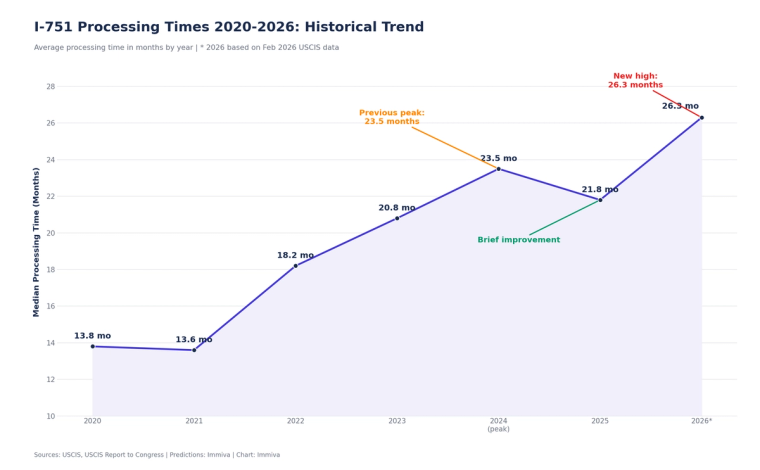
Processing times briefly improved in 2025 after the 2024 peak, but that improvement has reversed. As of February 2026, the average hit 26.3 months, well past the previous 2024 peak of 23.5 months. USCIS is approving well under half of what it receives each month, and the backlog is growing steadily. We're still far from the 6 to 9 month timelines that were normal a decade ago.
I-751 backlog: what the monthly data shows
USCIS files monthly processing data with Congress. Here's what the last six months show.
| Month | Received | Approved | Denied | Total Pending | Pending 6+ Months | Avg. Processing Time |
|---|---|---|---|---|---|---|
| Sep 2025 | 12,073 | 9,029 | 193 | 263,656 | 190,705 | 20.6 months |
| Oct 2025 | 11,928 | 10,286 | 191 | 264,972 | 193,627 | 20.9 months |
| Nov 2025 | 11,373 | 6,579 | 151 | 269,436 | 199,234 | 21.6 months |
| Dec 2025 | 12,664 | 5,728 | 155 | 276,028 | 206,072 | 22.5 months |
| Jan 2026 | 12,622 | 6,141 | 215 | 282,125 | 212,360 | 24.0 months |
| Feb 2026 | 13,153 | 5,318 | 225 | 289,491 | 217,999 | 26.3 months |
Source: USCIS Report to Congress, "Number of Service-Wide Forms by Month, Form Status, and Processing Time" (USCIS Immigration and Citizenship Data)
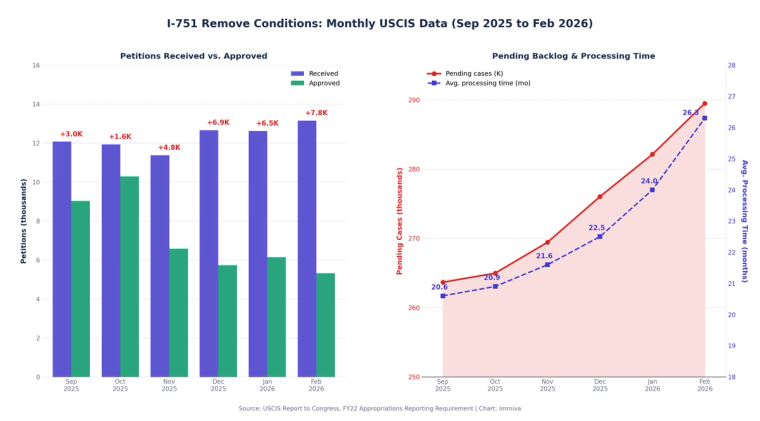
I-751 Remove Conditions: Monthly USCIS Data (Sep 2025 to Feb 2026). Left: petitions received vs. approved. Right: pending backlog and average processing time. Source: USCIS Report to Congress.
USCIS takes in roughly 12,000 to 13,000 I-751 petitions a month. Since December, it's approved only 5,300 to 6,100 of them. That gap of 6,000-plus cases every month isn't closing, which is why total pending cases climbed from 263,656 in September to 289,491 in February.
75% of those pending cases, 217,999 out of 289,491 as of February 2026, have been waiting more than six months. That share has grown every single month.
Average processing time went from 20.6 months to 26.3 months over the same period. That's 5.7 months added since last September. The last time it moved this fast was during the pandemic-era surge.
When USCIS does adjudicate an I-751, it almost always approves it. Approval rates run 95.9% to 98.2%. The backlog isn't about denials. USCIS just isn't clearing cases fast enough to keep up with what comes in.
What this means if you're filing now
Plan for 24 to 30 months for a joint petition, with many applicants now closer to 26. Waiver cases should expect 26 to 33.
The 48-month extension on your receipt notice matters a lot at these timelines. Your extended green card should remain valid throughout the wait, but it's worth understanding exactly what the extension covers.
If you're eligible to file N-400 while your I-751 is pending, it's worth considering. USCIS handles both at the same field office, and in some cases it moves things along. See our guide to filing N-400 with a pending I-751 for more information.
The 48-Month Extension: Your Safety Net
Here's the most important thing to understand: when USCIS accepts your I-751 petition, they automatically extend your conditional green card for 48 months beyond its expiration date (USCIS Alert, January 2023).
This extension started on January 25, 2023. USCIS made this change specifically because processing times had grown longer than the original 12 or 24 month extensions could cover.
What the 48-Month Extension Means for You
With your expired green card and your I-797C receipt notice together, you can:
Continue working legally. Your receipt notice satisfies Form I-9 employment verification requirements. Present your expired green card plus the receipt notice as a List C document (combined with a List B document).
Travel internationally. You can leave and re-enter the United States with your expired card and receipt notice. CBP officers are trained to recognize this combination as valid proof of status.
Apply for state IDs and driver's licenses. Most DMVs accept the receipt notice with your expired card, though policies vary by state.
Complete real estate and financial transactions. Banks and mortgage lenders increasingly recognize the 48-month extension letters.
What Happens After You File Form I-751
Once USCIS receives your petition, here's the typical timeline:
Step 1: Receipt Notice (2 to 4 weeks)
USCIS sends Form I-797C, Notice of Action, confirming they received your petition. This notice includes your case receipt number and the 48-month extension language.
Step 2: Biometrics Appointment (6 to 10 weeks after receipt)
You'll receive an appointment notice for fingerprinting at a local Application Support Center (ASC). This appointment usually takes less than 20 minutes.
In some cases, USCIS reuses biometrics from your original I-485 application. If so, you'll receive a "biometrics reuse" notice instead of an appointment.
Step 3: Active Review (Variable)
Your case enters the adjudication queue. During this phase, USCIS reviews your evidence to determine if your marriage is bona fide. This is where most of the waiting happens.
Step 4: Decision or Interview
USCIS either approves your petition without an interview or schedules you for one. If you've submitted strong documentation proving a genuine marriage, your interview may be waived.
If USCIS needs more information, they'll send a Request for Evidence (RFE). Responding quickly and completely to an RFE is critical since delays here extend your overall timeline.
Will You Need an I-751 Interview?
Not everyone gets called for an interview. USCIS may waive it if your evidence is strong and there are no red flags. Waiver cases and incomplete filings are more likely to require one. For the full list of factors that affect interview likelihood, see our I-751 guide.
What If Your Case Is Taking Too Long?
If your I-751 is outside normal processing times, you have options.
Check Your Case Status
Use your receipt number to check status at USCIS Case Status Online. Don't panic if it says "Case Was Received" for months. That's normal.
Submit an E-Request
If your case exceeds posted processing times, submit an e-Request through the USCIS website. This alerts them that your case needs attention.
Contact Your Congressional Representative
Your U.S. Senator or Representative's office has a constituent services team that can inquire about delayed immigration cases. This doesn't guarantee faster processing, but it creates another touchpoint with USCIS.
Consider a Mandamus Lawsuit (Last Resort)
If your case has been pending for years with no movement, you may have grounds to file a federal lawsuit compelling USCIS to act. This is expensive and should only be considered after exhausting other options and consulting with an immigration attorney.