
Quick reference: H-4 EAD filing facts
Before you start gathering documents, make sure you actually qualify. Your H-1B spouse must have either an approved I-140 petition or an H-1B extension beyond the 6-year limit under AC21 sections 106(a) and (b). If you're not sure whether you qualify, our H-4 EAD eligibility guide walks you through both pathways in detail. You can also check your eligibility in under 2 minutes.
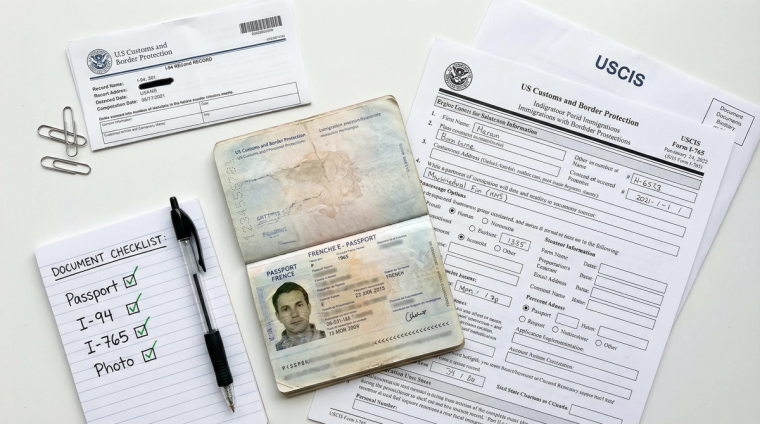
Complete H-4 EAD document checklist for initial applications
Here's every document you need if this is your first time applying for an H-4 EAD. This list is based on the I-765 form instructions and the USCIS evidence checklist for Form I-765, verified as of February 2026.
Form and payment
1. Form I-765 (use the current acceptable edition from the USCIS I-765 page)
Download the form directly from USCIS and confirm you have the current acceptable edition before filing. USCIS may reject your application if you submit an outdated edition or mix pages from different editions. Select eligibility category (c)(26) on the form.
2. Filing fee: $520
Pay using Form G-1450 (credit, debit, or prepaid card) or Form G-1650 (ACH bank transfer). USCIS no longer accepts personal checks, business checks, money orders, or cashier's checks for paper filings. If you've read other guides telling you to send a cashier's check payable to "U.S. Department of Homeland Security," that information is outdated. For more on the payment change, see our guide on how to pay USCIS filing fees.
The filing fee is $520 for paper filing. There is no separate biometrics fee for (c)(26); the biometrics cost is included in the $520.
Identity and status documents
3. Copy of your passport (biographical page)
A clear, legible photocopy of the page showing your photo, name, date of birth, and passport number.
4. Copy of your Form I-94 (Arrival/Departure Record)
Your I-94 must show current H-4 status. You can print your electronic I-94 from the CBP I-94 website. If you entered the U.S. before electronic records, you'll need a copy of the paper I-94 card. Not sure what an I-94 is or where to find yours? Read our I-94 explainer.
5. Copy of your most recent H-4 approval notice (Form I-797)
This is the notice USCIS sent when they approved your H-4 status. If you're filing your H-4 EAD at the same time as your H-4 extension (I-539), include the receipt notice for the pending I-539 instead.
6. Government-issued photo ID
For initial applications (not renewals), include a copy of any government-issued photo identification, such as a driver's license, state ID, or national ID card.
Relationship and eligibility evidence
7. Marriage certificate
A copy of your marriage certificate proving your relationship to the H-1B principal spouse. If your marriage certificate is not in English, you must include a certified English translation. "Certified" means the translator signs a statement saying the translation is complete and accurate to the best of their ability. A notarized translation is acceptable but not required.
8. Evidence of your spouse's I-140 approval (Form I-797) OR AC21 eligibility
This is the document that proves your eligibility for an H-4 EAD. What you need depends on which pathway qualifies you:
If your spouse has an approved I-140:
- Copy of the I-140 approval notice (Form I-797) filed on your H-1B spouse's behalf
If your spouse qualifies under AC21 (H-1B beyond 6 years):
- Evidence that a permanent labor certification (PERM) was filed at least 365 days before the H-1B 6-year limit
- DOL website printout showing PERM case status
- If more than 180 days since DOL certified the PERM: copy of I-797 Receipt Notice for I-140
For a deeper explanation of how the I-140 connects to your H-4 EAD eligibility, see our H-4 EAD and the I-140 guide.
9. Copy of your H-1B spouse's most recent I-797 approval notice
This shows your spouse's current H-1B status and the approved employer petition.
10. Copy of your H-1B spouse's I-94
Not strictly required by the form instructions, but widely recommended by immigration attorneys to establish your spouse's current status. Include it if you have it.
Photos and supporting forms
11. Two passport-style photographs
Specifications: 2 x 2 inches, white or off-white background, taken within the last 30 days, color photo, neutral expression, no glasses. Write your name and I-94 number lightly in pencil on the back of each photo.
12. Form G-1145 (optional)
This one-page form requests electronic notification when USCIS accepts your application. It's free, takes 30 seconds to fill out, and gives you a text or email confirmation. It's worth including.
13. Cover letter (optional but strongly recommended)
A cover letter lists every document in your package, summarizes your case, and makes it easier for the USCIS officer reviewing your file. It reduces the chance of documents getting lost or overlooked.
H-4 EAD renewal: What's different from initial filing
If you're renewing an existing H-4 EAD, your document checklist is mostly the same as the initial application with a few differences.
Additional documents for renewals:
- Copy of your current or most recent EAD card (front and back)
- Updated H-4 and H-1B approval notices if your spouse's petition was extended since your last filing
You do NOT need:
- A separate government-issued photo ID (your existing EAD serves this purpose)
What to do when your employer won't share the I-140 approval notice
This comes up constantly in H-4 EAD forums. Your spouse's employer filed the I-140, your spouse's employer received the approval notice, and your spouse's employer has no legal obligation to share it with you.
You have a few options:
Option 1: FOIA Request (Free, 4-6 weeks)
File a Freedom of Information Act request using Form G-639 through the USCIS FIRST portal. This is free, and USCIS will send you an annotated copy of the I-140 showing the approval. Immigration attorneys confirm this is accepted by USCIS as equivalent evidence to the original I-797.
Option 2: Use the I-140 receipt number
If your spouse knows the receipt number (which starts with EAC, LIN, SRC, WAC, or IOE), you can include that along with the receipt number of the most current I-129 extension.
Option 3: Include what you have and explain
In your cover letter, note that the employer will not provide the I-140 approval notice, reference the receipt number if known, and explain that a FOIA request is pending. USCIS has access to their own records and can verify the I-140 approval internally.
To understand how I-140 changes affect your H-4 EAD eligibility, see our H-4 EAD and I-140 guide.
Cover letter: What to include and why it matters
USCIS doesn't require a cover letter, but filing without one is like submitting a stack of papers with no table of contents. A good cover letter:
- States your full name, date of birth, and A-Number (if you have one)
- Identifies the form (I-765) and eligibility category ((c)(26))
- Specifies whether this is an initial application, renewal, or replacement
- Lists every enclosed document by number
- Notes any special circumstances (pending I-539, concurrent filing, name discrepancy)
- Includes your contact information and your attorney's contact information if applicable
A cover letter is especially important if you're filing concurrently with an I-539, if there are name discrepancies between your documents, or if you're using secondary evidence for the I-140 approval.
Photo requirements: The December 2025 rule change
The traditional photo specifications still apply for your paper filing:
- Size: 2 x 2 inches (51mm x 51mm)
- Head size: 1 inch to 1 3/8 inches from chin to top of head
- Background: plain white or off-white
- Color photo (not black and white)
- Taken within 30 days of filing
- No glasses (unless you have medical documentation)
- No head coverings (unless for religious or medical reasons)
- Neutral expression, mouth closed, both eyes open
- No digital editing, filters, or retouching
What changed: as of December 12, 2025, USCIS updated its photograph policy so that only photos taken at an Application Support Center are officially accepted. You should still include two photos with your mailed application (USCIS hasn't removed this from the form instructions), but plan for an ASC appointment. If USCIS has a biometrics photo on file from the last 3 years, they may reuse it. See our biometrics guide for what to bring and what to expect.
Filing concurrently with I-539 (H-4 extension)
If your H-4 status is also up for renewal, you can and should file your I-765 (EAD) and I-539 (H-4 extension) together in the same package (USCIS H-4 EAD page).
A few things to keep in mind:
- Mail both forms in one package to the same USCIS lockbox
- Pay separate fees for each form: $520 for I-765 + $470 for I-539 = $990 total
- Each form needs its own G-1450 or G-1650 payment form
- USCIS will not process your I-765 until they adjudicate the I-539
- Your cover letter should clearly state you're filing concurrently
For a walkthrough of how to fill out the I-539, see our Form I-539 guide.
3 critical 2025-2026 changes that affect your filing
Most H-4 EAD guides online were written before these changes took effect. Filing based on outdated information can lead to rejection, work authorization gaps, or unnecessary delays.
Change 1: No more automatic EAD extensions (October 30, 2025)
An interim final rule effective October 30, 2025 ended automatic EAD extensions for H-4 EAD renewals. If your EAD expires before your renewal is approved, you must stop working. File 180 days early to minimize the gap. See our H-4 EAD renewal guide for the full strategy.
Change 2: New photo and biometrics policy (December 12, 2025)
USCIS updated its policy on December 12, 2025 to require photos taken at an Application Support Center. For paper filers, the traditional photo specs still apply for now, but expect biometrics appointments to become more common.
Change 3: Electronic-only payments
USCIS stopped accepting paper checks and money orders after October 28, 2025. Use Form G-1450 (card) or Form G-1650 (ACH). See our USCIS payment guide for details.
Common RFE triggers and how to avoid them
A Request for Evidence (RFE) adds months to your processing time. These are the most common reasons USCIS issues RFEs for H-4 EAD applications, and how to avoid them:
1. Missing or insufficient H-4 status evidence. Include your I-797, I-94, and passport bio page. If you previously held H-1B status, include documentation showing your change to H-4.
2. Outdated form edition. Always verify you're using the current I-765 edition before mailing.
3. Missing signature. Sign the form. It sounds obvious, but USCIS reports this as one of the top reasons for rejection.
4. Old photographs. Photos must be taken within 30 days of filing. Don't reuse photos from a previous application.
5. Missing I-140 evidence. If you don't have the I-797, use secondary evidence (receipt number, FOIA results) and explain in your cover letter.
6. Missing or uncertified marriage certificate translation. Foreign-language marriage certificates need a certified English translation. The translator must sign a statement attesting to the accuracy of the translation.
7. Wrong payment amount or method. The fee is $520, payable only by card or ACH. Sending a check will get your application rejected before it's even opened.
8. Poor copy quality. Make clear, legible photocopies. If a document is faded or hard to read, include a note explaining the condition.
9. Name discrepancies. If your name appears differently on your passport, marriage certificate, and I-94, include an explanation in your cover letter. This is common for Indian applicants where a surname may be blank (listed as "FNU" for First Name Unknown).
10. Incomplete form fields. Don't leave required fields blank. If a field doesn't apply to you, write "N/A."
If you do receive an RFE or a denial, our H-4 EAD denial guide covers common denial reasons and your options for responding.
Document assembly order
While USCIS doesn't officially require a specific order, organizing your application package makes it easier for the reviewing officer and reduces the chance of documents getting separated or overlooked.
Recommended stacking order for your filing package:
- Form G-1145 (e-notification request) -- on top
- Form G-1450 or G-1650 (payment)
- Cover letter
- Form I-765 (signed)
- Two passport-style photographs (in a small envelope or clipped to the cover letter)
- Copy of your passport bio page
- Copy of your I-94
- Copy of your H-4 I-797 approval notice
- Marriage certificate (with certified translation if needed)
- Evidence of I-140 approval or AC21 eligibility
- Copy of H-1B spouse's I-797
- Copy of H-1B spouse's I-94
- Copy of previous EAD (renewals only)
- Any additional supporting documents
Use a binder clip, not staples, to hold the package together. If filing concurrently with I-539, place the I-539 package behind the I-765 package with a clear separator.
After filing, your case will take approximately 4 to 12 months depending on service center and filing method. See our H-4 EAD processing time guide for current wait times and how to track your case.