

Updated October 21, 2026: added USCIS's October 2026 processing-time snapshot for H-4 EAD and H-4 I-539 cases, a 13-month trend chart (August 2025 to August 2026), and a rewritten section on what to do when your case is outside normal processing time.
USCIS reported 42,416 pending H-4 EAD cases at the end of FY2026 Q2, up 25.3% from the published FY2025 year-end count. The average processing time across all I-765 categories reached 5.8 months in July 2026. Your H-4 EAD wait depends mostly on whether you file standalone or together with an I-539. For renewals filed on or after October 30, 2025, automatic EAD extensions no longer apply, so a delay can leave a gap in work authorization.
Current H-4 EAD processing times in 2026
The live USCIS tool reports how long it took to complete 80% of cases. USCIS now lists H-4 EAD under Service Center Operations (SCOPS) and shows standalone and I-539-linked filings separately. The monthly figures below are averages across all I-765 categories. For a complete overview of the H-4 EAD program and how to apply, see our step-by-step guide.
The latest figures come from two USCIS reports with different reporting periods:
| Metric | Latest reported value |
|---|---|
| Average I-765 processing time, all categories (July 2026) | 5.8 months |
| H-4 EAD approval rate among decisions (FY2026 Q2) | 95.3% |
| H-4 EAD pending cases (FY2026 Q2) | 42,416 |
| H-4 EAD receipts (FY2026 Q2) | 22,977 |
| H-4 EAD renewal share, excluding replacements (FY2026 Q2) | 72.3% |
The 5.8-month figure is the July 2026 average across all I-765 categories. It cannot tell you when USCIS will decide your H-4 EAD application or when your card will arrive.
Check USCIS processing times for Form I-765, category (c)(26), and the filing type that matches yours. The quarterly I-765 workbook reports application counts and decisions; it does not provide service-center wait estimates.
Immiva's monthly USCIS snapshot: October 2026
Each month Immiva records the USCIS Case Processing Times tool. This snapshot uses the figures USCIS published on October 19, 2026. The tool's number means that 80% of cases were completed within that many months, based on the past six months. The case inquiry date is the receipt date before which you may ask USCIS about your case. For other forms, see our USCIS processing times by form overview.
USCIS no longer lists individual service centers for these forms. The tool now shows Service Center Operations (SCOPS).
| Form and category | Office | 80% of cases completed within | Case inquiry receipt date |
|---|---|---|---|
| I-765, H-4 (c)(26), standalone | SCOPS | 17.5 months | Mar 26, 2025 |
| I-765, H-4 (c)(26), filed with I-539 H-4 | SCOPS | 6.5 months | Dec 30, 2025 |
| I-539, change of status to H-4, with I-765 | SCOPS | 7.5 months | Jan 13, 2026 |
| I-539, change of status to H-4, without I-765 | SCOPS | 10.5 months | Sep 2, 2025 |
| I-539, extension of H-4 stay, with I-765 | SCOPS | 5 months | Jan 29, 2026 |
| I-539, extension of H-4 stay, without I-765 | SCOPS | 10.5 months | Sep 15, 2025 |
For category (c)(26), USCIS lists 17.5 months for a standalone I-765 and 6.5 months for an I-765 filed with an I-539 H-4 application. For the H-4 extension itself, the I-539 with an I-765 shows 5 months and the I-539 without one shows 10.5 months. These 80% figures are a different measure from the all-category monthly average earlier in this post, so the two cannot be compared.
How I-765 processing times have changed
USCIS's monthly data runs through July 2026. The average processing time across all I-765 categories was 2.5 months in both June and July 2025 and reached 5.8 months in July 2026.

At 5.8 months, the all-category average was more than twice the 2.5-month level from summer 2025. Use the live H-4 estimate when planning your renewal, and allow for the possibility that your case will take longer.
Average I-765 processing time, August 2025 to August 2026
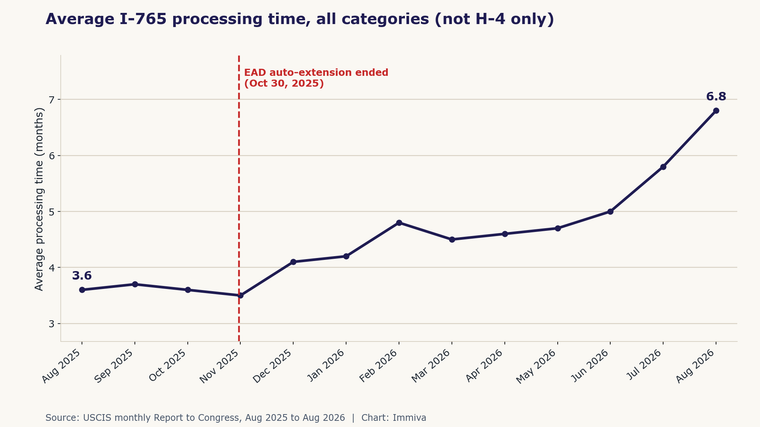
Source: USCIS monthly Report to Congress (FY22 Appropriations Reporting Requirement), Aug 2025 to Aug 2026. The chart covers all I-765 categories, not H-4 only.
The all-category average was 3.6 months in August 2025 and 6.8 months in August 2026. It has risen in most months since December 2025, when it was 4.1 months.
H-4 EAD application volume and approval rates
USCIS publishes quarterly I-765 data by eligibility category. The table covers H-4 category C26 from FY2025 Q1 through FY2026 Q2. The latest quarter covers January 1 through March 31, 2026, and the source data was queried in April 2026.

| Quarter | Total receipts | Approvals | Denials | Pending | Approval rate |
|---|---|---|---|---|---|
| FY2025 Q1 (Oct-Dec 2024) | 22,122 | 17,305 | 469 | 28,813 | 97.4% |
| FY2025 Q2 (Jan-Mar 2025) | 23,027 | 24,783 | 590 | 26,707 | 97.7% |
| FY2025 Q3 (Apr-Jun 2025) | 23,148 | 17,258 | 493 | 32,631 | 97.2% |
| FY2025 Q4 (Jul-Sep 2025) | 23,341 | 21,863 | 807 | 33,851 | 96.4% |
| FY2026 Q1 (Oct-Dec 2025) | 20,121 | 17,330 | 563 | 35,667 | 96.9% |
| FY2026 Q2 (Jan-Mar 2026) | 22,977 | 14,860 | 728 | 42,416 | 95.3% |
USCIS approved 14,860 H-4 EAD applications and denied 728 in FY2026 Q2, for a 95.3% approval rate among decisions. For the first half of FY2026, it reported 43,098 receipts, 32,190 approvals, and 1,291 denials, with a 96.1% approval rate. Here, approval rate means approvals divided by approvals plus denials.
Published H-4 pending counts rose from 33,851 at the end of FY2025 Q4 to 42,416 at the end of FY2026 Q2, an increase of 25.3% between snapshots. USCIS cautions that pending totals cannot be rolled forward from one quarter to the next using reported receipts and decisions. Administrative closures, transfers, system updates, and post-adjudicative outcomes may not appear in the report.
H-4 EAD receipts totaled 20,121 in FY2026 Q1 and 22,977 in Q2. For comparison, FY2025 quarterly receipts ranged from 22,122 to 23,341.
Initial vs. renewal breakdown
In FY2026 Q2, renewals made up 72.3% of initial and renewal H-4 EAD receipts combined. This share excludes 118 replacement receipts.

| Type | FY2025 Q1 receipts | FY2025 Q2 receipts | FY2025 Q3 receipts | FY2025 Q4 receipts | FY2026 Q1 receipts | FY2026 Q2 receipts |
|---|---|---|---|---|---|---|
| Initial EAD | 6,847 (31%) | 6,820 (30%) | 8,106 (35%) | 8,187 (35%) | 6,528 (33%) | 6,324 (28%) |
| Renewal EAD | 15,154 (69%) | 16,075 (70%) | 14,903 (64%) | 15,038 (64%) | 13,472 (67%) | 16,535 (72%) |
USCIS received 13,472 H-4 EAD renewal applications in FY2026 Q1 and 16,535 in Q2. Renewal applicants who filed on or after October 30, 2025 no longer receive automatic EAD extensions. If their renewals aren't approved before their current EADs expire, they face gaps in work authorization.
Initial receipts fell from 6,528 in FY2026 Q1 to 6,324 in Q2, while renewal receipts rose from 13,472 to 16,535. Replacement receipts fell from 121 to 118.
Standalone vs. bundled filing: why it matters more now
The single biggest factor affecting your H-4 EAD processing time is whether you filed your I-765 by itself or together with your H-4 extension and your spouse's H-1B extension.
Bundled filing means you submit all three forms together: your spouse's I-129 (H-1B extension), your I-539 (H-4 extension), and your I-765 (EAD).
Standalone filing means you submit Form I-765 by itself, without bundling it with your H-4 extension and your spouse's H-1B extension.
One important change: the Edakunni v. Mayorkas settlement, which required USCIS to adjudicate bundled H-4/L-2 filings simultaneously with the principal's petition, expired on January 18, 2025. USCIS is no longer required to process bundled cases together. Some cases may still be adjudicated close in time, but it's not guaranteed.
Bundling still gives you the best chance at faster processing. Learn more about filing your H-4 EAD without a lawyer. When you are ready to file, you can apply for your H-4 EAD with Immiva, which walks you through Form I-765 and checks every field before you mail it.
The October 2026 snapshot shows the gap. USCIS lists 6.5 months for category (c)(26) filed with an I-539 H-4 application and 17.5 months for a standalone I-765.
The growing I-765 backlog: why it matters for H-4
USCIS also reports how many I-765 applications across all eligibility categories have been pending for more than six months. This broader measure does not show how long any individual H-4 case will take.

In July 2026, 1,383,136 I-765 applications had been pending for more than six months. That was 183.3% above the February 2025 low of 488,237. The count covers all I-765 categories, so it cannot establish the reason for a delay in an individual H-4 case.
The auto-extension is gone: what this means for processing
On October 30, 2025, DHS published an Interim Final Rule ending the automatic extension of EADs for renewal applicants who file Form I-765 on or after that date.
Before this change, if you timely filed your H-4 EAD renewal, your existing EAD and work authorization were automatically extended for up to 540 days while USCIS processed your renewal. That safety net let you keep working with your expired EAD card plus your I-797C receipt notice.
That's gone for anyone who filed on or after October 30, 2025.
USCIS generally recommends filing no more than 180 days before your EAD expires. If your renewal is still pending when your EAD expires and you do not qualify for an automatic extension, you can face a gap in work authorization.
If USCIS received your renewal before October 30, 2025, the old rules still apply. You may retain up to 540 days of automatic extension.
On the litigation front, a federal lawsuit filed January 8, 2026 is challenging the October 2025 rule. As of March 2026, no injunction has been issued. Plan based on the rule currently in effect.
For renewal strategies and how to minimize the work gap, read our guide on H-4 EAD renewal after auto-extensions ended.
How to check your H-4 EAD case status
A few ways to track your case once you've filed:
Your I-797C receipt notice contains a 13-character receipt number starting with three letters (EAC, WAC, LIN, SRC, or YSC) that identify your service center. Allow 2 to 4 weeks from filing if you haven't received it yet.
Use USCIS Case Status Online to check with your receipt number. You can also create an account at myaccount.uscis.gov to link your receipt number and get email and text notifications.
The USCIS Processing Times tool shows estimates for Form I-765, category (c)(26). If your case exceeds posted times, submit an e-Request.
For a detailed walkthrough of all tracking methods, see our guide on 5 ways to check your EAD application status.
What your case status messages mean
| Status Message | What It Means |
|---|---|
| Case Was Received | USCIS has your application and assigned a receipt number |
| Case Is Being Actively Reviewed | An officer is working on your case |
| Request for Evidence Was Sent | USCIS needs more documents (respond within the deadline) |
| Case Was Approved | Your EAD is approved; card production starts |
| Card Is Being Produced | Your physical EAD card is being printed |
| Card Was Mailed to Me | USPS has your card; allow 7 to 10 business days |
If your status shows "Case Was Received" for months without changing, that's common. Many H-4 EAD cases jump straight from received to approved.
What to do if your H-4 EAD is delayed
If your case is past the posted time, work through these steps in order.
- Check your case inquiry date. On the USCIS processing times page, choose Form I-765, category (c)(26), enter your receipt date and select Get Inquiry Date. If your receipt date is before the case inquiry receipt date, USCIS allows you to ask about your case.
- Submit the online request. Use the e-Request Check Case Processing form. USCIS accepts it only for certain cases, and not if your case had activity in the last 60 days, such as a notice, an answered RFE or an online status update. It asks for your receipt number, date filed, form and email. You can also call the USCIS Contact Center at 800-375-5283, Monday to Friday, 8am to 8pm Eastern.
- Request an expedite if a criterion fits. USCIS lists severe financial loss (not caused by late filing), an emergency or urgent humanitarian situation, a qualifying nonprofit, government interests and clear USCIS error. Meeting a criterion does not guarantee approval. Make only one request, because several can delay processing. See how to make an expedite request.
- Contact the CIS Ombudsman. Submit a case assistance request (DHS Form 7001). You must have contacted USCIS in the last 90 days and given it at least 60 days to resolve the issue, and your case inquiry date must have passed. The Ombudsman cannot compel USCIS to act.
- Optional: ask a congressional caseworker. A member of Congress or staff can submit a case assistance request for you with your consent. A congressional inquiry pauses Ombudsman help for 45 days.
While you wait, check your EAD's expiration date. USCIS's rule ended automatic extension of EADs for timely renewals in the covered categories filed on or after October 30, 2025. The final rule, effective October 14, 2026, adopts it without changes, and its discussion addresses H-4 dependent-spouse EADs. See the Federal Register final rule.
Some people also consider a federal lawsuit over a delayed case. That is not covered on an official USCIS page, so talk to an immigration attorney first.
Do not work without authorization. Even if your case is severely delayed, working without your EAD violates your status. This includes freelance work, remote work for foreign companies, and unpaid work for a U.S. employer.
Learn about common H-4 EAD application mistakes that cause delays.
Filing fees and payment methods (2026)
The Form I-765 filing fee for the H-4 (c)(26) category is $520. USCIS does not list (c)(26) for online filing, so the $470 online rate does not apply. There is no separate biometrics fee.
USCIS no longer accepts personal or business checks, money orders, or cashier's checks for paper filings (with limited exceptions). Pay by credit, debit, or prepaid card using Form G-1450, or pay directly from a bank account using Form G-1650. Online filers pay through the myUSCIS portal.
Starting March 5, 2026, USCIS requires the 08/21/25 edition of Form I-765. Applications on older editions will be rejected.
Always verify fees on the USCIS fee schedule before filing. Sending the wrong fee amount means automatic rejection.
Recent policy changes affecting H-4 EAD processing in 2026
October 30, 2025: Automatic EAD extensions eliminated. Any gap between your EAD expiration and renewal approval is now a gap in work authorization. See our H-4 EAD renewal guide for strategies.
January 18, 2025: Edakunni settlement expired. USCIS is no longer required to adjudicate bundled H-4/EAD applications simultaneously with premium-processed H-1B petitions.
H.R. 1 (One Big Beautiful Bill Act). Signed July 4, 2025, this introduced annual inflation adjustments to certain USCIS fees and changed EAD validity periods for some categories. H-4 EADs aren't directly affected by the validity period changes, but the overall USCIS workload from implementing these changes may slow processing across all categories.
New form edition required. Starting March 5, 2026, USCIS requires the 08/21/25 edition of Form I-765.
Processing holds for certain nationals (reported). Recent reporting indicates USCIS halted or paused certain immigration benefit applications for people from specific countries. Check the latest official DHS/USCIS announcements for the current scope.
For a broader understanding, see our H-4 visa guide for H-1B spouses and dependents.
Frequently Asked Questions
The average processing time across all I-765 categories reached 5.8 months in July 2026. In USCIS's October 2026 snapshot, 80% of standalone (c)(26) cases were completed within 17.5 months and 80% of (c)(26) cases filed with an I-539 H-4 application within 6.5 months. Check USCIS processing times for Form I-765, category (c)(26), for the current estimate that applies to your case.
The live USCIS figure shows the time in which 80% of cases were completed. Some cases take longer, including when USCIS requests more evidence or biometrics are delayed. Check the live tool to see when you can submit a case inquiry. If you need a decision urgently, you can also check whether you qualify for an expedite request.
Use USCIS Case Status Online with your 13-character receipt number from your I-797C notice. You can also create an account at myaccount.uscis.gov for alerts. See our guide on 5 ways to check your EAD application status.
Bundled is still better in most cases. Filing your I-539 and I-765 alongside your spouse's I-129 with premium processing gives you the best chance at faster adjudication. Just know that simultaneous adjudication is no longer guaranteed after the Edakunni settlement expired.
USCIS no longer lists individual service centers for H-4 EAD. Its processing times tool now shows Service Center Operations (SCOPS) for Form I-765, category (c)(26), with standalone filings and filings made with an I-539 H-4 application listed separately.
No. USCIS does not list category (c)(26) for online filing, so you mail the paper Form I-765 with the $520 fee. Once USCIS accepts the packet, it mails you a receipt notice (Form I-797C) with a 13-character receipt number you can use to track the case.
'Case received' means USCIS accepted your filing and gave you a receipt number. Nobody is looking at it yet. 'Actively being reviewed' means an officer actually has your file. The gap between these two can be months.
The H-4 EAD approval rate was 95.3% in FY2026 Q2 and 96.1% for the first half of FY2026. These rates are calculated by dividing approvals by approvals plus denials. They describe the decisions USCIS issued during those periods and do not predict the outcome of an individual application.
No fixed timeline. Some applicants see approvals within weeks of their biometrics appointment, while others wait months. USCIS is increasingly reusing existing biometrics rather than scheduling new appointments.
Change log
- October 21, 2026: added the October 2026 USCIS snapshot for H-4 (c)(26) I-765 and H-4 I-539 cases, the August 2025 to August 2026 trend chart, and a numbered outside-normal-processing-time section; replaced the service-center wording with the SCOPS listing.
- September 9, 2026: refreshed with USCIS monthly data through July 2026 and FY2026 Q2 reports.