

Getting that denial notice feels like the ground just dropped out from under you. If your Form I-751 petition to remove conditions on your green card was denied, you're probably wondering: Am I going to be deported? Can I still work? What do I do now?
An I-751 denial does not mean immediate deportation. You still have options, and in many cases, people recover from this. USCIS doesn't publish an official I-751 approval rate, so be skeptical of anyone claiming a specific percentage. Most denials come down to insufficient evidence, missed appointments, or failure to respond to an RFE or NOID.
This post covers what happens after USCIS denies your I-751, why denials happen, and four paths to recover.
What Happens Immediately After an I-751 Denial
When USCIS denies your I-751, several things happen in sequence (USCIS Policy Manual, Vol. 6, Part I, Ch. 6):
You receive a written denial notice. This letter explains the specific reasons USCIS denied your petition. Read it carefully. Every word matters, because your recovery strategy depends entirely on understanding the reason for denial.
Your conditional permanent resident status is terminated. As of the date on the denial notice, USCIS considers your conditional status ended. You'll be instructed to surrender your Permanent Resident Card.
USCIS issues a Notice to Appear (NTA). This initiates removal proceedings in immigration court (8 CFR § 216.4(d)(2)). An NTA is not a deportation order. It's a notice that an immigration judge will review your case.
The timeline between receiving the denial and your first court hearing can take months or even years. EOIR reported the immigration court pending caseload was under 3.75 million as of September 4, 2025, and the backlog continues to cause long waits in many locations. You may have significant time to prepare your defense.
Common Reasons for I-751 Denial
Why your petition was denied matters. These are the most common I-751 denial reasons, based on USCIS Policy Manual guidance and the Form I-751 Instructions:
Failure to prove a bona fide marriage. This is the most common reason. USCIS determined the evidence you submitted wasn't enough to show your marriage was entered in good faith, not just to get immigration benefits (USCIS Policy Manual, Vol. 6, Part I, Ch. 2).
Failure to respond to an RFE or NOID. If USCIS sent you a Request for Evidence or Notice of Intent to Deny and you missed the deadline or didn't respond adequately, your case may have been denied for abandonment.
Failure to appear for your biometrics appointment. Missing your biometrics appointment without rescheduling can result in denial.
Failure to appear for your interview. If USCIS scheduled an interview and you did not attend, the case will be denied.
Filing outside the 90-day window. For joint petitions, you must file within the 90-day period before your conditional green card expires (8 CFR § 216.4(a)(1)).
Criminal history issues. Certain criminal convictions can lead to a denial, particularly if they raise concerns about admissibility or deportability.
Spousal non-cooperation. If you filed a joint petition and your spouse refused to participate in the interview or sign required documents, USCIS may deny the petition.
Inconsistencies in documentation. Conflicting information between your application, interview answers, and supporting documents can undermine your case.
Your Four Recovery Options After an I-751 Denial
Federal regulations provide four paths to recover from an I-751 denial. Which one is right for you depends on why the denial happened and what new evidence you can provide.
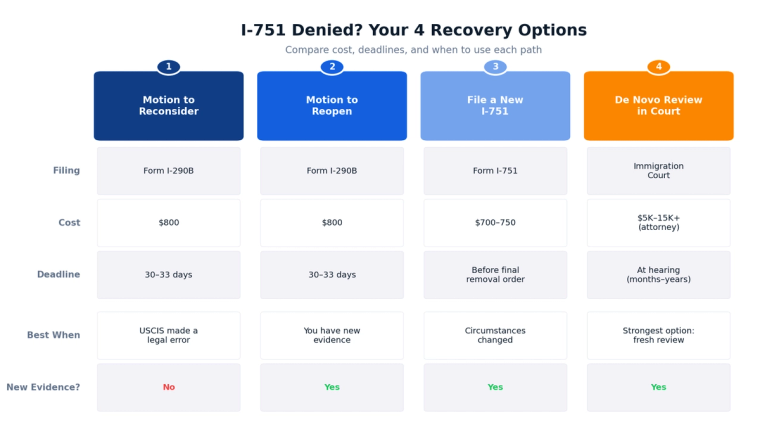
Option 1: Motion to Reconsider (Form I-290B)
A motion to reconsider asks USCIS to take another look at its own decision based on the evidence that was already in the record. You're essentially arguing that USCIS made a legal or policy error when it denied your case.
When to use this: USCIS misapplied the law, ignored key evidence you already submitted, or applied the wrong legal standard.
Requirements: You must show that the original decision was incorrect based on the existing evidence. You cannot submit new documents with this motion (USCIS Appeals & Motions Q&A).
Deadline: 30 calendar days from personal service of the denial, or 33 calendar days if the denial was mailed.
Cost: $800 for Form I-290B (USCIS fee rule table).
Option 2: Motion to Reopen (Form I-290B)
A motion to reopen asks USCIS to reexamine your case based on new facts or evidence that you did not previously submit.
When to use this: You have new documents, affidavits, or evidence that directly addresses the reason for denial, and this evidence was not available or was not submitted during the original petition.
Requirements: You must provide new evidence supported by affidavits or documentary proof. Simply repeating facts you already submitted does not qualify as "new facts."
Deadline: Same as above, 30-33 calendar days.
Cost: $800 for Form I-290B.
Option 3: File a New I-751 Petition
There is no limit on how many times you can file Form I-751. If your joint petition was denied, you may be able to refile, especially if your circumstances have changed (for example, if you have since divorced and now qualify for a divorce waiver under 8 CFR § 216.5).
When to use this: Your situation has fundamentally changed since the denial, or you can now submit a much stronger evidence package.
Important timing: You can file a new I-751 at any time before a final order of removal is issued. Once a final removal order exists, this option is no longer available (8 CFR § 216.5(a)(2)).
Cost: $750 for paper filing or $700 for online filing.
Option 4: De Novo Review in Immigration Court
This path is often the strongest. When USCIS issues an NTA after your I-751 denial, your case goes to immigration court. There, an immigration judge (IJ) takes a fresh look at USCIS's denial of your petition.
Why this matters:
The burden of proof shifts for joint petitions. Under 8 CFR § 216.4(d)(2), the government bears the burden of proving that your petition was properly denied. USCIS must show, by a preponderance of evidence, that the facts you presented are not true. If you filed a waiver, the burden of proving you qualify stays with you, but the judge still has to consider any new evidence you submit.
Judges should review your case when you ask. In Matter of H. N. Ferreira, 28 I&N Dec. 765 (BIA 2023), the BIA ruled that an immigration judge should ordinarily review an I-751 denial upon the respondent's request.
The downside is time. EOIR reported the pending immigration court caseload was under 3.75 million as of September 4, 2025, and DOJ describes OCIJ as overseeing approximately 700 immigration judges. Your hearing could take years to schedule depending on the court's backlog.
Motion to Reopen vs. Motion to Reconsider: Which Should You File?
| Motion to Reconsider | Motion to Reopen | |
|---|---|---|
| Basis | USCIS made a legal or policy error | You have new evidence |
| Evidence | Original record only | New facts and documents required |
| Best for | Clear misapplication of law | Weak evidence package that can be strengthened |
| Filed on | Form I-290B | Form I-290B |
| Cost | $800 | $800 |
| Deadline | 30-33 days | 30-33 days |
If you're not sure which applies, talk to an immigration attorney. Filing the wrong type of motion wastes your filing fee and your limited time.
Can You Still Work and Stay in the US After an I-751 Denial?
This part confuses most people.
Technically, when USCIS denies your I-751 and terminates your conditional resident status, your work authorization tied to that status also ends. However, once you're placed in removal proceedings, your case is before the immigration court, and you continue to be physically present in the US while your case is pending.
Work authorization during removal proceedings is a complex legal question that depends on your specific circumstances. Some people may be able to obtain work authorization through the immigration court process. Talk to an immigration attorney about your situation.
What to Expect in Immigration Court
If your case goes to immigration court, the process typically looks like this:
Master calendar hearing. This is your first appearance. The judge confirms the charges against you (that your conditional status was terminated) and sets a schedule for future hearings. You'll state whether you admit or deny the allegations.
Individual hearing (merits hearing). This is where the judge reviews your I-751 on the merits. You (or your attorney) will present evidence, testimony, and legal arguments for why your petition should be approved. The government attorney may cross-examine you and present counter-evidence.
The judge's decision. If the judge rules in your favor, removal proceedings end and you remain a permanent resident with the conditions removed. If the judge upholds USCIS's decision, a removal order can follow. Either side can appeal to the Board of Immigration Appeals.
You get a genuine second chance in court, and you can present evidence you did not include in your original filing. For a jointly filed petition, the government must prove by a preponderance of the evidence that the petition was properly denied (8 CFR § 216.4(d)(2)). For a waiver filing, the judge takes a fresh look and must consider your new evidence (Matter of Herrera Del Orden, 25 I&N Dec. 589 (BIA 2011)), but you keep the burden of showing you qualify.
Costs of Recovery After an I-751 Denial
| Recovery Path | Filing Fee | Estimated Attorney Fees |
|---|---|---|
| Motion to Reconsider (I-290B) | $800 | $1,500-$4,000 |
| Motion to Reopen (I-290B) | $800 | $2,000-$5,000 |
| New I-751 Petition | $700-$750 | $1,500-$4,000 |
| Immigration Court Defense | No separate fee | $5,000-$15,000+ |
These are rough estimates based on attorney fee ranges reported by immigration law firms. Actual costs vary by location, complexity, and attorney.
When You Need an Immigration Lawyer
For most I-751 denial situations, hire an immigration attorney. This is especially true if:
- Your denial involved a fraud finding or misrepresentation allegation
- You have criminal history issues
- You are already in removal proceedings
- You need to file a waiver (divorce, abuse, or extreme hardship)
- Your case involves complex facts or inconsistencies that need to be explained
If your denial was for a procedural reason, like a missed biometrics appointment or failure to respond to an RFE, and you can now provide the missing information, you may be able to handle a motion to reopen or a new I-751 filing on your own. Immiva can help you prepare a new I-751 petition for a flat fee, with automated checks on every answer before you file.