Four things that can sink your citizenship application
The Travel Reconstruction Trap
USCIS wants you to account for every day you spent outside the U.S. over the last five years. Most applicants try to reconstruct that from memory. Most get it wrong. A discrepancy between what you report and what CBP's I-94 records show isn't treated as a mistake. It's treated as dishonesty. On an N-400, dishonesty is grounds for denial on Good Moral Character.
Built-in physical presence calculator
Our calculator works out your exact day count, flags trips that push you close to the 913-day threshold, and shows you the earliest date you can legally file — before you pay USCIS a cent.
- Day-by-day physical presence calculation
- Flags borderline absences and continuous residence risks
- Know your safe filing date before you start
The Good Moral Character Audit
The N-400 asks who you've been for the last five years. Every tax return. Every arrest, even without a conviction. Every lapse in child support. Every Selective Service registration you might have missed. Male applicants who didn't register between 18 and 26 get denied even when everything else is clean. USCIS officers are trained to find the thing you didn't think mattered.
A GMC screening before you file
Every question that touches Good Moral Character gets flagged with plain-language guidance and documentation instructions. We walk you through Selective Service status letters, IRS payment plans, and how to handle prior incidents so nothing catches you off guard at the interview.
- GMC flag on every sensitive question
- Selective Service and tax compliance guidance
- Contextual help explains exactly what to disclose
The Risk Nobody Tells You About
If you got your green card through marriage and that marriage ended in divorce, a USCIS officer can use your N-400 interview to look again at whether that marriage was genuine. If they decide it wasn't, it's not a denied application. It can become removal proceedings. Filing for citizenship can turn into a fight to stay in the country. Almost no form-filling software brings this up.
A pre-filing risk review for complex histories
Our guided flow works through the questions that find problems for marriage-based green card holders — prior visa violations, overlapping petition timelines, gaps in your record. You'll know where you stand before USCIS sees anything.
- Identifies red flags for marriage-based LPR holders
- Surfaces prior petition history issues
- Flags anything that could trigger secondary review
The "Actively Reviewing" Lie
You check the USCIS portal every day. It says "Your case is actively being reviewed by an immigration officer." It's been saying that for four months. That status is almost always triggered by an automated background check refresh, not an officer opening your file. Meanwhile you won't book travel, you're half-monitoring your email, and you're spending evenings on Reddit trying to figure out if "actively reviewing" means anything at all.
Make your file impossible to delay on your end
We can't speed up USCIS. Nobody can. But we can make sure your application has no errors, no missing documents, nothing that triggers an RFE. The G-1145 e-notification form is included so you get a text and email the moment your case moves.
Four steps to a complete filing packet
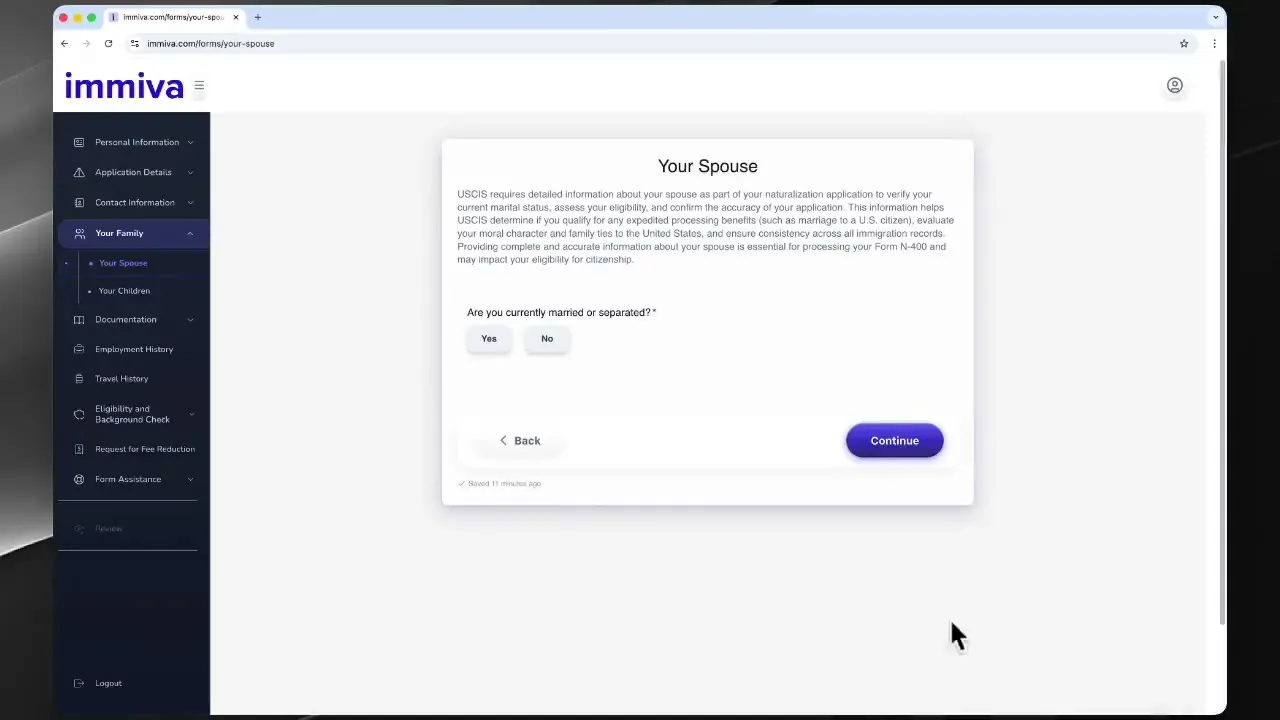
Answer plain-English questions. Immiva checks over 10 things against your responses: travel day counts, GMC flags, residency gaps. Nothing gets printed until your file clears.
- 1
Check Eligibility
Confirm your 5-year or 3-year path, physical presence, and 90-day early filing window.
- 2
Complete Your N-400
Our guided system walks you through every question. Plain English in, correct legal fields out.
- 3
See What USCIS Will See
Before you pay, Immiva runs over 10 checks against your completed application: physical presence calculation, Good Moral Character flags, continuous residence verification, removal history screening, and more. You see the full report. Every issue surfaced. Every flag explained. Nothing moves forward until your file is clean.
- 4
Download & File
Get print-ready PDFs, your personalized checklist, and filing instructions.
What Our Customers Say
I'm on the road constantly. Five years of trips across maybe eight countries, and I had no idea how to count any of it. Immiva ran the numbers and told me I was 11 days short of the 913-day threshold. Eleven days. I would have filed, paid $760, and gotten denied. I waited six more weeks and filed clean.
My green card came through my first marriage, which ended in divorce. I'd had this background fear about naturalization ever since and just never filed. Immiva flagged that exact situation in the pre-filing review and told me what I'd need to prove the marriage was genuine. Three years I'd been sitting on that. I'm taking my Oath next month.
I figured my case was clean. Five years, steady job, nothing on my record. Immiva still found three things: a two-week gap in my address history, an old employer I'd completely blanked on, and a trip that put me closer to the physical presence line than I'd realized. None of it was disqualifying. But I went into that interview having actually checked my file, which is a different feeling.
Everything in your filing packet — verified before it prints
- Pre-Filing VerificationPre-Filing Verification ReportBefore you pay, Immiva runs 10+ checks: physical presence calculation, Good Moral Character screening, continuous residence, removal history, address gaps, and more. Every flag explained. Nothing surprises you at the interview.
- Form N-400Application for NaturalizationThe primary 14-page form, completed and formatted to USCIS specs. Every answer validated against USCIS field requirements.
- Form G-1145E-Notification of AcceptanceKnow the moment USCIS receives your file — no more checking the portal.
- G-1450 / G-1650Payment AuthorizationPay the USCIS filing fee by credit card or bank transfer
- ChecklistPersonalized Document ListEvery supporting document tailored to your situation. Nothing missing, nothing USCIS can reject you for.
A Lawyer Charged Us $2,000. Our Application Got Rejected.
When we filed our own immigration forms, we hired an attorney — and later discovered over 70 errors in the paperwork. The application was rejected by USCIS for preventable mistakes a computer could have caught.
We built Immiva so nobody else has to go through that. Every question is translated into plain English. Every answer is validated in real time. And the entire filing packet costs less than a single hour of most attorneys' time.
Frequently Asked Questions
Ten things, in order: physical presence calculation, continuous residence, Good Moral Character screening, removal history, address gaps, employment history consistency, jurisdictional residency, age requirements, allegiance disclosures, and a data integrity scan. You see the full report before you pay — every flag explained, nothing glossed over.
The N-400 is free on the USCIS website. What Immiva does is check it. Most denials aren't caused by people who didn't try hard enough — they're caused by a miscounted travel day, a forgotten address, or a GMC question answered wrong. Immiva catches those before your envelope reaches the mailbox.
Yes, and those cases are exactly why the verification step exists. The pre-filing review specifically checks marriage-based green card holders, prior incident disclosures, borderline physical presence counts, and Selective Service gaps. If something in your history needs attention, the report names it and tells you what to do about it.
You see it explained before you pay — what the flag is, why it matters, what documentation or steps address it. Some issues are minor and easy to resolve. Others may genuinely need an attorney. Immiva tells you which is which — it doesn't leave you staring at a red flag with no context.
If you complete your application and aren't satisfied for any reason before downloading your filing packet, we'll refund you. No questions asked.
No. Immiva prepares and verifies your forms, but you mail the packet yourself. You keep full control over what gets submitted and when.
No. Immiva is software, not a lawyer. It doesn't provide legal advice and isn't a substitute for an immigration attorney. If your situation involves questions a form can't answer, talk to a licensed attorney.
Yes. Data is encrypted in transit and at rest, never sold or shared with third parties. You can delete your account and everything in it at any time.