
What Is Form I-751 and Who Needs to File?
Form I-751 is the petition that converts your 2-year conditional green card into a permanent 10-year card. If you need a refresher on who must file and when, see our complete I-751 guide.
The Filing Window Explained
Your 90-day filing window opens exactly 90 days before your green card's expiration date. For full details on calculating your window and what happens if you file late, see our I-751 guide.
Mandatory Documents (Required for Every Filing)
Before diving into evidence, make sure you have these basics covered. USCIS will reject your petition if any are missing. Immiva's I-751 preparation builds this list for your case and audits the packet before you file.
Copies of both sides of your conditional green card. Don't send the original card, just clear photocopies of front and back.
Passport-style photos if required by the current form instructions. Check the I-751 instructions for the most recent photo requirements.
Understanding How USCIS Evaluates Evidence
USCIS officers reviewing I-751 petitions want to see that your marriage wasn't entered to evade immigration laws (8 CFR § 216.4(a)(5)). They're looking for documents that show you and your spouse share a life together: combined finances, shared housing, family planning, and the general pattern of a real marriage.
Here's what matters:
Quality over quantity. Ten strong documents beat fifty weak ones. An officer would rather see two years of joint bank statements than hundreds of selfies.
Time coverage. Evidence should span from your marriage date through the present. Submitting only recent documents raises questions about what the marriage looked like earlier.
Variety of document types. Showing different aspects of your shared life (financial, residential, social) paints a more complete picture than multiple documents of the same type.
Official documents over personal items. Bank statements, tax returns, and insurance policies carry more weight than photos or greeting cards. Use personal items to supplement, not replace, official documentation.
Evidence Strength Tiers: What USCIS Values Most
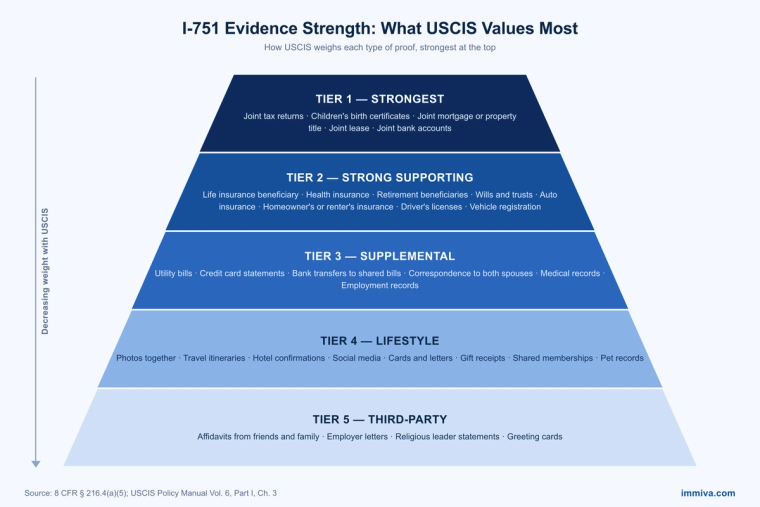
Based on 8 CFR § 216.4(a)(5) and the USCIS Policy Manual (Vol. 6, Part I, Ch. 3), here's how different evidence types rank in strength.
Tier 1: Strongest Evidence (Submit Everything You Have)
These documents carry the most weight because they involve legal or financial commitments that would be unusual in a fake marriage.
Jointly filed federal tax returns with W-2s. Submit returns for every year of your marriage. Jointly filed taxes show the IRS recognizes you as a married couple sharing finances. Request copies from the IRS if you don't have them.
Birth certificates of children born to the marriage. Children are powerful evidence of a bona fide marriage. Include birth certificates showing both parents' names.
Joint mortgage deed or property title. If you own property together, include the deed showing both names as owners. This represents a major shared financial commitment.
Joint lease or rental agreement. Your lease should show both spouses as tenants. If only one name appears, see the section below on what to do without a joint lease.
Joint bank account statements. Submit quarterly statements for the entire duration of your marriage. These show ongoing financial commingling.
Tier 2: Strong Supporting Evidence
These documents demonstrate shared financial responsibilities and planning.
Life insurance policies naming your spouse as beneficiary. This shows you're planning for your spouse's financial future.
Health insurance with spouse or family coverage. Documentation showing your spouse is covered under your plan, or vice versa.
401(k), IRA, or retirement account beneficiary designations. Official documentation showing your spouse is your designated beneficiary.
Wills or trusts naming your spouse. Estate planning documents that include your spouse demonstrate long-term commitment.
Joint auto insurance policy. A policy covering vehicles for both spouses.
Homeowner's or renter's insurance listing both names. Insurance documentation with both spouses named.
Driver's licenses showing the same address. Both spouses having the same address on their licenses supports cohabitation.
Vehicle registration at the same address. Registration documents showing shared residence.
Tier 3: Supplemental Evidence
These documents add supporting detail but shouldn't be your primary evidence.
Utility bills with both names or at the same address. Electric, gas, water, and internet bills help establish shared residence.
Credit card statements showing a shared address. Even individual credit cards sent to your shared home support cohabitation.
Bank statements showing transfers to shared bills. If you don't have joint accounts, individual statements showing you pay the same bills help.
Correspondence addressed to both spouses. Official mail addressed to "Mr. and Mrs." at your home.
Medical records listing your spouse as emergency contact. Hospital and doctor's office records.
Employment records showing spouse as emergency contact. HR paperwork naming your spouse.
Tier 4: Lifestyle Evidence
Use these to supplement stronger documentation, not as your main evidence.
Photos together. Include photos from your wedding, holidays, vacations, everyday life, and family events. Date and label photos. A photo collage organized chronologically works better than loose pictures.
Travel itineraries and boarding passes. Evidence of trips taken together.
Hotel confirmations with both names. Reservations showing you traveled as a couple.
Social media posts and screenshots. Relationship posts, photos, check-ins, and comments showing your public life as a couple.
Cards and letters to each other. Personal correspondence demonstrating affection.
Receipts for gifts. Major purchases for each other, especially anniversary or birthday gifts.
Shared memberships. Costco, gym, Amazon Prime, AAA, and other memberships with both names or family status.
Pet records with both names. Vet bills, adoption papers, or registration showing shared pet ownership.
Tier 5: Third-Party Evidence
Affidavits from others who know your marriage.
Two to four affidavits from friends or family. Sworn statements from people with personal knowledge of your relationship. Affidavits should describe how the person knows you, specific observations of your relationship, and their belief that your marriage is genuine. Don't overdo it. Four strong affidavits are better than ten weak ones.
Letters from employers confirming spouse as emergency contact. Written confirmation from HR.
Religious leader statements. If applicable, a letter from clergy who officiated your wedding or knows your family.
Greeting cards from family addressed to both spouses. Holiday and birthday cards showing family acceptance.
What to Do If You're Missing Key Documents
The most common anxiety couples face is not having "traditional" evidence like joint bank accounts or a shared lease. The good news: these aren't required. The regulations list them as examples, not mandates (8 CFR § 216.4(a)(5)).
If You Don't Have a Joint Bank Account
Many couples keep separate finances for practical reasons. Here's how to document shared financial life without joint accounts:
Submit individual bank statements showing transfers to the same bills. If one spouse pays rent and the other pays utilities, show both payment patterns.
Include Venmo, Zelle, or PayPal transfer history between spouses. Screenshots showing regular transfers for shared expenses demonstrate commingling even without formal joint accounts.
Provide statements showing deposits to shared expenses. Rent, utilities, and groceries paid from either account.
Document that one spouse pays household bills from their account. Consistent bill payment from one account still shows shared responsibility when combined with other evidence of cohabitation.
Consider writing a brief explanation letter. A one-page letter explaining why you maintain separate accounts (different banks before marriage, workplace direct deposit requirements, personal financial management preferences) can provide context.
If You Don't Have a Joint Lease
Leases often only include one name, especially if one spouse was living there before the marriage. Here's what to submit instead:
Lease in one name plus utility bills showing both names or the same address. The lease proves where you live; utilities prove both people live there.
Mail and correspondence sent to both spouses at the same address. Bank statements, credit cards, official notices, all showing the same home address.
Driver's licenses showing the same address. Both spouses having updated licenses with your shared address.
Insurance documents at the same address. Auto, health, or renter's insurance showing the shared residence.
Affidavit from your landlord. A signed statement from your landlord confirming both spouses reside at the property. This is particularly helpful if the landlord is aware of and accepts both tenants even though only one signed the lease.
If One Spouse Doesn't Work
When only one spouse has income, showing financial commingling looks different but it's still possible.
Submit tax returns filed jointly. Even if one spouse has no income, filing jointly demonstrates shared financial status.
Show the working spouse's accounts paying for shared expenses. The non-working spouse benefits from these payments, demonstrating shared resources.
Include evidence the non-working spouse is listed on the working spouse's benefits. Health insurance, retirement beneficiaries, and emergency contacts all show integration.
Document household management by the non-working spouse. Bills, subscriptions, and services in the non-working spouse's name.
Evidence Organization Best Practices
How you organize your evidence matters. A well-organized package signals attention to detail and makes the officer's job easier.
Use a two-hole punch at the top of pages with ACCO fasteners. This keeps documents together without staples or paper clips that can separate.
Create an index or cover letter listing all evidence. Organize by category (financial, residential, family, social) with page numbers.
Arrange documents chronologically within categories. Show the progression of your relationship over time.
Highlight relevant names, addresses, and dates. Use a highlighter to draw attention to key information on each document.
Create a photo collage in PDF format. Organize photos chronologically with captions and dates rather than submitting loose pictures.
Label each document clearly. A small label or note identifying what each document is and why it's relevant.
Immigration attorneys often recommend aiming for 100 to 200 pieces of evidence covering 10 to 15 different evidence types, spanning your entire relationship. This benchmark isn't a rule, but it gives you a sense of the depth USCIS expects.
What NOT to Include
Submitting too much irrelevant material can actually hurt your case by diluting strong evidence and frustrating the reviewing officer.
Duplicate copies of the same document. One copy is sufficient.
Documents entirely in a foreign language without translations. Every foreign document needs a certified English translation.
Evidence that only shows the wedding. USCIS wants to see your ongoing life together, not just the ceremony.
Hundreds of similar photos. A curated selection showing different occasions works better than overwhelming quantity.
Documents that contradict each other. Review everything for consistency in addresses, dates, and names before submitting.
Evidence from before the marriage. Focus on your life since becoming married, not your dating history (except for affidavits that might reference how long you've known each other).
Special Situations
If You're Filing a Waiver Instead of Jointly
If you're filing without your spouse due to divorce, abuse, death, or extreme hardship, your evidence requirements differ. Waiver cases focus on proving the marriage was entered in good faith at its inception rather than proving an ongoing relationship (8 CFR § 216.5(e)(2)).
For divorce waivers, include your divorce decree or pending divorce documentation, a statement explaining your marriage history, evidence from during the marriage showing it was genuine, and evidence of good faith at the time of marriage (pre-marriage relationship documentation).
For abuse waivers, include police reports, protective orders, medical records documenting injuries, shelter records, counseling records, and affidavits from witnesses. There is no filing fee for an abuse waiver. Since April 1, 2024, these filings are automatically fee exempt under 8 CFR 106.2(a)(43), so you do not need Form I-912, and there is no biometrics fee either.
For death of spouse, include the death certificate, marriage certificate, evidence of your bona fide marriage during your spouse's life, and the obituary if available.
Our posts on I-751 waiver after divorce and joint filing vs. waiver cover these scenarios in detail.
Children on the I-751
If you have children who are also conditional residents, they can be included on your I-751 (if applicable). Follow the Form I-751 instructions and USCIS guidance for how to list and include conditional resident children, and use the USCIS Fee Calculator to confirm the total fee for your specific filing. Children 14 and older may be required to provide a signature/biometrics as part of USCIS processing.
Military Families
Military spouses have additional evidence options. DD-1172-2 (military ID application), DEERS enrollment, and SGLI (Servicemembers' Group Life Insurance) beneficiary designations all demonstrate a genuine marriage (USCIS Policy Manual, Vol. 6, Part I, Ch. 3).
After You File: What to Expect
Once USCIS receives your I-751, they'll send a receipt notice (Form I-797C). This receipt extends your conditional green card validity for 48 months beyond its original expiration date.
Processing currently takes about 26 months as of early 2026. See our I-751 processing time breakdown for the latest data by service center.
If USCIS needs more documentation, they'll send a Request for Evidence (RFE). See our guide on how to respond to an I-751 RFE.
USCIS may waive the interview if your evidence is strong. For factors that affect interview likelihood, see our I-751 guide.
You can file for citizenship while your I-751 is pending. Learn how in our N-400 while I-751 pending guide.
You can track your case status using USCIS case status tools.
Complete I-751 Document Checklist
Here's your printable checklist. Gather these documents before you start your application.
Required Documents (Mandatory)
- Form I-751, current edition (04/01/24)
- Filing fee: $750 for paper filings (pay electronically via Form G-1450 or Form G-1650) or $700 when applying online
- Photocopies of both sides of conditional green card
- Passport-style photos (only if residing overseas)
Tier 1: Strongest Evidence
- Jointly filed federal tax returns with W-2s (all years of marriage)
- Birth certificates of children born to the marriage
- Joint mortgage deed or property title
- Joint lease or rental agreement with both names
- Joint bank account statements (quarterly for entire marriage)
Tier 2: Strong Supporting Evidence
- Life insurance policies naming spouse as beneficiary
- Health insurance showing spouse/family coverage
- 401(k)/IRA/retirement account beneficiary designations
- Wills or trusts naming spouse
- Joint auto insurance policy
- Homeowner's/renter's insurance with both names
- Driver's licenses showing same address
- Vehicle registration showing same address
Tier 3: Supplemental Evidence
- Utility bills with both names or same address
- Credit card statements showing shared address
- Bank statements showing transfers to shared bills
- Correspondence addressed to both spouses
- Medical records listing spouse as emergency contact
- Employment records showing spouse as emergency contact
Tier 4: Lifestyle Evidence
- Photos (wedding, holidays, vacations, everyday life, family events)
- Travel itineraries and boarding passes
- Hotel confirmations with both names
- Social media posts and screenshots
- Cards and letters exchanged
- Receipts for gifts
- Shared memberships (Costco, gym, Amazon Prime, AAA)
- Pet records with both names
Tier 5: Third-Party Evidence
- 2-4 affidavits from friends or family
- Letters from employers confirming spouse as emergency contact
- Religious leader statements
- Greeting cards from family addressed to both spouses