
Your receipt number: The key to tracking your J-2 EAD
For a full overview of J-2 work authorization rules and eligibility, see our J-2 EAD guide.
All status tracking starts with your receipt number from Form I-797C (Notice of Action). This 13-character identifier has three letters followed by 10 digits (for example, EAC2190012345 or IOE9210054321).
The three-letter prefix tells you which service center is handling your case:
- EAC = Vermont Service Center
- WAC = California Service Center
- LIN = Nebraska Service Center
- SRC = Texas Service Center
- MSC (and sometimes NBC) = National Benefits Center
- IOE = USCIS electronic processing (appears on cases filed online and some paper-filed cases added to an online account system)
Knowing your service center matters because processing times vary. Use your USCIS receipt number and the USCIS Processing Times tool (Form I-765) to check current estimates and the "receipt date for a case inquiry" for your case type.
If you haven't received your receipt notice: Receipt notice timing varies. If you filed Form G-1145 with a paper application, you may get an email or text when USCIS accepts it. If you mailed your application and still have no receipt notice after a reasonable period, contact USCIS (1-800-375-5283) to ask about your case.
5 ways to check your J-2 EAD application status
Once you have your receipt number, you can track your case through several channels. Here's what each one offers and its limitations for J-2 applicants.
1. USCIS Case Status Online
Go to egov.uscis.gov and enter your receipt number. You'll see your current status along with a description of what it means and suggested next steps.
Limitation for J-2 applicants: The status descriptions are generic. They won't mention anything specific to category (c)(5) or J-2 concerns like DS-2019 validity. Status updates often lag actual case progress by days or weeks.
2. myUSCIS account
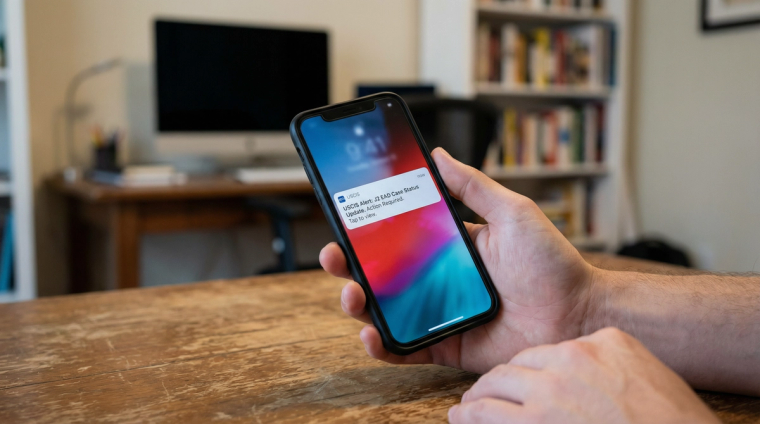
Create an account at my.uscis.gov for more detailed tracking. You can link paper-filed cases using your receipt number. Benefits include case history showing the last five status changes, email and text alerts when your status updates, the ability to respond to RFEs online, and secure messaging with USCIS.
This is the most useful tool for J-2 applicants because it shows the full timeline of your case, not just the most recent status.
3. USCIS Processing Times tool
The Processing Times page shows estimated wait times for your form, category, and service center. For J-2 EADs (category (c)(5)), select Form I-765 and then choose the option that matches how the tool lists your eligibility category. If (c)(5) isn't listed separately, USCIS may group it under a broader option (like "All other applications for employment authorization").
This tool also shows the "receipt date for a case inquiry," which is the cutoff date that determines whether your case is considered outside normal processing time. If your receipt date is before this date, you can submit a service request.
4. USCIS Contact Center
Call 1-800-375-5283 (TTY: 1-800-767-1833). Live assistance is available Monday through Friday, 8 a.m. to 8 p.m. Eastern. The Contact Center uses a tiered system; Tier 1 can resolve many inquiries and some issues get escalated to Tier 2 (USCIS Immigration Services Officers) when needed.
5. e-Request (for delayed cases)
If your case exceeds normal processing time, submit a service request at egov.uscis.gov/e-request. You can use this tool when your receipt date is earlier than the "receipt date for a case inquiry" shown on the Processing Times page. This is the formal way to flag your case for USCIS attention.
What each USCIS status message means for your J-2 EAD
USCIS uses standard status messages for all case types. Here's what the most common ones mean and whether you need to do anything.
"Case Was Received"
USCIS accepted your application and assigned a receipt number. This is the starting point. For J-2 EAD cases, this status often stays unchanged for 2-5 months during adjudication. A long period with no update is normal and does not mean something is wrong.
"Case Is Being Actively Reviewed"
An officer has your case and is reviewing it. This usually means a decision is coming within a few weeks, though some cases stay in this status for a month or more.
"Request for Evidence Was Sent" / "Request for Initial Evidence Was Sent"
USCIS needs more documentation. For J-2 applicants, common RFE topics include evidence of J-2 status, documentation of the J-1/J-2 relationship, and other evidence USCIS needs to determine eligibility. USCIS sets an RFE response deadline. When served by ordinary mail, USCIS treats a response as timely if received within the prescribed period plus 3 days (often up to 87 days from the date USCIS mails the RFE, depending on the timeframe given). Respond promptly and completely. An RFE delays adjudication because USCIS must review your response before continuing.
"Case Was Approved"
Your EAD has been approved. Card production begins shortly. You still need to wait for the physical card before you can start working.
"Card Is Being Produced" / "Card Was Produced"
USCIS is producing your EAD. After approval, the card should be produced within about 2 weeks and mailed via USPS Priority Mail. Delivery time varies. USCIS advises allowing 30 days from approval before inquiring about non-delivery. You may be able to find a USPS tracking number in Case Status Online.
"Card Was Mailed to Me"
Your EAD is in the mail. USCIS advises allowing 30 days from approval before inquiring about non-delivery. If you still haven't received the card after that, submit an inquiry using USCIS e-Request (for non-delivery of a card) or contact USCIS.
"Case Was Denied"
Your application was not approved. The denial notice explains the reason and your options, which may include filing a motion to reopen or reapplying. For guidance on next steps, see our article on J-2 EAD denied: what to do next.
J-2 scenarios that affect your EAD status
Unlike most other EAD categories, J-2 work authorization is closely tied to the J-1 principal's status. These situations can directly impact your pending or approved EAD.
Your DS-2019 is expiring
Your J-2 stay in the United States is tied to the exchange program dates on Form DS-2019 (with a 30-day grace period after program completion for travel). If the J-1's program is ending soon, work with the program sponsor about extension options. If your J-2 status ends while your EAD application is pending, USCIS may deny the application because you would no longer be eligible under (c)(5).
The J-1 principal changes visa status
If the J-1 changes to a different nonimmigrant status (for example, from J-1 to H-1B), your J-2 status ends. This means you must stop working immediately, even if your EAD card is still valid on its face (8 CFR § 274a.12(c)(5)). If you have a pending EAD application, it will likely be denied. Coordinate with the J-1 before any status changes.
The J-1's program ends before your EAD is approved
The J-1 and J-2 have a 30-day grace period after completing the program to depart the United States. Employment is not authorized during this grace period. If the program has ended and you are in the grace period, you are not eligible to begin (or continue) J-2 employment under an EAD based on (c)(5).
No automatic extension for J-2 EAD renewals
J-2 EADs under category (c)(5) are not among the categories eligible for automatic EAD extension while a renewal is pending. When your J-2 EAD expires, you must stop working until you receive the new card. This makes tracking your renewal status especially important. File early, and note that USCIS advises not filing a renewal more than 180 days before the current EAD expires. For full renewal details, see our J-2 EAD renewal guide.
When to contact USCIS about a delayed J-2 EAD
Not every delay requires action. Here's a framework for deciding when to wait and when to escalate.
Wait if:
- Your case is within normal processing times shown on the USCIS Processing Times tool
- Your status has been "Case Was Received" for less than 4 months
- You have no pressing employment deadline
Take action if:
- Your receipt date is earlier than the "receipt date for a case inquiry" shown on the Processing Times page. Submit an e-Request at egov.uscis.gov/e-request
- You received an RFE and the deadline is approaching. Respond immediately with all requested documents
- Your DS-2019 is expiring within 60 days and you haven't received your EAD
- Your address has changed since filing. Update it through your myUSCIS account or by filing Form AR-11
- Your card was mailed more than 30 days ago and hasn't arrived
Escalate if:
- You submitted an e-Request or service inquiry more than 60 days ago with no response
- You're experiencing severe financial hardship due to the delay. Consider requesting expedited processing, though approval is rare for J-2 cases. Read more about J-2 EAD expedite requests
- All USCIS channels have been exhausted. Contact the DHS CIS Ombudsman at dhs.gov/case-assistance as a last resort, or reach out to your congressional representative's office for a congressional inquiry