

Check the USCIS processing time estimate for J-2 category (c)(5) before planning a work start date. USCIS reported a 5.8-month average across all I-765 categories in July 2026. Its separate J-2 report shows 4,356 pending applications at March 31, 2026.
Current J-2 EAD processing times in 2026
The live USCIS tool reports how long it took to complete 80% of cases in the selected category. Some cases take longer. Our J-2 EAD application process guide explains how to prepare and file.
The figures below have different reporting periods and cover different groups of applications.
| Metric | Value and reporting period |
|---|---|
| Average I-765 processing time, all categories | 5.8 months in July 2026 |
| J-2 EAD approval rate | 98.0% in FY2026 Q2 |
| J-2 EAD pending cases | 4,356 at March 31, 2026 |
| J-2 EAD applications received | 3,636 in FY2026 Q2 |
| J-2 renewal share of initial and renewal receipts | 49.8% in FY2026 Q2, excluding replacements |
The processing time estimate covers USCIS review through a decision. Card production and delivery follow an approval, so allow time for the EAD to arrive.
Check USCIS processing times for the form and category that apply to your case. Use the current result when planning for a possible gap in work authorization.
How I-765 processing times have changed
Across all I-765 categories, the reported monthly average was 2.5 months in both June and July 2025. It reached 5.8 months in July 2026.

The increase was 3.3 months between July 2025 and July 2026. This comparison covers all I-765 categories; the monthly report does not provide a separate J-2 average.
J-2 EAD application volume and approval rates
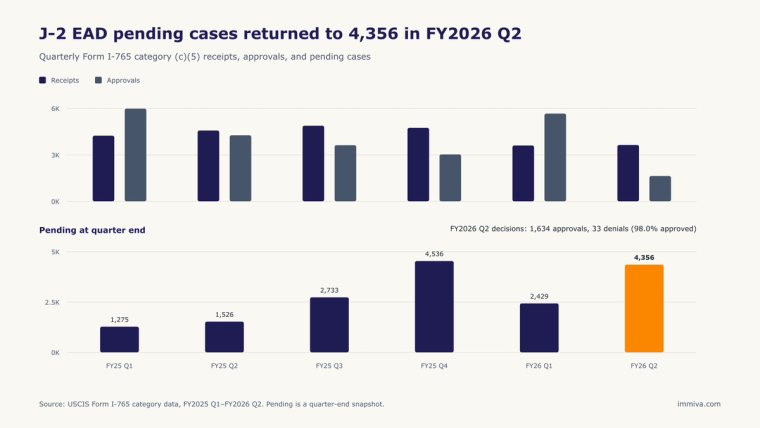
USCIS records J-2 employment authorization under category C05, also written (c)(5). The quarterly figures below cover FY2025 and the first two quarters of FY2026.
| Quarter | Receipts | Approvals | Denials | Pending at quarter end | Approval rate |
|---|---|---|---|---|---|
| FY2025 Q1 (Oct to Dec 2024) | 4,237 | 5,983 | 72 | 1,275 | 98.8% |
| FY2025 Q2 (Jan to Mar 2025) | 4,570 | 4,262 | 55 | 1,526 | 98.7% |
| FY2025 Q3 (Apr to Jun 2025) | 4,880 | 3,622 | 54 | 2,733 | 98.5% |
| FY2025 Q4 (Jul to Sep 2025) | 4,742 | 3,026 | 63 | 4,536 | 98.0% |
| FY2026 Q1 (Oct to Dec 2025) | 3,605 | 5,663 | 80 | 2,429 | 98.6% |
| FY2026 Q2 (Jan to Mar 2026) | 3,636 | 1,634 | 33 | 4,356 | 98.0% |
Approval rate here means approvals divided by approvals plus denials. Pending cases and applications received are excluded from that calculation.
During the first half of FY2026, USCIS received 7,241 J-2 applications and recorded 7,297 approvals and 113 denials. The approval rate among those decisions was 98.5%, compared with 98.0% in Q2 alone. These figures do not predict the outcome of an individual application.
Reported J-2 pending cases fell from 4,536 at the end of FY2025 Q4 to 2,429 in FY2026 Q1, then rose to 4,356 in FY2026 Q2. The latest count is 4.0% below FY2025 Q4. USCIS cautions against calculating a new pending balance from receipts and decisions alone because closures, transfers, system updates and post-adjudicative outcomes also affect the figures.
Initial vs. renewal breakdown
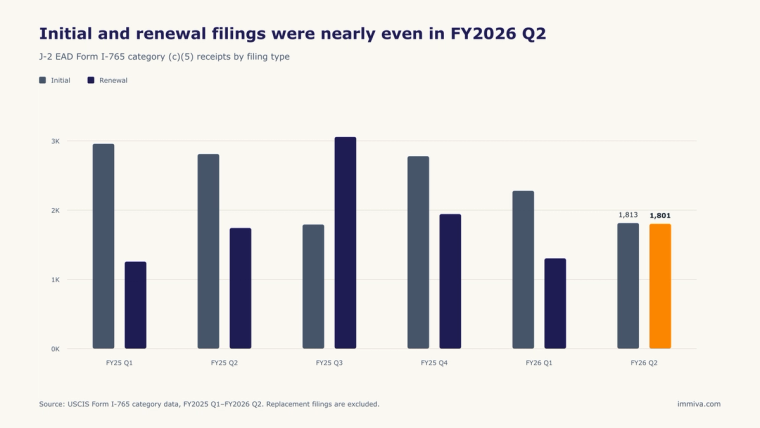
USCIS separates initial EAD receipts from renewal receipts. Replacement applications are a third filing type and are excluded from this comparison.
| Type | FY2025 Q1 | FY2025 Q2 | FY2025 Q3 | FY2025 Q4 | FY2026 Q1 | FY2026 Q2 |
|---|---|---|---|---|---|---|
| Initial EAD | 2,958 | 2,809 | 1,792 | 2,778 | 2,279 | 1,813 |
| Renewal EAD | 1,256 | 1,742 | 3,057 | 1,943 | 1,303 | 1,801 |
The highest renewal count in these six quarters was 3,057 in FY2025 Q3. In FY2026 Q2, initial and renewal receipts were nearly even at 1,813 and 1,801. Renewals made up 49.8% of their combined total, excluding 22 replacement applications.
The growing I-765 backlog: why it matters for J-2
USCIS also reports how many I-765 applications across all categories have been pending for more than six months.

That count reached 1,383,136 in July 2026, up 183.3% from the February 2025 low of 488,237. It includes applications in all I-765 categories. The monthly report does not give a separate count of J-2 cases pending for more than six months.
What is a J-2 EAD?
The J-2 EAD is a work permit that lets dependents of J-1 exchange visitors work legally anywhere in the U.S. Our J-2 visa work authorization guide covers eligibility, restrictions, and the complete application process.
J-2 EAD eligibility requirements
You need valid J-2 status and a current DS-2019 to qualify. For the full list of eligibility requirements, see our J-2 work authorization guide.
Required documents for J-2 EAD
The I-765 application requires several supporting documents, including proof of J-2 status and identity. Our I-765 field-by-field instructions list exactly what you need.
Filing fees and payment methods (2026)
The Form I-765 filing fee for J-2 (c)(5) category is $520 (paper only; J-2 (c)(5) cannot be filed online). Biometrics fee is included.
Starting January 1, 2026, USCIS implemented H.R. 1 inflation-adjusted fees for certain categories (asylum, TPS, parole). The standard I-765 fee for J-2 applicants was not affected, but always verify fees on the USCIS fee schedule before filing. Sending the wrong fee amount will get your application rejected.
USCIS no longer accepts personal or business checks, money orders, or cashier's checks for paper filings (with limited exceptions). Pay by credit, debit, or prepaid card using Form G-1450, or pay directly from a bank account using Form G-1650.
One more thing to watch: USCIS now accepts only the 08/21/25 edition of Form I-765. Using an outdated form edition is a common reason for rejection.
J-2 EAD timeline: what happens after you apply
USCIS reviews your eligibility after accepting the application. Biometrics or a Request for Evidence may be part of that review before the agency makes a decision.
Step 1: receipt notice
USCIS sends Form I-797C confirming they received your application. This includes your receipt number and starts your official processing clock.
Step 2: biometrics, if required
If USCIS requires biometrics for your application, it will send appointment instructions. USCIS may reuse biometrics from a previous application. If you cannot attend a scheduled appointment, see how to reschedule your biometrics appointment.
Step 3: USCIS review
An officer reviews your documents and eligibility. Your online status may remain unchanged while USCIS works on the application.
Step 4: decision
USCIS sends a notice of its decision. If it needs more information before deciding, it may issue a Request for Evidence (RFE). Our RFE response guide explains how to prepare a response.
Step 5: card delivery
Your EAD arrives by USPS Priority Mail to the address on your application. Make sure your mailing address is current -- USCIS will not redirect cards to a new address after production.
Total timeline summary
| Stage | What happens |
|---|---|
| Receipt notice | USCIS acknowledges the application and provides a receipt number. |
| Biometrics, if required | USCIS gives instructions if it requires biometrics. |
| USCIS review | An officer reviews eligibility and supporting documents. |
| Decision | USCIS issues an approval or denial notice. |
| Card delivery | After approval, USCIS produces and mails the EAD. |
Critical 2025-2026 policy changes affecting J-2 EAD
A few recent changes worth knowing about.
H.R. 1 (One Big Beautiful Bill Act). Signed into law July 4, 2025, it introduced annual inflation adjustments to certain USCIS fees and changed EAD validity periods for some asylum, TPS and parole categories. The law's EAD validity changes do not apply to J-2 category (c)(5).
No automatic extension for J-2 renewals. If your current card expires before your renewed work authorization starts, you must stop working. File as early as USCIS permits, generally no more than 180 days before expiration.
Premium processing still not available. Despite expansion to F-1 OPT categories, J-2 EADs under category (c)(5) still don't qualify. You can't pay extra for faster processing.
New form edition required. Starting March 5, 2026, USCIS requires the 08/21/25 edition of Form I-765. Applications on older editions will be rejected.
Can you expedite J-2 EAD processing?
USCIS allows expedite requests in certain situations, like severe financial loss or urgent humanitarian reasons. Our J-2 EAD expedite request guide explains what qualifies and how to file.
What to do if your J-2 EAD is delayed
If your case exceeds normal processing times:
Check the USCIS processing time website. Times change monthly. Your case might still be within the current published range. Go to the USCIS Processing Times tool, select I-765, and check the estimate for your service center and category.
Submit an e-Request. Through the USCIS website, you can ask about cases outside normal processing times. You'll get a response within 30 days.
Contact your congressperson. Congressional inquiries can prompt USCIS to review stuck cases. No guarantee of faster processing, but it adds another review layer.
Consult with an attorney. If your case has been pending well beyond average, or if you received an RFE you don't understand, professional help may be worthwhile.
Document everything. Keep copies of all communications with USCIS. Note dates you called and what representatives told you.
Do not work without authorization. Even if your case is severely delayed, working without your EAD violates your status. This can affect future applications and your ability to remain in the U.S. And if you’re thinking about traveling while your case is pending, understand the risks before you go.
J-2 EAD renewal: when and how to apply
File your renewal as early as USCIS permits, generally no more than 180 days before your current EAD expires. J-2 category (c)(5) does not receive an automatic extension while a renewal is pending, so filing early cannot guarantee continuous work authorization. Immiva's J-2 EAD application fills Form I-765 under category (c)(5) and prepares the employment statement.
Our J-2 EAD renewal guide covers the complete process, documents needed, and how to avoid gaps in work authorization.
Common mistakes that delay J-2 EAD processing
Filing errors are the leading preventable cause of processing delays. The most common: using the wrong eligibility category code (must be (c)(5)), submitting an outdated form edition, sending the wrong fee amount, and missing supporting documents.
If you get a Request for Evidence, our RFE response guide explains how to handle it. If your application is denied, see our guide on what to do after a J-2 EAD denial.