
Getting a denial notice from USCIS is stressful, especially when your ability to work depends on it. But J-2 work authorization is generally approved when you meet all requirements and submit a complete, correct application. That means many denials come from fixable mistakes in the application, not eligibility problems.
Here's exactly what to do after a J-2 EAD denial, from understanding why it happened to choosing the right path forward. And if you're preparing to reapply, check your eligibility for a J-2 EAD to make sure everything lines up before you file.
Denial vs. Rejection: Two Very Different Things
Before you do anything else, look at your notice carefully. There's a big difference between a denial and a rejection, and the steps you take depend entirely on which one you received.
A denial means USCIS reviewed your application and made a final adverse decision. Your case was evaluated on the merits and found lacking. You'll receive a formal notice explaining the specific reasons. Recovering from a denial requires either filing a motion (within 30 days) or submitting a brand-new application.
A rejection means USCIS returned your application without reviewing it at all. This usually happens because of administrative errors like a missing signature, incorrect fee, wrong form edition, or filing at the wrong service center. The fix is straightforward: correct the error and resubmit. Your original filing date is lost, but you don't need a motion or lawyer to try again.
Seven Reasons USCIS Denies J-2 EAD Applications
Most J-2 EAD denials fall into one of these categories. Identifying which one applies to you is the first step toward fixing it.
Wrong Eligibility Category Code
This is one of the most common mistakes. On Form I-765, Part 2, Item 27, you must select category code (c)(5) for J-2 dependent employment authorization (8 CFR § 274a.12(c)(5)). Selecting the wrong category can result in a denial because USCIS will evaluate your application under a different eligibility category.
Cover Letter Issues
USCIS requires that J-2 EAD income will not be used to support the J-1 principal (USCIS Policy Manual, Vol. 2, Part D, Ch. 6). Your cover letter or supporting statement should explain that the employment is for personal expenses, cultural enrichment, or professional development. Language suggesting the income will support the household, including the J-1 holder, can trigger a denial.
J-1 Principal Status Problems
Your J-2 EAD depends entirely on the J-1 principal maintaining valid status. If the J-1's exchange visitor program has ended, their DS-2019 has expired, or they've changed to a different immigration status, your J-2 EAD application will be denied. Always verify the J-1's current status before applying.
Incomplete or Missing Documentation
USCIS expects a complete filing package: copies of your passport, I-94 arrival/departure record, current DS-2019 showing J-2 status, and the J-1 principal's DS-2019. Missing any of these documents gives USCIS grounds to deny.
Failure to Respond to an RFE
If USCIS sends a Request for Evidence (RFE) and you don't respond by the deadline, your application is considered abandoned and will be denied. You can check your EAD application status online to make sure you haven't missed any correspondence.
Identity Verification Failures
If USCIS cannot verify your identity through your submitted documents or biometrics appointment, your application will be denied. This can happen if your passport photos don't match, your name has changed without documentation, or you failed to appear for biometrics.
DS-2019 Issues
Your name must appear on your own valid DS-2019 issued by the J-1 program sponsor. If your DS-2019 is expired, or if the program sponsor has ended or terminated your J-2 program participation in SEVIS, USCIS can deny the application.
What to Do in the First 72 Hours After Denial
Read Your Denial Notice Carefully
Your denial notice lists the specific reasons USCIS refused your application. Read every line. The reasons stated in the notice determine which recovery option makes the most sense.
Calculate Your Deadline
You generally have 30 days from the date of service of the decision to file a motion to reopen or motion to reconsider (8 CFR § 103.5(a)(1)(i)). If USCIS mailed the decision, you generally get 33 days (8 CFR § 103.8(b)). Mark this date on your calendar immediately. If you miss the deadline, USCIS may excuse a late motion to reopen only if you show the delay was reasonable and beyond your control; there is no similar exception for an untimely motion to reconsider.
Gather Your Evidence
Start collecting any documents that address the specific denial reason. If your category code was wrong, prepare a corrected form. If documents were missing, locate them. If the J-1's status was the issue, get current proof of their valid status.
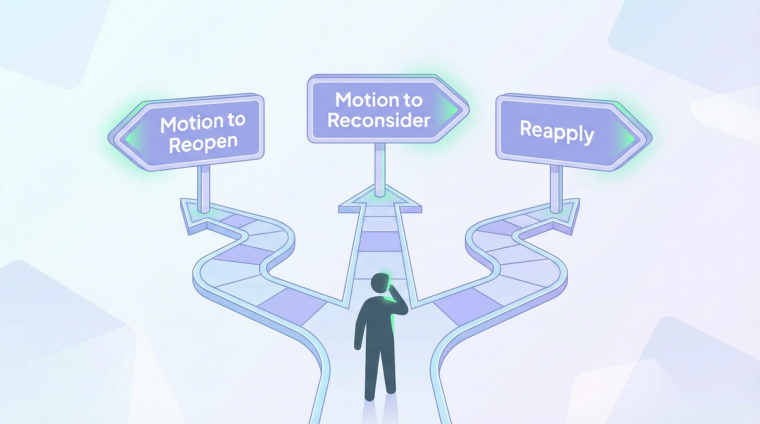
Your Three Options After J-2 EAD Denial
There is no formal appeal process for I-765 denials (8 CFR § 274a.13(c)). But you do have three paths forward.
Option 1: Motion to Reopen (Form I-290B)
A motion to reopen asks USCIS to take another look at your case based on new facts or evidence that weren't part of the original application (8 CFR § 103.5(a)(1)). This is the right choice when you can now provide documents that were missing before, or when your circumstances have changed in a way that fixes the problem.
Cost: $800 filing fee for Form I-290B (USCIS Fee Schedule)
Timeline: USCIS does not publish a fixed timeline for deciding these motions, and a decision can take several months.
Deadline: Must be filed within 30 days of the denial decision (33 if mailed).
Option 2: Motion to Reconsider (Form I-290B)
A motion to reconsider argues that USCIS made an error in applying the law or policy to your case. You're not providing new evidence. Instead, you're pointing out that the existing record should have led to a different outcome. Use this option when you believe the denial was wrong based on the facts already in your file.
Cost: $800 filing fee (USCIS Fee Schedule)
Timeline: Same as a motion to reopen; USCIS does not publish a fixed timeline.
Deadline: Same 30-day window.
Option 3: File a New I-765 Application
In many cases, the fastest and simplest path is to just apply again. This makes sense when the denial was caused by a clear, fixable error (wrong category code, missing documents, expired DS-2019 that has since been renewed), and you don't need the earlier filing date preserved.
Cost: $520 (paper filing) (USCIS Fee Schedule)
Timeline: J-2 EAD processing times vary. Check USCIS Processing Times for Form I-765 and your eligibility category to see current estimates.
How to Choose Between Options
| Your Situation | Best Option |
|---|---|
| You have new evidence that fixes the denial reason | Motion to Reopen |
| USCIS misapplied a rule to your case | Motion to Reconsider |
| Clear fixable error (wrong code, missing docs) | File a New I-765 |
| You're not sure what went wrong | Consult an attorney |
| The 30-day deadline has passed | File a New I-765 |
How J-2 EAD Denial Affects Your Status
Something many people worry about unnecessarily: a J-2 EAD denial does not affect your J-2 immigration status. Your visa status and your work authorization are separate things. You can continue living in the U.S. on your J-2 visa as long as the J-1 principal maintains their status, even if your EAD is denied.
What you cannot do is work. Without an approved EAD, any employment is unauthorized and could create serious problems for future immigration applications. If you were working under a previous EAD that has since expired, you must stop working immediately after the denial.
The October 2025 Policy Change Makes Denials Worse
Before October 30, 2025, some EAD holders who filed timely renewals got an automatic 540-day extension of their work authorization while the renewal was pending. That safety net no longer exists (90 FR 48799). J-2 EADs filed under category (c)(5) were never eligible for automatic extensions, and the October 2025 rule removed any remaining ambiguity.
This means a denial today creates an immediate gap in your ability to work, and that gap won't close until your motion is granted or your new application is approved. If you need to speed things up, look into whether you qualify for a J-2 EAD expedite request. And if your current EAD is nearing expiration, start your J-2 EAD renewal as early as possible to avoid a gap in work authorization.
When to Talk to an Immigration Attorney
Most J-2 EAD denials can be resolved by fixing a clear error and reapplying. But some situations call for professional help:
- The denial notice cites complex legal reasons you don't understand.
- The J-1 principal's status is in question or has changed.
- You've been denied more than once for the same application.
- The 30-day motion deadline is approaching and you're not sure what to file.
- You worked without authorization after the denial and need to understand the consequences.
If you decide to reapply on your own, you can find answers to most procedural questions in our J-2 EAD FAQ. And for a full walkthrough of the J-2 work authorization process, see our complete guide to J-2 visa work authorization.