

The government charges $760 to process your N-400 application when filing by mail. But the full picture is more complicated - your total bill could range from under $900 to well over $3,000 depending on the route you choose.
So you're finally ready to become a U.S. citizen. Congratulations! But before you start memorizing the civics questions, there's a question you probably want answered first: how much is this going to cost me?
The short answer: $760 if you file by mail, $710 if you file online. But that's just what USCIS charges. Your actual total could be anywhere from under $900 to well over $3,000 depending on how you approach the process.
What USCIS Charges for Form N-400
Let's start with the fees you absolutely cannot avoid. Here's what USCIS charges right now:
| Filing Method | Total Fee | What's Included |
|---|---|---|
| Online (via myUSCIS) | $710 | Application + biometrics |
| Paper (by mail) | $760 | Application + biometrics |
| Reduced fee (paper only) | $380 | Same as above, if you qualify |
| Full waiver (paper only) | $0 | Same as above, if you qualify |
| Military (active duty/veteran) | $0 | With proof of service |
If you're requesting a fee waiver or reduced fee, you'll need to file by paper, so $760 applies. Everyone else can file online for $710. That includes people using a preparation service like Immiva: you prepare your application with Immiva, then file it online yourself and pay the lower fee.
Change you need to know about: As of October 28, 2025, USCIS stopped accepting paper checks and money orders completely. You must pay by credit card (using Form G-1450) or ACH bank transfer (using Form G-1650). This trips up a lot of people who try to mail in checks, so don't be one of them.
How the fees changed in 2024
Before April 2024, USCIS charged $640 for the application plus a separate $85 biometrics fee. Both are now bundled into one charge: $710 online, $760 paper. The 2024 fee rule also widened reduced-fee eligibility to households earning between 150% and 400% of the Federal Poverty Guidelines. For current income limits and how to qualify, see our N-400 fee waiver guide.
Hidden Costs Most Guides Don't Mention
The USCIS fee is just the starting point. Here are other expenses that can sneak up on you:
Passport Photos ($10-$25)
USCIS may request physical passport-style photos during processing. You can get these at pharmacies, shipping stores, or even print them yourself.
Document Copies and Translations ($0-$200+)
Any documents in a foreign language need certified English translations. Professional translation services typically charge $20-$50 per page. You'll also want copies of your green card, passport pages, and any supporting documents.
Travel and Time Off Work ($50-$300+)
Your biometrics appointment and naturalization interview will be scheduled during business hours at a USCIS office. Depending on where you live, this could mean taking time off work or paying for transportation. If your nearest USCIS office is far away, you might need gas money or even a hotel stay.
Civics and English Test Preparation ($0-$300)
If you filed your N-400 on or after October 20, 2025, you'll take the new 2025 civics test, and it's significantly harder than the old version. You'll now need to study 128 possible questions (up from 100), answer 20 questions during your interview (up from 10), and get at least 12 correct to pass.
USCIS offers free study materials, but some people prefer structured classes or tutoring, especially if English isn't their first language.
Heads up: The new civics test requirements apply to anyone who files their N-400 on or after October 20, 2025. If you already filed before that date, you'll take the older, shorter test.
Your First U.S. Passport ($165-$195)
Here's a cost almost nobody talks about: once you become a citizen, you'll need a passport. And that's not free.
You'll pay:
- $165 for a passport book (required for international air travel)
- $30 for a passport card (optional, but useful for land/sea travel to Canada, Mexico, Caribbean)
- $195 if you get both the book and card together (you pay the $35 execution fee only once)
Most people need this within a few months of citizenship because that's the whole point: you can finally travel freely. Budget for it.
Add it all up, and even a completely DIY application could cost $1,100-$1,400 when you factor in these extras plus your passport.
How Much Does Citizenship Cost for a Family?
If you're not applying alone, the math changes fast.
Let's say a family of four is all applying for citizenship at the same time. Each adult needs their own N-400 application. Here's what that looks like:
| Scenario | Cost per Person | Total for 4 People |
|---|---|---|
| Full price (online) | $710 | $2,840 |
| Full price (paper) | $760 | $3,040 |
| Reduced fee (paper) | $380 | $1,520 |
| With attorney help | $760 + $500-$2,500 | $5,040-$12,040 |
Quick note about kids: If your children are under 18 when you become a citizen, they automatically become citizens too (if they have green cards and live with you). You don't need to file separate N-400s for them. But if you want proof of their citizenship, you can file Form N-600, which costs $1,170. Most people just wait and apply for their kids' passports instead, which serves as proof and costs way less.
What Immigration Attorneys Charge for Citizenship Cases
Now let's talk about lawyer fees.
Attorney fees for N-400 applications typically range from $500 to $2,500 for straightforward cases. On the lower end, you might just get help reviewing your completed form. On the higher end, the attorney handles everything: filling out the application, gathering documents, and accompanying you to your interview.
If your case has complications (a criminal history, lengthy travel abroad, or gaps in your residency) expect to pay more, potentially $2,000-$3,000 or higher. Some immigration attorneys charge hourly rates of $200-$450, which can add up quickly for complex situations.
Most people don't need a lawyer for the N-400. The form is detailed, yes, but it's designed for applicants to complete on their own. Naturalization is one of the more predictable immigration pathways, and USCIS provides extensive instructions. Learn more about when you can file N-400 without a lawyer.
That said, legal help makes sense if:
- You have any criminal record, even minor arrests
- You've taken long trips outside the U.S. that might affect your eligibility
- You're unsure whether you meet the physical presence requirements
- You've received a Request for Evidence (RFE) on a previous application
- You want peace of mind and can afford the cost
A Smarter Option: Guided Preparation Services
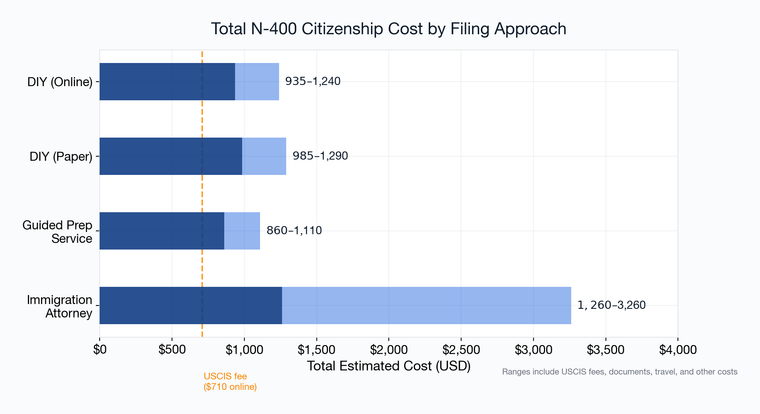
What if you want more help than going it completely alone, but don't want to pay $1,500+ for an attorney?
This is where online preparation platforms come in. Immiva's N-400 platform asks plain-English questions and builds the form from your answers. It checks every answer as you go, flags errors before you file, and produces completed forms ready to print, sign, and mail.
The cost? A fraction of what attorneys charge.
A platform doesn't replace a lawyer when your record needs one: an arrest or conviction, a prior denial, or a case in removal proceedings. For everyone else, guided preparation offers:
- Error prevention: Catch mistakes before they cause rejections (learn about common N-400 mistakes to avoid)
- Time savings: No deciphering confusing government instructions
- Confidence: Know your forms are complete and consistent
Think of it this way: the filing fee ($710 online, $760 paper) goes to USCIS no matter what. The question is how much extra you spend on preparation, and whether that money actually reduces your risk of problems.
Citizenship vs. Keeping Your Green Card: The Real Cost Comparison
What if you just keep your green card instead?
It sounds cheaper at first. But let's run the numbers.
Your green card expires every 10 years. Each time you need to renew it, you pay $540 (as of 2025). So over 30 years, that's $1,620 in renewal fees.
Compare that to citizenship:
- One-time N-400 fee: $760
- Passport (lasts 10 years): $165
- Passport renewals over 30 years: $260 ($130 per renewal, with no execution fee)
Total over 30 years:
- Green card holder: $1,620
- Citizen: $1,185
Citizenship is actually cheaper in the long run. And that's before you consider the other benefits: voting rights, no worries about deportation, easier family sponsorship, access to certain government jobs, and the ability to live outside the U.S. without risking your status.
So yeah, the upfront cost might feel steep. But it's a one-time investment that pays off.
Quick Takeaways: Your N-400 Cost Cheat Sheet
- USCIS filing fee (paper): $760 - biometrics included
- USCIS filing fee (online): $710 - but not available for fee waivers or reduced fees
- Reduced fee option: $380 if household income is 150-400% of poverty guidelines
- Full fee waiver: $0 if income is at or below 150% of poverty guidelines
- Military applicants: $0 filing fee with proof of service
- Attorney fees: Typically $500-$2,500 for standard cases, higher for complex situations
- Total DIY cost (paper filing): Approximately $900-$1,100 including incidentals
- Total with passport: Approximately $1,100-$1,400
- Total with attorney: Approximately $1,500-$3,500+
- Family of 4 (full price): $2,840-$3,040 just for filing fees
Pro tip: If you qualify for a fee waiver or reduced fee, you must file by paper mail. Budget extra time for mailing and processing.
Making Your Decision: What's the Right Path for You?
The citizenship application fee isn't cheap, but it's a one-time investment in something permanent: becoming an American citizen. Unlike visa renewals that happen every few years, naturalization is forever.
Here's my honest advice after watching many people go through this process:
Go completely DIY if:
- Your case is straightforward (no criminal issues, no long absences from the U.S.)
- You're comfortable with paperwork and detail-oriented
- You want to save maximum money
Use a guided platform if:
- You want to avoid mistakes without paying attorney prices
- You prefer step-by-step guidance in plain language
- You want every answer checked automatically before you file
Hire an attorney if:
- You have any concerns about your eligibility
- There's anything in your history that might raise red flags
- You want someone in your corner for the interview
Whatever route you choose, don't let the cost scare you away from applying when you're eligible. Citizenship opens doors that permanent residence doesn't: voting rights, certain government jobs, easier sponsorship of family members, and the security of knowing your status can never be revoked.
Start by confirming you meet the basic requirements (check our guide on N-400 physical presence requirements), gather your documents, and pick the preparation method that fits your budget and comfort level.
The finish line is closer than you think.