
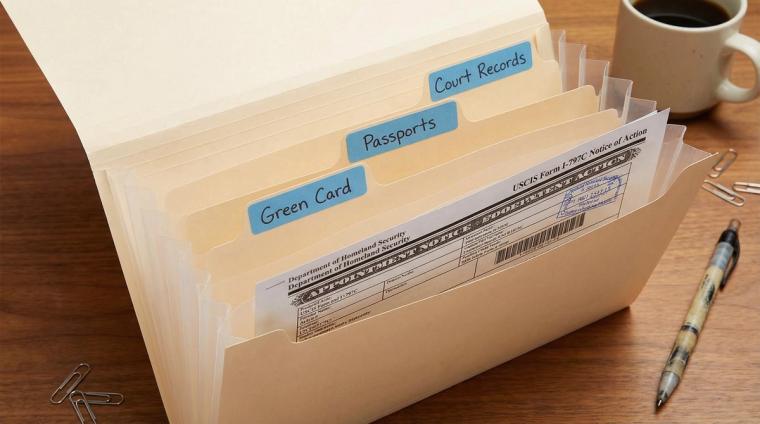
Your citizenship interview is the final hurdle before becoming a U.S. citizen. Walking in without the right documents can mean rescheduling, delays, or worse. This guide covers exactly what you need to bring based on your situation, what to leave at home, and how to organize everything so your interview goes smoothly. For the complete N-400 application process, see our step-by-step guide. You may also want our N-400 interview questions and N-400 document checklist.
Still working on the application itself? Our N-400 Document Checklist 2026 covers what goes into the package you mail to USCIS.
The 6 Documents Every Applicant Must Bring
Regardless of your situation, you need these six items at every naturalization interview. Missing even one can cause problems.
1. Interview Appointment Notice (Form I-797C)
This is your ticket in the door. The notice shows your interview date, time, and the exact USCIS field office address. Bring the original. If you lost it, check your myUSCIS account to download a copy, or call the USCIS Contact Center at 1-800-375-5283.
2. Permanent Resident Card (Green Card)
Bring your green card even if it's expired. Your lawful permanent resident status doesn't expire when your card does (USCIS Policy Manual, Vol. 12, Part B, Ch. 2). USCIS needs to verify your A-Number and photograph. If your card is lost or stolen, you can still attend with your I-797C receipt notice from your N-400 filing, which extends card validity for 24 months.
3. State-Issued Photo ID
This can be your driver's license, state ID card, or valid passport. It must show your current legal name. If your name changed after your green card was issued, bring documentation of the name change (marriage certificate, divorce decree, or court order).
4. All Passports (Current and Expired)
Bring every passport you've held since becoming a permanent resident, including expired ones. USCIS uses these to verify your travel history and continuous residence. If you've lost an old passport, you can request your I-94 travel history from CBP to help reconstruct your trips.
5. Travel Documents (If Applicable)
If you've used any USCIS-issued travel documents, bring them:
- Reentry Permit (Form I-131)
- Advance Parole document
- Refugee Travel Document
6. Originals of All Documents Submitted With Your N-400
Per 8 CFR § 316.4, officers may request original documents to verify authenticity during your interview. This includes birth certificates, marriage certificates, tax transcripts, and any court records you submitted as copies with your application.
If you used Immiva to file your N-400, you can log in to review exactly which documents you submitted. Use our free N-400 eligibility checker to confirm you met all requirements before your interview.
Documents based on your situation
Plenty of applicants need more than the core six. If you're applying through marriage, have any arrest or criminal history, took a trip over 6 months, were of Selective Service age and male, qualify for a disability waiver, or have military service to document, you'll need situation-specific records too. Our N-400 document checklist has the full breakdown by situation and the USCIS guidance behind each one. Bring originals plus copies of everything you submitted with your application.
Originals vs. Copies: What You Actually Need
One of the most common questions is whether to bring originals or copies. Here's the practical answer:
Bring both originals AND copies of everything.
While 8 CFR § 316.4 states that officers "may" request original documents for verification, having copies ready speeds up the process. The officer reviews your originals to verify authenticity and may keep copies for your file. If you only bring originals, USCIS may need to make copies, which takes time.
Documents that MUST be originals:
- Green card
- Passports (current and expired)
- Interview appointment notice
- State-issued photo ID
Documents where copies are acceptable (but bring originals too):
- Birth certificates
- Marriage certificates
- Divorce decrees
- Court records
- Tax transcripts
- Selective Service letters
Foreign Language Documents
All documents in a language other than English must include a certified English translation. The translation must include:
- The translator's certification that the translation is accurate and complete
- The translator's signature, printed name, and date
- A statement of the translator's competency
Notarization is NOT required. Any competent person can translate documents, though professional translation is recommended for complex legal documents.
What NOT to Bring
Knowing what to leave at home is almost as important as knowing what to bring. These items can cause delays or problems:
Documents You Don't Need
- Original copies of forms you submitted online: USCIS already has them
- Photos of yourself: Unlike some immigration applications, no photos are required for your interview (your photo was taken at biometrics)
- Documents for other family members (unless directly relevant to your application)
- Tax returns beyond what's relevant: For most applicants, this means the last 3-5 years only
Items That May Cause Issues
- Large bags or backpacks: Security screening takes longer. Bring a small folder or envelope with your documents
- Weapons or sharp objects: These are prohibited in federal buildings
- Food and drinks: Most field offices don't allow these past security
- Multiple electronic devices: Some offices restrict electronics. Bring only your phone if needed
Leave Personal Opinions at the Door
Your interview isn't the place to discuss your political views, opinions about immigration policy, or complaints about USCIS. Stay focused on answering the officer's questions honestly and directly.
How to Organize Your Documents
Walking in with a messy stack of papers creates a poor impression and makes it harder for the officer to help you. Here's how to organize for success:
The Folder System
Folder 1: Essential Documents
- Interview appointment notice (I-797C)
- Green card
- State ID
- Current passport
Folder 2: Passports and Travel
- All expired passports
- Travel documents (if any)
- Travel history summary (if extensive travel)
Folder 3: Situation-Specific Documents
- Marriage evidence (if 3-year rule)
- Court records (if criminal history)
- Selective Service documents (if applicable)
- Military documents (if applicable)
Folder 4: Copies for USCIS
- Copies of everything in Folders 1-3
- Organized in the same order
Label Everything
Use sticky notes or tabs to label sections. This helps both you and the officer find documents quickly. Write your A-Number on the top right corner of each page.
Create a Personal Checklist
Before your interview, go through your N-400 application question by question. For each answer that required documentation, verify you have the supporting document. Our step-by-step N-400 guide walks through every section.
What to Expect on Interview Day
Before You Leave Home
- Double-check your document checklist
- Review your N-400 answers (you should know what you wrote)
- Study for the civics test if you haven't already
- Eat a light meal (plan on a few hours at the office between security, waiting, and the interview)
- Dress professionally but comfortably (business casual is appropriate)
Arriving at the Field Office
Plan to arrive 15-30 minutes early. Most USCIS offices are in federal buildings with security screening:
- You'll need to show your ID and appointment notice at the entrance
- Walk through a metal detector
- Bags may be X-rayed
After clearing security, check in at the reception desk and wait for your name to be called.
The interview itself typically runs about 20 to 30 minutes: the officer puts you under oath, verifies your identity and documents, reviews your N-400 answers, and administers the English and civics tests. For a full walkthrough and what officers actually ask, see our guide on N-400 interview questions.
The 2025 Civics Test: What Changed
The 2025 civics test has 128 questions. You'll be asked up to 20 and need 12 correct to pass. To prepare, study all 128 civics questions organized by topic.
What If You Forget a Document?
It happens. If you arrive and realize you're missing something, here's what to expect:
Best case: The officer proceeds with the interview and asks you to mail or bring the missing document later. You'll receive a follow-up notice.
Likely case: The officer reschedules your interview to give you time to obtain the document. You won't be penalized, but you'll need to wait for a new appointment.
Rare case: If the missing document is critical (like your green card) and you can't verify your identity, the officer may not be able to proceed at all.
To avoid this situation, use the checklist in this guide and verify everything the night before. If you realize you're missing something important, call the USCIS Contact Center before your appointment to ask if you should reschedule or bring what you can.
New for 2025: Good Moral Character Evidence
In August 2025, USCIS rewrote its Good Moral Character guidance and brought back neighborhood investigations for the first time since 1991. You don't have to bring character evidence to your interview, but a folder of employer letters, volunteer records, or tax transcripts is worth having in case the officer asks. For the full evidence list and how to prepare for a neighborhood visit, see our N-400 document checklist.