

If you hold an H-4 visa and you are wondering whether you can still work in the United States, you are not alone. "Will H-4 EAD be cancelled?" is the question H-4 spouses ask most. The short answer is no. H-4 EAD has not been cancelled, and no rule to cancel it has been published.
One thing did change recently, and almost nobody has reported it. The rescission effort now has a new regulatory identity, and its official status is calmer than what you will see quoted elsewhere. This page tracks every H-4 EAD rule change from 2015 to today. For filing mechanics instead, start with our complete H-4 EAD guide or the renewal guide.
H-4 EAD status right now
The full timeline is further down. This is what matters today.
| Item | Status |
|---|---|
| H-4 EAD program | Still active. Applications are being accepted and approved |
| 540-day EAD auto-extension | Eliminated for renewals filed on or after October 30, 2025 |
| Proposed rescission of H-4 EAD | RIN 1615-AD14, listed on the Unified Agenda as a Long-Term Action. No proposed rule published and no date set |
| Supreme Court challenge (Save Jobs USA) | Resolved. Cert denied October 14, 2025, leaving the lower-court ruling that upheld DHS authority in place (a cert denial, not a merits ruling) |
| Lawsuits over the auto-extension removal | Three pending. No nationwide order has restored the auto-extension |
| Form I-765 edition | Changing September 15, 2026. The 09/15/26 edition becomes mandatory with no grace period |
| 18-month EAD validity cap (December 2025) | Does not apply to H-4 (c)(26) |
| Bundled processing with H-1B | No longer guaranteed (Edakunni settlement expired January 2025) |
| Premium processing for standalone H-4 EAD | Not available |
| Photo policy change | Since December 12, 2025, some applicants may be scheduled for an ASC photo appointment |
| Social media vetting for H-4 applicants | Active since December 15, 2025 |
The bottom line: the program exists and you can still apply. What has gotten harder is keeping work authorization without a gap during renewals. Not sure whether you still qualify? Check your H-4 EAD eligibility.
Where the rescission proposal actually stands
This is the part most coverage gets wrong, including earlier versions of this page.
For years the rescission was tracked under RIN 1615-AC15. That was the first Trump administration's effort, it was withdrawn from OIRA review on January 25, 2021, and it has not come back.
The current effort is a different action with a different number: RIN 1615-AD14, "Removing H-4 Dependent Spouses From the Classes of Noncitizens Eligible for Employment Authorization." DHS describes it as a proposal to remove certain H-4 spouses from eligibility to request employment authorization under (c)(26), reversing the 2015 rule (Unified Agenda, RIN 1615-AD14).
Three details from that listing matter more than the title does:
- It appears under "Long-Term Actions." In Unified Agenda terms, that means the agency does not expect to take action within the next 12 months.
- The NPRM date is listed as "To Be Determined." There is no target date at all.
- It is the first time this RIN has appeared on the Unified Agenda.
The intent is formally on the record now, which it was not before, and that is real. But nothing is at OMB, no proposed rule text exists publicly, and no comment period has opened. Anyone telling you a rescission has sat at OMB since June 2025 is describing something that is not on the regulatory record.
That gap matters because H-4 EAD was created by regulation at 8 CFR § 274a.12(c)(26), so only full notice-and-comment rulemaking can undo it: a proposed rule, a comment period, a reasoned response to every substantive comment, then a final rule with an effective date. Each step takes months and each is reviewable in court.
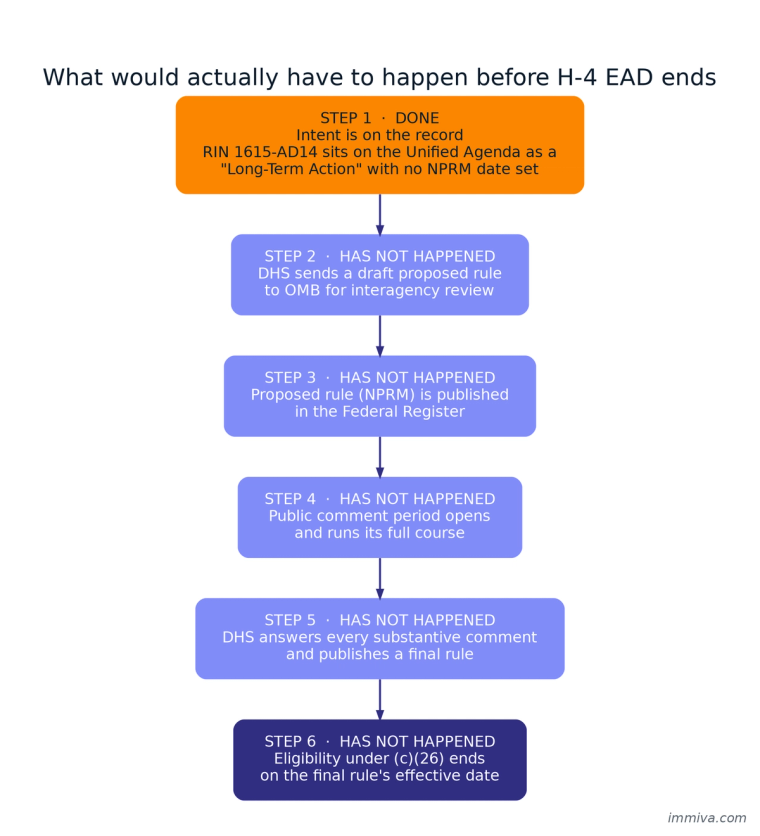
The rescission is at step one of six. Everything after it, including any published proposed rule, has not happened.
What has actually changed in 2025 and 2026
There is a lot of fear circulating about H-4 EAD. Here is what actually moved, in the order it happened. The third item changed daily life for most H-4 EAD holders. The last one needs your attention right now.
Changes already in effect
1. Bundled processing stopped being guaranteed (January 18, 2025)
The Edakunni v. Mayorkas settlement, which required USCIS to adjudicate H-4 and EAD applications alongside the H-1B petition, expired. Some adjudicators still bundle and some do not, so filing the I-539 and I-765 together can still help at some service centers.
2. Personal checks stopped being accepted (October 29, 2025)
Pay by card, Form G-1450, or ACH debit (Form G-1650). See our USCIS fee payment guide.
3. The EAD auto-extension ended for renewals filed on or after October 30, 2025
This is the biggest practical blow of the six. Renewal applicants who timely filed Form I-765 could previously receive an automatic extension of up to 540 days. That ended for most renewal categories, including H-4 (c)(26), under an Interim Final Rule published at 90 FR 48799 (Federal Register). The full identifiers are RIN 1615-AD05, CIS No. 2826-25, DHS Docket No. USCIS-2025-0271, amending 8 CFR § 274a.13(e).
Two practical consequences. Your I-797C receipt notice no longer carries automatic extension language, so there is nothing to show an employer. And since you can only file 180 days early, any renewal slower than that leaves you unable to work while it is pending. Our processing time guide tracks current timeframes, and filing the day your window opens is now the most useful thing you can do.
The rule did not disturb extensions granted before October 30, 2025, and does not affect TPS-based extensions under INA § 244.
4. Photo policy changes began triggering ASC appointments (December 12, 2025)
USCIS updated its photo policy, including no longer using self-submitted photos and limiting photo reuse. Some Form I-765 filers may be scheduled for a Biometrics Services Appointment so USCIS can capture a photo, which adds time. This is discretionary and case-by-case rather than a blanket requirement. See our biometrics appointment guide for what to expect.
5. Social media vetting expanded (December 15, 2025)
H-1B and H-4 applicants now face expanded social media screening on new applications and renewals alike.
6. A new Form I-765 edition becomes mandatory (September 15, 2026)
The current edition is dated 08/21/25, which has been the only accepted edition since March 5, 2026. On September 15, 2026, USCIS publishes a revised 09/15/26 edition, and there is no grace period. USCIS will reject the 08/21/25 edition if it is postmarked or submitted on or after that date (Form I-765 page).
This is the only item on the list that has not landed yet, and if you are filing near that date it is the detail most likely to get your application rejected. Check the edition date in the bottom-left corner of every page, and do not mix pages from two editions. Our field-by-field Form I-765 walkthrough for (c)(26) shows where the code goes, and our September 15, 2026 changes roundup covers the other forms swapping that day.
What has not changed
The program itself has not been cancelled or revoked. USCIS is still accepting and approving applications under (c)(26).
Eligibility is the same. You must be the spouse, not the child, of an H-1B holder who either has an approved I-140 or holds H-1B status beyond six years under AC21 (USCIS Policy Manual, Vol. 10, Part B, Ch. 2). The H-1B Modernization Final Rule (89 FR 103058) changed neither pathway. See our H-4 EAD eligibility and I-140 guide.
The 18-month EAD validity cap does not apply to you. In December 2025, USCIS cut maximum EAD validity from five years to 18 months for refugees, asylees, withholding grantees, pending asylum and withholding applicants, pending adjustment applicants under INA § 245, and NACARA-related categories (USCIS). H-4 (c)(26) is not on that list. It is the change people most often mistake for a cancellation.
The wage-weighted H-1B selection rule did not touch (c)(26). The tiered lottery replacing random selection took effect February 27, 2026 and changed nothing about H-4 EAD eligibility.
Fees and filing channels are unchanged. $520 for Form I-765 filed by mail. H-4 EAD (c)(26) is not eligible for online filing and has no premium processing option. Our H-4 EAD cost breakdown covers the full picture.
Complete H-4 EAD policy timeline: 2012 to 2026
Program creation (2012 to 2017)
| Date | Event |
|---|---|
| May 12, 2014 | Notice of Proposed Rulemaking published (79 FR 26886) |
| February 25, 2015 | Final rule published (80 FR 10284), creating category (c)(26) at 8 CFR § 274a.12 |
| April 23, 2015 | Save Jobs USA files suit in D.C. District Court challenging the rule |
| May 26, 2015 | Rule takes effect. USCIS begins accepting applications |
| September 27, 2016 | District court dismisses the suit for lack of standing |
First rescission attempt (2017 to 2021)
| Date | Event |
|---|---|
| April 18, 2017 | "Buy American and Hire American" Executive Order signed (82 FR 18837) |
| December 14, 2017 | DHS places rescission on the regulatory agenda under RIN 1615-AC15 |
| February 20, 2019 | DHS submits the proposed rescission to OMB for review |
| November 8, 2019 | D.C. Circuit reverses on standing, sending Save Jobs USA back for merits review |
| January 25, 2021 | RIN 1615-AC15 withdrawn from OIRA review. No rescission rule was ever published |
Protections and reforms (2021 to January 2025)
| Date | Event |
|---|---|
| May 4, 2022 | DHS increases EAD auto-extension from 180 to 540 days (87 FR 26614) |
| January 19, 2023 | Edakunni settlement restores bundled adjudication with H-1B petitions |
| March 28, 2023 | District court rules for DHS on the merits in Save Jobs USA |
| August 2, 2024 | D.C. Circuit affirms DHS, rejecting the major questions doctrine argument |
| December 13, 2024 | Final rule codifying the 540-day auto-extension published (89 FR 101208) |
| January 18, 2025 | Edakunni settlement expires. Bundled processing no longer guaranteed |
Current administration (January 2025 to present)
| Date | Event |
|---|---|
| October 14, 2025 | Supreme Court denies cert in Save Jobs USA (No. 24-923), leaving the ruling that upheld DHS authority in place |
| October 30, 2025 | Interim Final Rule eliminates the 540-day auto-extension (90 FR 48799, RIN 1615-AD05) |
| December 1, 2025 | IFR comment period closes. 18 attorneys general and business and civil society groups file opposition |
| December 5, 2025 | 18-month EAD validity cap takes effect for other categories. H-4 (c)(26) is not included |
| December 12, 2025 | Photo policy change may trigger ASC appointments for some filers |
| December 15, 2025 | Social media vetting expanded for H-1B and H-4 applicants |
| January 8, 2026 | First lawsuit filed over the auto-extension elimination (C.D. Cal.) |
| April 20, 2026 | Second lawsuit filed over the same rule (D.D.C.) |
| June 24, 2026 | Preliminary relief hearing held in the California case |
| 2026 Unified Agenda | Rescission appears as RIN 1615-AD14 under Long-Term Actions, NPRM date To Be Determined |
H-4 EAD lawsuits: where things stand
Save Jobs USA v. DHS: fully resolved
This was the decade-long challenge to the program itself, filed in 2015 by workers arguing DHS lacked authority to let H-4 spouses work. The D.C. Circuit affirmed DHS's authority in August 2024, and the Supreme Court declined to hear the case on October 14, 2025.
The district court found DHS's authority clear under the Immigration and Nationality Act (8 U.S.C. § 1103, 8 U.S.C. § 1184). The program's underlying legal validity is settled.
Three challenges to the auto-extension removal
All three attack the same October 30, 2025 Interim Final Rule, arguing DHS skipped notice and comment without good cause and acted arbitrarily.
Jane Doe 1 v. DHS, No. 8:26-cv-00060 (C.D. Cal.). Filed January 8, 2026 by seven H-4 spouses proceeding under pseudonyms, before Judge David O. Carter. The court held a hearing on preliminary relief on June 24, 2026 and afterward entered a limited order barring DHS from taking certain adverse actions against the named plaintiffs without advance notice.
That distinction is the one to hold onto. The order protects the people named in the case. It did not restore the 540-day automatic extension for anyone else, and no court has done so. DHS's deadline to answer or otherwise respond was extended to August 7, 2026, and a dismissal-related filing was docketed that day. The court has not ruled on it, and the case is not marked closed. None of this changes what you should file today.
Jane Doe v. USCIS, No. 1:26-cv-01336 (D.D.C.). Filed April 20, 2026 before Judge Carl J. Nichols, brought by Public Citizen Litigation Group for a VAWA relief holder whose EAD expired while her renewal sat pending. The complaint cites more than 395,000 EAD renewals pending over 180 days as of September 30, 2025.
Bade v. DHS, No. 3:26-cv-00436 (W.D.N.C.). Argues the good-cause exception rested on a pretextual security rationale, since DHS already runs continuous vetting, and separately alleges unreasonable delay.
What this means for you
Do not build a plan around a lawsuit. None of these cases has produced relief reaching beyond its own plaintiffs, and the comment period on the underlying rule closed December 1, 2025 with no final rule since. Treat the current rules as the rules.
What to do if you hold H-4 EAD right now
1. File your renewal the day your window opens. You can file up to 180 days before your current EAD expires. With no auto-extension, every day of that window is worth using. Avoid the common filing mistakes that cause rejections and delays.
2. Check the form edition before you mail. Especially around September 15, 2026. A rejected filing costs you weeks you cannot get back.
3. Consider filing the I-539 and I-765 together. If your H-4 status also needs renewal, some service centers still adjudicate them together. Immiva handles both in one guided flow.
4. Keep your evidence current. Passport, H-4 approval notice, and your spouse's I-140 approval or AC21 extension paperwork. Our document checklist covers what to include, and filing without a lawyer is realistic for most (c)(26) cases.
5. Plan for a gap. If your EAD expires before approval, you must stop working. Tell your employer early.
Three myths worth clearing up
Myth 1: "H-4 EAD has already been cancelled." False. Applications are accepted and approved daily. What ended was the 540-day auto-extension for renewals, which is a separate rule.
Myth 2: "A rescission has been sitting at OMB since 2025." False, and this one is everywhere. The only rescission action on the regulatory record is RIN 1615-AD14, listed as a Long-Term Action with no NPRM date. Nothing is at OMB.
Myth 3: "I can still work while my renewal is pending." Depends when you filed. Filed before October 30, 2025, the old auto-extension rules may still help you. Filed on or after, your authorization ends when the card expires.