

When my company started the green card process for me, I thought I had a handle on things. I'd been through visa applications before. How hard could it be to check my place in line?
Then I opened the Visa Bulletin for the first time.
Rows of dates that didn't match up. Two separate charts with different numbers. Category codes like "EB-2" and "F2A" with no explanation. I spent way too long trying to figure out which chart I was even supposed to look at.
My priority date was already current. I could have filed right away. But I didn't know that because I couldn't make sense of what I was reading. Was I supposed to look at Chart A or Chart B? Did "current" mean I was good to go, or was there another step? Why did India have its own column when I wasn't even from India?
Nobody handed me a guide. I pieced it together from forum posts, outdated blog articles, and a lot of second-guessing myself. I almost delayed filing because I wasn't confident I was reading the bulletin correctly.
That's time and stress I didn't need to waste.
So I wrote the guide I wish I'd had. This post covers what the bulletin is, how to find your priority date, the difference between the two charts, and what each visa category means for your wait time. I'll also explain why applicants from India and China face longer waits, what happens when dates move backward, and what you should do when your date becomes current.
What is the Visa Bulletin and why it matters
The Visa Bulletin is a monthly update from the U.S. Department of State. It controls the pace for immigrant visas, both for people applying at consulates abroad and those filing inside the United States.
It works like a queue. There are only so many green cards available each year, and the bulletin tells you which cases can move forward this month based on when they entered the line.
The bulletin contains two separate charts:
Chart A (Final Action Dates) shows when a green card can actually be approved and issued. If your priority date is earlier than the date shown, you're eligible for final approval.
Chart B (Dates for Filing) shows when you can submit your application to get into the system early. This lets you file paperwork and start building your case, even if final approval isn't available yet.
Each month, USCIS publishes a separate announcement telling applicants inside the U.S. which chart to use for Adjustment of Status filings. You'll need to check both the DOS bulletin and the USCIS announcement to know your options.
The bulletin covers both family-sponsored and employment-based categories. Each category has its own row, with columns for different countries. Some countries have their own dates because demand is higher than the annual limit allows.
How to find your priority date
Your priority date is your place in line. It's the most important date in your immigration case.
For family-based cases, your priority date is typically the day USCIS received your I-130 petition. You can find this on your I-797 approval notice.
For employment-based cases, it depends on which category you're in:
- PERM labor certification cases: Your priority date is when the Department of Labor received your PERM application
- Cases without PERM (like EB-1A or NIW): Your priority date is when USCIS received your I-140 petition
Look at your I-797 Notice of Action. There's a field labeled "Priority Date" that shows exactly what date applies to your case.
If your petition is still pending, you won't have a confirmed priority date to track. You'll need to wait for approval before you can use the bulletin.
Where to find your priority date on the I-797
The I-797 is the notice USCIS sends when they receive or approve a petition. Look for:
- The "Priority Date" field, usually in the middle section of the notice
- The receipt date, which may be your priority date for some case types
- The petition type (I-130 for family, I-140 for employment)
If you've lost your I-797 or can't find the date, you can check your case status online through the USCIS case status tool or create a myUSCIS account to access your case history.
Final Action Dates vs. Dates for Filing: which chart matters
This is where most people get confused. The bulletin has two charts, and they often show different dates.
Chart A: Final Action Dates
This chart tells you when a green card can actually be issued. If your priority date is earlier than the date shown in your category and country column, you can receive final approval.
For people outside the U.S. doing consular processing, Chart A is what matters for scheduling your visa interview.
For people inside the U.S. filing Adjustment of Status, Chart A determines when USCIS can approve your I-485 and issue your green card.
Chart B: Dates for Filing
This chart tells you when you can submit your application early. The dates are usually more advanced (further into the future) than Chart A.
If you're inside the U.S., Chart B might let you file your I-485 sooner. That matters because once you file I-485, you can usually apply for an Employment Authorization Document (EAD) and Advance Parole for travel. You get these benefits while waiting for Chart A to catch up for final approval.
How USCIS decides which chart you can use
The catch: USCIS doesn't always allow Chart B filings.
Each month, USCIS publishes a separate announcement stating whether Adjustment of Status applicants can use Chart B or must wait for Chart A. This varies by category (employment-based vs. family-based) and can change month to month.
Always check the USCIS website for the current month's filing chart determination before submitting any application. If USCIS says "use Final Action Dates," then Chart B doesn't help you that month.
For consular processing, the National Visa Center (NVC) uses Chart B to determine when you can submit documents and pay fees. But your actual interview won't be scheduled until Chart A is current.
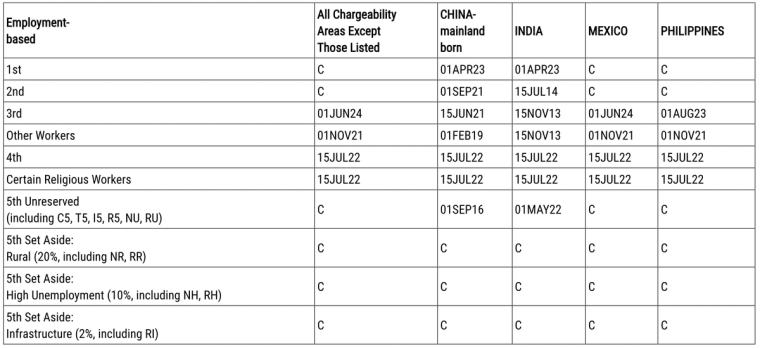
Employment-based visa categories explained
Employment-based green cards are split into five preference categories, EB-1 through EB-5. Each has different requirements and wait times.
EB-1: Priority workers
EB-1 is for people at the top of their field. It includes:
- EB-1A: Individuals with extraordinary ability in sciences, arts, education, business, or athletics
- EB-1B: Outstanding professors and researchers
- EB-1C: Multinational managers and executives
EB-1 cases don't require PERM labor certification, which speeds things up. For most countries, EB-1 is current or moves quickly. India and China are the exceptions, where backlogs have built up.
EB-2: Advanced degrees and exceptional ability
EB-2 includes:
- Workers with advanced degrees (master's or higher, or bachelor's plus 5 years experience)
- Workers with exceptional ability in their field
- National Interest Waiver (NIW) cases, which don't need employer sponsorship
Most EB-2 cases require PERM labor certification from an employer. NIW is the exception, letting individuals self-petition.
EB-2 has long backlogs for India and China. Worldwide applicants usually see faster movement.
EB-3: Skilled workers and professionals
EB-3 covers:
- Skilled workers with at least two years of training or experience
- Professionals with bachelor's degrees
- Other workers (unskilled labor requiring less than two years of experience)
All EB-3 cases require PERM labor certification. The "Other Workers" subcategory (sometimes called EB-3 Other or EW) has its own row in the bulletin and often moves more slowly.
EB-2 vs. EB-3: which category moves faster?
This is one of the most common questions, and the answer keeps changing.
For India specifically, there have been periods where EB-3 moved faster than EB-2. This led many applicants to consider "downgrading" from EB-2 to EB-3. The strategy involves filing a new PERM and I-140 in EB-3 while keeping the EB-2 case as a backup.
Whether this makes sense depends on:
- Your current priority date in EB-2
- How the two categories are moving relative to each other
- How long a new PERM/I-140 would take
- Your risk tolerance for having your priority date in a category that might reverse course
There's no universal answer. Watch the trends over several months before making a decision, and consider consulting an immigration attorney if you're thinking about this strategy.
EB-4 and EB-5: Special categories
EB-4 includes special immigrants like religious workers, certain broadcasters, Iraqi/Afghan translators, and Special Immigrant Juvenile Status (SIJS) beneficiaries. SIJS has faced significant backlogs in recent years.
EB-5 is for immigrant investors who invest $800,000 to $1,050,000 (depending on the area) in a U.S. business that creates jobs. EB-5 has reserved and unreserved subcategories. Reserved visas for rural areas, high unemployment areas, and infrastructure projects sometimes move faster.
Family-based visa categories and wait times
Family-based immigration has its own preference system. One thing to know upfront: immediate relatives of U.S. citizens don't use the Visa Bulletin at all.
Immediate relatives: no wait required
If you're the spouse, unmarried child under 21, or parent of a U.S. citizen, you're an "immediate relative." There's no annual limit for immediate relatives, which means no line to wait in. The Visa Bulletin doesn't apply to you.
You can file I-485 (if in the U.S.) or begin consular processing right away once your I-130 is approved.
Preference categories F1 through F4
Everyone else in the family system falls into preference categories:
F1: Unmarried adult children of U.S. citizens (21 and older)
F2A: Spouses and unmarried children (under 21) of lawful permanent residents
F2B: Unmarried adult children (21 and older) of lawful permanent residents
F3: Married adult children of U.S. citizens
F4: Siblings of adult U.S. citizens
Wait times vary a lot by category and country. F2A tends to move fastest. F4 sits at the other extreme: roughly 15 to 22+ years in most cases, and longer still for high-demand countries.
If your case runs through an I-130, our I-130 priority dates guide covers the family-specific strategy, including what happens to your date when categories change or the petitioner becomes a citizen.
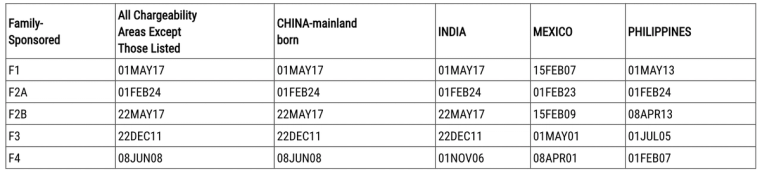
Family category wait times by country
The bulletin shows different dates for Mexico, Philippines, and sometimes other countries because demand from these countries exceeds annual limits. India and China, which dominate employment-based backlogs, don't have the same level of backlog in most family categories.
If you're in an F4 case from the Philippines, for example, expect priority dates from the early 2000s or even earlier. The wait is genuinely multi-decade.
Why India and China face longer waits
India and China have their own columns in the employment-based charts. The dates are often years behind the "All Chargeability Areas" column. Here's why.
The 7% per-country limit
By law, no single country can receive more than 7% of the family-sponsored and employment-based preference green cards available each year, counted together. The cap was meant to keep geographic diversity in immigration.
The problem is that demand from India and China far exceeds 7% of available visas. There are more qualified applicants from these countries than the annual cap allows.
So a backlog forms. Applicants from India and China wait years (sometimes decades) longer than applicants from other countries with the same priority date and category.
Current backlog estimates
The backlog for EB-2 India is measured in years, not months. Applicants with priority dates from 2012-2013 are only now becoming current in some months.
EB-3 India has similar delays. China faces backlogs too, though generally not as severe as India.
For worldwide applicants (anyone not from India, China, Mexico, or Philippines for the relevant category), most employment-based categories move much faster, often showing as "Current" or with recent dates.
If you want to understand the backlog situation better and what legislation might change it, check out our green card backlog analysis.
Cross-chargeability: using your spouse's country
Something many applicants don't know: your chargeability is based on your country of birth, not your current citizenship or residence.
But if you're married, you may be able to use your spouse's country of birth instead. This is called cross-chargeability.
Example: You were born in India, but your spouse was born in Canada. If cross-chargeability applies, you could be charged to Canada's quota, which has no backlog for most categories.
Cross-chargeability has specific rules:
- Both spouses must be immigrating together
- You can't use it if your spouse isn't applying for a green card
- It must be claimed at the appropriate time in the process
This isn't a loophole; it's written into the law. But many applicants don't know about it or don't realize it could apply to them.
How to read the Visa Bulletin step by step
Here's how to use the bulletin each month.
Step 1: Identify your preference category
Are you employment-based or family-based? Which subcategory?
For employment: EB-1, EB-2, EB-3, EB-4, or EB-5?
For family: Immediate relative (no bulletin needed), F1, F2A, F2B, F3, or F4?
If you're unsure, look at your I-140 or I-130 approval notice. It will state the category.
Step 2: Find your chargeability country
Your chargeability is your country of birth, not citizenship or current residence.
Look at the column headers in the bulletin. Most categories show:
- All Chargeability Areas (worldwide)
- China (mainland born)
- India
- Mexico
- Philippines
Some categories only show certain countries if there's no backlog for others.
Step 3: Compare your priority date to the chart
Find the intersection of your category row and your country column.
- If the chart shows a date, your priority date must be earlier than that date to be current
- If the chart shows "C" (Current), everyone in that category/country is current regardless of priority date
- If the chart shows "U" (Unavailable), no one in that category/country can proceed that month
Understanding "current" correctly
This trips people up all the time: if the chart shows April 1, 2013, and your priority date is April 1, 2013, you are not current. Your date must be earlier than the listed date.
If your priority date is March 31, 2013, you're current. April 1, 2013 or later? Not yet.
What happens when dates move backward (retrogression)
The bulletin doesn't always move forward. Sometimes dates move backward. This is called retrogression.
Why retrogression happens
Each fiscal year (October through September), there's a fixed number of green cards available. The Department of State tries to spread them evenly throughout the year.
If more people become current and file than expected, DOS might advance dates too quickly. When they realize the year's supply is running out, they pull dates back.
The end of the fiscal year (August and September bulletins) tends to be volatile. DOS might make large adjustments to use remaining visas or avoid overshooting the limit.
What retrogression means for pending cases
If you've already filed I-485 and your priority date retrogresses:
- USCIS cannot approve your I-485 until your date is current again
- Your case sits in a holding pattern
- But you can usually continue renewing your EAD and Advance Parole while waiting
- You don't lose your place in line
If you haven't filed yet and were planning to use Chart B:
- Retrogression might close your filing window
- You'll need to wait for dates to advance again
- This is frustrating but normal for oversubscribed categories
Preparing for retrogression
The best defense is filing as soon as you're eligible. Once your I-485 is pending:
- Keep your work authorization current through EAD renewals
- Maintain valid travel documents through Advance Parole
- Keep job evidence updated (pay stubs, employment verification letters)
- Stay in valid status or authorized employment
If you're in an H-1B/H-4 situation, avoiding H-4 EAD application mistakes becomes especially important during wait periods.
What to expect in 2026: Visa Bulletin trends
Predicting bulletin movement is not exact. The Department of State responds to filing patterns, and those shift based on economic conditions, policy changes, and individual decisions.
That said, some patterns are worth watching.
Historical movement by category
Looking at past years helps set expectations:
- EB-1 worldwide: Generally current or close to current, with occasional brief retrogression
- EB-1 India/China: Has developed multi-year backlogs in recent years
- EB-2 India: Moves very slowly, often just a few weeks per month. Multi-year waits are standard
- EB-2 worldwide: Usually current or with recent dates
- EB-3 India: Has sometimes moved faster than EB-2, prompting downgrade strategies
- Family categories: Move slowly but predictably for most countries. Mexico and Philippines face the longest waits
Fiscal year patterns
Each October starts a new fiscal year with fresh visa numbers. You might see:
- Dates advance in October-November as new numbers become available
- Steady movement through mid-year
- Volatility in August-September as DOS manages remaining numbers
What we're watching in 2026
Legislative proposals like the Dignity Act could change country caps if passed. Any immigration bill that addresses backlogs would affect bulletin movement.
Until something passes, expect incremental changes rather than dramatic shifts. Plan based on current movement patterns, not hoped-for reforms.
For the latest month-by-month numbers, our June 2026 visa bulletin analysis breaks down where each category moved and why.
When your priority date becomes current: next steps
This is what you've been waiting for. Your date is finally current. What now?
Adjustment of Status (inside the U.S.)
If you're in the United States, you'll file Form I-485 along with supporting documents. Most people also file:
- I-765 for Employment Authorization Document (EAD)
- I-131 for Advance Parole (travel document)
Filing both alongside the I-485 lets you work and travel while it's pending. USCIS may issue the two benefits on a single "combo card" or as separate documents, so check what your card actually authorizes before you travel. Our I-485 EAD and advance parole guide explains how to tell them apart.
Before filing, make sure you:
- Confirm which chart USCIS is accepting this month
- Complete your medical exam (Form I-693) from a USCIS-designated civil surgeon
- Gather all required documents (birth certificates, passport copies, photos, employment letters)
- Calculate your filing fees correctly
For help with USCIS fees and payment methods, see our guide on how to pay USCIS filing fees.
Consular processing (outside the U.S.)
If you're abroad, you'll work with the National Visa Center (NVC) to:
- Pay the immigrant visa fee
- Submit Form DS-260 (immigrant visa application)
- Upload civil documents
- Complete medical exam with a panel physician
Once NVC determines you're "documentarily qualified" and your Chart A date is current, they'll schedule your interview at a U.S. embassy or consulate.
Documents to prepare now
Don't wait until your date is current to start gathering documents. Get ahead by collecting:
- Birth certificates (with translations if not in English)
- Marriage certificate (if applicable)
- Divorce decrees for any prior marriages
- Passport biographical pages
- Employment verification letters (for employment-based cases)
- Tax returns and W-2s from recent years
- Evidence of lawful status maintenance
- Passport-style photos meeting USCIS specifications
For employment-based cases, you may also need letters from your employer confirming the job offer still exists at the approved salary and location.
Protecting children from aging out: CSPA basics
The Child Status Protection Act (CSPA) prevents children from "aging out" of eligibility while waiting in line with their parents.
How CSPA works
When a child turns 21, they normally lose derivative beneficiary status and would need their own petition. CSPA provides protection by "freezing" a child's age under certain conditions.
The CSPA age is calculated as:
Child's biological age on the date visa becomes available minus days the petition was pending
If the result is under 21, the child remains a derivative beneficiary.
The August 2025 policy change
USCIS changed how CSPA calculations work in August 2025.
Previously, there was a question about whether to use Final Action Dates or Dates for Filing for CSPA calculations. The policy change clarified that Final Action Dates (Chart A) are used for determining when a visa became "available" for CSPA purposes.
If your child is approaching 21 and you're planning around CSPA, this matters. Consult with an immigration attorney if you have concerns about your child's eligibility.
The "sought to acquire" requirement
CSPA protection also requires that the child "sought to acquire" lawful permanent resident status within one year of a visa becoming available. In practice, this means filing I-485 or taking action toward consular processing within that window.
Missing this deadline can cost CSPA protection even if the age calculation would otherwise qualify.
Monthly tracking checklist
Use this checklist each month when the new bulletin is released:
Step 1 (2 minutes): Go to the DOS Visa Bulletin page. Find your table (employment or family) and locate your category row and country column. Screenshot your row.
Step 2 (1 minute): Check the USCIS announcement for which chart Adjustment of Status applicants should use this month.
Step 3 (3 minutes): Compare the new cutoff date with your priority date. Calculate how far you are (in months or years). Note whether dates advanced, stayed the same, or retrogressed.
Step 4 (if within 6 months): If you're within about 6 months of being current, start preparing:
- Schedule your medical exam
- Gather civil documents
- Confirm employer support (for employment-based cases)
- Budget for filing fees
Step 5 (as needed): If you see significant movement or concerning patterns, verify with official sources before taking action. Don't make decisions based on forum speculation.
Putting it all together
The Visa Bulletin isn't complicated once you know the pieces. Your priority date is your place in line. The charts tell you when that place reaches the front. Two charts exist because the system lets some people file early while waiting for final approval.
Country backlogs happen because demand exceeds the 7% per-country cap. Retrogression happens when the government needs to slow things down to stay within annual limits.
Your job is to know your category, know your priority date, and check the bulletin monthly. When you're getting close, prepare your documents. When you're current, be ready to file immediately.
If you're feeling overwhelmed by the paperwork, you're not alone. Thousands of people go through these forms every month. What matters most is accuracy and timing.
For help preparing forms like I-539 for status changes or EAD applications, Immiva walks you through each question in plain English and catches common mistakes before you file. Every answer gets the same automated checks, on the form edition USCIS accepts today, for a flat fee instead of a lawyer's hourly bill.
Start by understanding your place in line. Then prepare so you're ready when your turn comes.