

If you're on an H-1B, L-1, O-1, or other work visa and your employer has sponsored you through PERM or an I-140, the I-485 is the step that turns your approved petition into a green card. Most guides on the internet cover marriage-based adjustment. This one is specifically for employment-based (EB-2 and EB-3) applicants, which means the rules about priority dates, concurrent filing, job portability, and EAD renewals all work differently for you.
What Form I-485 does for EB-2 and EB-3 applicants
Form I-485 is the Application to Register Permanent Residence or Adjust Status. It's the final filing in a three-step employment-based pipeline: PERM labor certification, I-140 immigrant petition, and I-485 adjustment of status. If you're physically in the United States and your priority date is current, I-485 is how you "adjust" from your nonimmigrant status (such as H-1B) to lawful permanent resident status without leaving the country.
The alternative is consular processing abroad. For people already working in the U.S., I-485 is almost always the better path because it preserves your current job, lets you apply for a work permit (EAD) and travel document (Advance Parole) at the same time, and avoids the visa interview abroad. For a broader comparison across forms, our guide to I-130 vs. I-485 explains where the I-485 sits in the family- and employment-based systems.
EB-2 vs. EB-3: which category applies to you
The category your employer files you under determines your timeline, the documents you'll need, and in many cases whether you can self-petition. EB-2 is for advanced-degree professionals, people with exceptional ability, and self-petitioners under the National Interest Waiver. EB-3 is broader and covers skilled workers with at least two years of experience, bachelor's-level professionals, and "other workers" performing unskilled labor.
The visual below summarizes the key operational differences. Annual visa allocations are identical on paper, but worldwide and per-country wait times diverge significantly, which is where most strategic decisions get made.
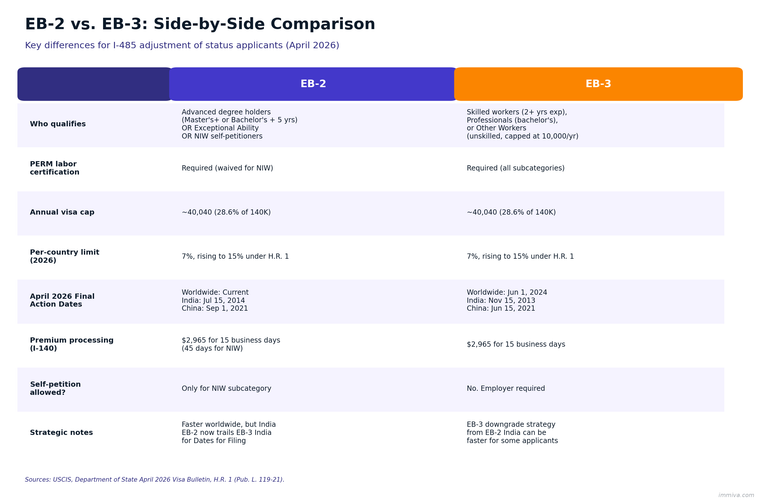
One point worth flagging: the EB-2 National Interest Waiver is the only subcategory that lets you self-petition without an employer or PERM. USCIS tightened NIW adjudication on January 15, 2025 under policy update PA-2025-03. The framework from Matter of Dhanasar still applies, but officers now scrutinize threshold EB-2 qualification first, and they expect independent corroboration of any proposed endeavor. STEM PhDs in emerging technologies tend to fare well; classroom teaching alone generally does not.
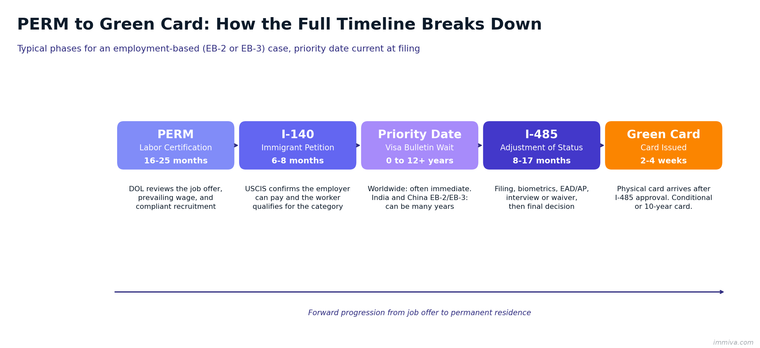
For most EB-2 and EB-3 applicants, though, the PERM-to-I-140-to-I-485 path is standard. Here's what the full timeline looks like end to end.
Eligibility requirements for filing I-485
You qualify to file I-485 under EB-2 or EB-3 when all of the following are true:
You have an approved or pending I-140 in the relevant category. You were inspected and admitted or paroled into the U.S. under INA § 245(a). Your priority date is current per the Visa Bulletin chart USCIS has designated for the filing month. You're physically present in the U.S. And you don't fall under any of the bars in INA § 245(c), or you qualify for the employment-based accommodation in INA § 245(k), which forgives up to 180 days of unauthorized employment or failure to maintain status.
The 245(k) provision is one of the most underappreciated parts of employment-based AOS. If you had a brief gap in H-1B status, or if you unknowingly worked past an I-94 expiration for a few weeks, 245(k) can save your case. It doesn't exist in family-based AOS.
Priority dates and how to read the Visa Bulletin
Your priority date is the day the Department of Labor accepted your PERM application, or, if you skipped PERM with an EB-2 NIW, the day USCIS received your I-140. You can find it on your I-140 approval notice (I-797). If you have multiple approved I-140s, you're entitled to the earliest priority date under 8 CFR § 204.5(e)(1).
Each month the Visa Bulletin has two charts for every category. Final Action Dates says when USCIS can approve an I-485. Dates for Filing says when you can submit one. USCIS posts which chart it is using each month on this page. For September 2026, USCIS requires the Final Action Dates chart for every employment-based category, so fewer people can file than in a month when Dates for Filing applies.
Worldwide, Mexico, and Philippines EB-2 are all current. India EB-2 is Unavailable, and has been for three straight months. Unavailable is harsher than retrogression: no numbers can be issued at all, so an India EB-2 applicant cannot file this month. China EB-2 is at September 1, 2021. For EB-3, India is at January 1, 2014, China at January 1, 2022, and worldwide EB-3 at September 1, 2024. On the Dates for Filing chart, India EB-2 and EB-3 both show January 15, 2015, which is where the “EB-3 downgrade” talk comes from, but USCIS is not using that chart for employment-based cases this month. Our latest Visa Bulletin analysis tracks the monthly movement, and this explainer covers how to read the two charts if you're new to them.
One thing worth knowing: a lot of the recent forward movement on backlogged categories is being driven by reduced consular demand, not by more visas being issued. The State Department paused immigrant visa processing for 75 countries in January 2026, and that demand reduction ripples through the bulletin. The State Department has warned that dates could retrogress later in FY2026 if that demand comes back.
How to file: step-by-step
Step 1: Confirm your priority date is current. Check the Visa Bulletin against the USCIS chart-selection page for the month you plan to file.
Step 2: Gather your documents. You'll typically need your I-140 approval notice (I-797), passport biographical page, I-94 record from CBP, two passport-style photos, birth certificate with certified English translation, Form I-693 medical examination completed by a USCIS-designated civil surgeon when required, employment verification evidence, and a certified ETA-9089 labor certification if applicable. Form I-485 Supplement J is generally required for employment-based cases that require a job offer when the I-485 is filed based on a previously filed Form I-140, but if you are filing Form I-485 together with the Form I-140 that names you as the beneficiary, you do not need to file Supplement J. NIW-based applicants generally do not need Supplement J.
Step 3: Complete the current I-485 edition. Use Form I-485 edition 01/20/25 if your packet is postmarked before September 18, 2026, and the 09/18/26 edition from that date. Always confirm the edition shown on the official Form I-485 page before filing. Immiva's I-485 preparation always uses the current edition and validates every field against your I-140.
Step 4: File I-765 and I-131 concurrently. The I-765 is your work permit (EAD). The I-131 is your travel document (Advance Parole). Both are $260 and $630 respectively for I-485s filed on or after April 1, 2024. Filing them with the I-485 lets you work and travel during the wait.
Step 5: Pay each filing fee separately. For paper filings, USCIS no longer accepts personal checks, cashier's checks, or money orders. Since October 28, 2025 you pay by debit or credit card on Form G-1450, or by ACH bank transfer on Form G-1650, unless you qualify for an exemption and file Form G-1651. For applications filed on or after April 1, 2024, the standard totals are $1,440 for Form I-485, $260 for a pending-I-485 Form I-765, and $630 for advance parole on Form I-131, which comes to about $2,330 for a principal applicant when all three are filed and each fee is paid on its own form.
Step 6: Attend biometrics. USCIS typically schedules biometrics three to five weeks after filing. Our biometrics appointment guide walks through what to expect and what to bring.
Step 7: Interview, or interview waiver. USCIS may waive interviews in some employment-based I-485 cases, but interview waiver decisions remain discretionary and case-specific. If you're interviewed, the officer may verify your identity, admissibility, and the basis for adjustment. Because interview-waiver rates and processing times change frequently by case type and office, applicants should check current USCIS guidance and processing tools rather than rely on fixed percentages or timelines.
Step 8: Decision. Approval comes as an I-485 approval notice, followed by the physical green card in the mail. Denials can trigger a Notice to Appear in removal proceedings under USCIS's February 2025 NTA policy, so the stakes on a denial are genuinely higher now than they were three years ago.
Costs and processing times in 2026
Total filing costs for an employment-based principal land near $2,330. Add $260 and $630 for each derivative spouse or child. The I-140 itself costs $715, and premium processing for I-140 is $2,965 for a 15-business-day decision (45 days for NIW and EB-1C). No premium processing exists for I-485.
Processing times vary significantly by service center. Nebraska, which handles much of the EB caseload, is currently averaging about 9.8 months. Texas is running closer to 13.5 months. The National Benefits Center and high-volume field offices trend longer. USCIS publishes official processing times that let you filter by form, category, and office. Pending inventory is around 720,000 cases, down about 18% from the 2023 peak, but overall USCIS backlogs across all forms crossed 11.3 million in 2025.
What changed in 2025-2026 that every EB applicant should know
The last twelve months reshaped the I-485 picture in ways most older guides don't reflect. Seven changes matter most.
Automatic EAD extensions ended on October 30, 2025. An interim final rule eliminated the automatic extension for renewal applications filed on or after that date, reversing the December 2024 rule that had made the 540-day extension permanent. Extensions granted on earlier filings stay valid, but new renewals get no grace period.
For applicants with a pending Form I-485, EADs issued on or after December 5, 2025 are valid for a maximum of 18 months under policy alert PA-2025-27, down from the five-year cards issued earlier. Premium processing is not available for pending-I-485 Form I-765 filings; USCIS limits I-765 premium processing to certain categories, such as certain F-1 OPT and STEM OPT filings. File renewals as early as the rules allow.
CSPA age calculation reverted on August 15, 2025. Under PA-2025-15, USCIS now uses only the Final Action Dates chart for Child Status Protection Act calculations. That's devastating for EB-2 India families with children approaching 21, because Final Action Dates lag Dates for Filing by a year or more. I-485s filed before August 15, 2025 are grandfathered under the old calculation.
USCIS has not imposed a blanket hold on I-485, I-765, and I-131 adjudications by nationality. Presidential Proclamations 10949 and 10998 restrict entry and visa issuance, and DOS paused immigrant visa issuance for 75 countries on January 21, 2026, but none of those measures stops USCIS from adjudicating an adjustment application filed from inside the U.S.
The per-country limit for preference immigrants remains 7%. Proposals to raise the employment-based cap or add a premium fee for long-waiting applicants have circulated in Congress, but none has become law as of mid-2026.
Not every I-485 fee now adjusts annually. Public Law 119-21 requires yearly inflation adjustments for the new fees that law created, but the standard I-485 filing fee does not automatically increase every January.
The Form I-485 edition changes on September 18, 2026. Check the edition date printed in the bottom-left corner of every page, and download the form fresh from the USCIS website right before you file. USCIS takes the 01/20/25 edition before September 18, 2026 and only the 09/18/26 edition from that date.
Working, traveling, and changing jobs while I-485 is pending
Once your I-485 is filed, a few protections kick in that are specific to employment-based applicants.
Working: Your I-765 EAD will arrive in 2 to 5 months. If you stay on H-1B, you can keep working for your sponsoring employer without using the EAD at all. Many attorneys recommend keeping H-1B active as a backup. Using the EAD terminates H-1B status, so this is a one-way door worth thinking carefully about. Your spouse, as a derivative applicant, can also file for an EAD once the I-485 is filed.
Traveling: You need Advance Parole (I-131) before leaving the U.S. Departing without it abandons your I-485. The exception: H-1B and L-1 holders can generally travel on the underlying nonimmigrant visa as long as it's still valid and they maintain status.
Changing jobs: INA § 204(j) AC21 portability lets you change to a same-or-similar job after the I-485 has been pending at least 180 days. You'll file I-485 Supplement J with the new employer's information. If your employer withdraws the I-140 after it has been approved for 180 days (or after your I-485 has been pending 180 days), the I-140 remains valid for portability purposes. NIW petitioners can change jobs freely because there's no underlying job offer requirement.