
If you're a U.S. citizen or permanent resident sponsoring a family member for a green card, you'll deal with two forms: the I-130 and the I-485. They're not the same thing, they serve different purposes, and they're filed by different people. But in some cases, you can file them together and cut your timeline by months. This guide covers the difference between the I-130 and I-485, who qualifies for concurrent filing, and the costs and timelines for 2026. If you're not sure how the Visa Bulletin works, we have a full guide on that too.
What Is Form I-130?
Form I-130, Petition for Alien Relative, is the first step in nearly every family-based green card case. The U.S. citizen or lawful permanent resident (the petitioner) files it to prove a qualifying family relationship with the person they want to sponsor (the beneficiary) (USCIS I-130 Page).
The I-130 does not give anyone a green card or any immigration status. USCIS is clear about this: approving the petition only confirms the family relationship exists. The beneficiary still needs a second step to actually get the green card.
Who can file an I-130? U.S. citizens can petition for spouses, unmarried children under 21, unmarried adult sons and daughters, married sons and daughters, parents (if the petitioner is 21 or older), and siblings (if the petitioner is 21 or older). Lawful permanent residents are more limited. LPRs can only petition for spouses and unmarried children (INA Section 203).
The I-130 filing fee is $625 when filed online or $675 when filed by mail (USCIS Fee Schedule). You can file online through your myUSCIS account. If the beneficiary will file Form I-485 by mail, USCIS says you may still file Form I-130 online first and include the I-130 receipt notice with the paper I-485 package. USCIS stopped accepting paper checks, money orders, and cashier's checks for most paper-filed forms on Oct. 28, 2025, unless an exemption applies.
What Is Form I-485?
Form I-485, Application to Register Permanent Residence or Adjust Status, is the form that actually gets you the green card. Unlike the I-130, the beneficiary (the immigrant) files the I-485, not the sponsor (USCIS I-485 Page).
To file an I-485, the beneficiary must be physically present in the United States, have been inspected and admitted or paroled, and have an immigrant visa number immediately available (INA Section 245(a)). That last requirement is where the Visa Bulletin comes in, which we'll cover below.
The I-485 filing fee is $1,440 for applicants aged 14 and older (biometrics fee included). Children under 14 filing with a parent pay $950 (USCIS Fee Schedule). The I-485 can only be filed on paper. There's no online option as of March 2026.
When USCIS approves the I-485, the applicant becomes a lawful permanent resident and receives a green card. They get an alien registration number (A-Number) that stays with them permanently.
I-130 vs I-485 at a Glance
| Form I-130 | Form I-485 | |
|---|---|---|
| Full name | Petition for Alien Relative | Application to Register Permanent Residence |
| Purpose | Proves a qualifying family relationship | Applies for the actual green card |
| Who files | The petitioner (U.S. citizen or LPR) | The beneficiary (the immigrant) |
| Where beneficiary must be | Anywhere (no location requirement) | Must be physically in the United States |
| Filing fee | $625 online / $675 paper | $1,440 (age 14+) / $950 (under 14 with parent) |
| Filing method | Online or paper | Paper only |
| Visa number required? | No | Yes, must be immediately available |
| Result when approved | Confirms family relationship only | Green card (permanent residence) |
| Biometrics included? | Yes (absorbed into fee) | Yes (absorbed into fee) |
| Interview | Generally not required | Usually required at a USCIS field office |
In short: the I-130 is step one (proving the relationship), and the I-485 is step two (getting the green card while in the U.S.). Not everyone goes through the I-485. Beneficiaries outside the U.S. go through consular processing instead, using Form DS-260 at a U.S. embassy abroad.
What Is Concurrent Filing?
Concurrent filing means filing the I-485 before the underlying immigrant petition is approved. In family-based cases, that usually means filing the I-130 and I-485 together, but it does not always have to be the same paper package because USCIS also allows Form I-130 to be filed online and the I-485 to be mailed with the I-130 receipt notice.
Why does this matter? Filing separately usually takes longer because the beneficiary cannot file Form I-485 until the I-130 has been approved or a visa number is otherwise available. Concurrent filing lets USCIS work on both cases during the same overall period, which can shorten the total timeline. Processing times vary by form category, field office, and service center, so check the current USCIS Processing Times tool before relying on any estimate.
There's a cost trade-off. If you mail the I-130 together with the I-485 in one package, the I-130 paper filing fee is $675 rather than the $625 online rate. But USCIS also allows you to file Form I-130 online first and then mail the I-485 with the I-130 receipt notice. If the I-130 is ultimately denied, the related I-485 will generally also be denied, and filing fees are not refunded.
Who Qualifies to File I-130 and I-485 Together?
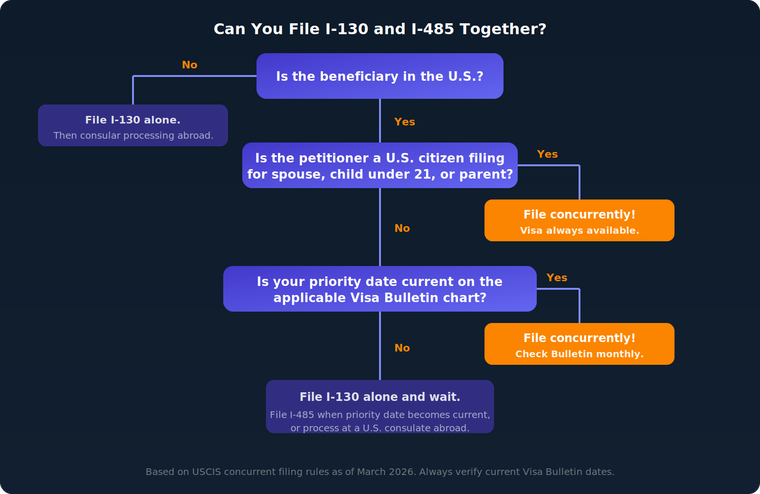
Not everyone can file concurrently. The requirement is that an immigrant visa number must be immediately available at the time you file the I-485 (8 CFR Part 245).
Always eligible for concurrent filing:
- Spouses of U.S. citizens (immediate relatives, no visa backlog)
- Unmarried children under 21 of U.S. citizens (immediate relatives)
- Parents of U.S. citizens aged 21+ (immediate relatives)
These categories are "immediate relatives" under immigration law (INA Section 201). There's no annual cap on immigrant visas for immediate relatives, so a visa number is always available. If you fall into one of these groups and the beneficiary is in the U.S., you should almost always file concurrently.
Sometimes eligible (depends on the Visa Bulletin):
- Spouses of LPRs (F2A category)
- Unmarried children under 21 of LPRs (F2A category)
- Unmarried adult sons and daughters of U.S. citizens (F1 category)
These preference categories have annual visa limits and backlogs. You can only file the I-485 concurrently when the priority date is earlier than the cut-off date shown in the applicable Visa Bulletin chart. Check the March 2026 Visa Bulletin analysis for current dates.
Rarely or never eligible:
- Unmarried adult sons and daughters of LPRs (F2B, roughly 10-year backlog)
- Married sons and daughters of U.S. citizens (F3, roughly 14-year backlog)
- Siblings of U.S. citizens (F4, roughly 18-year backlog)
For these categories, you file the I-130 alone and wait years for a visa number to become available. The green card backlog for these preference categories is severe.
Visa Bulletin: Dates for Filing vs. Final Action Dates
Immediate relatives never need to check the Visa Bulletin: a visa number is always available, and concurrent filing is open by default. For preference categories (F1, F2A, F2B, F3, F4), the Visa Bulletin decides when you can even submit the I-485.
The bulletin has two charts. Final Action Dates is the chart USCIS uses to actually approve an I-485, so your priority date must be earlier than the date shown there. Dates for Filing is usually more recent, meaning it lets you submit the I-485 sooner. USCIS picks one chart each month for AOS filings, and the choice can change month to month.
Filing on the wrong chart is one of the most common ways to get an I-485 denied. Check uscis.gov/visabulletininfo every month before you file, and confirm which chart USCIS authorized for your category.
Our I-130 priority dates and the visa bulletin guide walks through Chart A vs Chart B in plain language, covers the five family preference categories, and explains the August 2025 CSPA policy reversal that affects when children age out.
Filing Fees for I-130 and I-485 in 2026
The total cost depends on whether you file together or separately. All fees below are current as of the April 1, 2024 fee schedule (USCIS G-1055):
| Scenario | Forms | Total Government Fees |
|---|---|---|
| I-130 alone (online) | I-130 | $625 |
| I-130 alone (paper) | I-130 | $675 |
| I-130 + I-485 concurrent (no extras) | I-130 + I-485 | $2,115 |
| I-130 + I-485 + EAD | I-130 + I-485 + I-765 | $2,375 |
| Full concurrent package | I-130 + I-485 + I-765 + I-131 | $3,005 |
| I-130 first, then I-485 later | Sequential | $2,955 to $3,005 total |
Since April 2024, the I-765 (EAD) and I-131 (Advance Parole) are no longer free with the I-485. USCIS unbundled them in the 2024 fee rule (8 CFR Part 106). The full concurrent package went from about $1,760 to $3,005, a 71% increase. If you filed your I-485 between July 30, 2007 and April 1, 2024, you're grandfathered in and don't pay extra for I-765 or I-131 renewals while the I-485 is pending.
For payment, USCIS accepts credit cards, debit cards, and ACH bank transfers only. Learn more in our USCIS payment guide. At Immiva's pricing, preparing your forms costs a fraction of attorney fees.
Concurrent Filing vs. Filing Separately: Which Path to Choose
File concurrently (I-130 + I-485 at the same time) when:
- You're a U.S. citizen sponsoring a spouse, child under 21, or parent, and the beneficiary is in the United States
- You're an LPR and the F2A priority date is current on the Visa Bulletin
- The beneficiary needs work authorization while the I-485 is pending (most EADs filed with the I-485 arrive within about 2 to 5 months)
- You want the fastest possible timeline (8 to 14 months total vs. 20+ months sequentially)
File the I-130 alone when:
- The beneficiary is outside the United States (they'll go through consular processing after I-130 approval)
- The visa preference category has a long backlog (F1, F2B, F3, F4)
- You're an LPR and the F2A date is not current
- You want to keep upfront costs lower ($625 now vs. $3,005 all at once)
- There's any doubt about the qualifying relationship, and you want I-130 approval before investing in I-485 fees
Something else to factor in: the State Department paused immigrant visa issuance for nationals of 75 countries effective January 21, 2026, and that pause covers immigrant visas only. USCIS memo PM-602-0194 (January 1, 2026) separately placed pending benefit applications, including the I-485, on hold for nationals of the roughly 39 countries covered by Proclamation 10998, until a federal court struck those holds down on June 5, 2026. USCIS is expected to resume decisions while a likely appeal plays out; our USCIS travel ban ruling guide explains what that means in practice. If the beneficiary is from a country on either list, check the current rules before assuming one path dodges the delay.
The USCIS backlog matters here too. With over 11 million pending cases, processing times fluctuate. Filing concurrently gets your I-485 into the queue sooner.
What happens after I-130 is approved (when filed alone)
When the I-130 was filed by itself (no concurrent I-485), what comes next splits by where the beneficiary lives.
Inside the U.S., the beneficiary can file Form I-485 once a visa number is current. Immediate relatives can file right after I-130 approval; preference categories wait for the chart USCIS designates that month.
Outside the U.S., USCIS forwards the approved I-130 to the National Visa Center, which collects fees, DS-260, civil documents, and the I-864 Affidavit of Support before scheduling a consular interview. Total time from I-130 approval to entry is typically 4 to 9 months for immediate relatives, longer for preference categories that still have a visa-bulletin wait.
Our what happens after I-130 is approved guide covers both paths in detail, and the I-130 consular processing timeline breaks down the embassy path stage by stage.
Working and Traveling While the I-485 Is Pending
Can you work? Not automatically. You need an approved Employment Authorization Document (Form I-765). When filed with the I-485, most I-765 approvals arrive within about 2 to 5 months (USCIS Processing Times). You can check your EAD application status online through your USCIS account.
Can you travel? Usually only after USCIS approves your request for Advance Parole. You request Advance Parole by filing Form I-131. If you leave the United States while your I-485 is pending without the required travel authorization, USCIS may treat the I-485 as abandoned. Processing times for Form I-131 vary and should be checked in the USCIS Processing Times tool.
The rules around EADs and travel documents changed several times in 2025. USCIS often issues the EAD and Advance Parole as separate documents now, so plan for two documents arriving on separate timelines. Automatic renewal extensions also ended, and new EADs are capped at 18 months. Our guide to working and traveling while your I-485 is pending covers the current rules.