
If you hold a conditional green card based on marriage, Form I-751 is the petition you file to remove those conditions and get your full, 10-year green card. But there isn't just one way to file. Your path depends on your relationship status, your spouse's willingness to cooperate, and sometimes circumstances outside your control.
Pick the wrong path and your case could get delayed or denied. Pick the right one and you'll have a much smoother process. This guide puts all the options next to each other so you can make the right call.
The two paths to removing conditions
Path 1: Joint filing. You and your spouse file Form I-751 together, both signing the form. This is the default path.
Path 2: Individual filing (waiver or individual filing request). You file alone, without your spouse's signature. Common bases include a waiver based on divorce/annulment, battery or extreme cruelty, or extreme hardship. If your spouse died after you became a conditional permanent resident, you may file individually based on the death of the petitioning spouse (USCIS treats this as an individual filing request rather than a waiver).
Joint filing is simpler, faster, and more likely to succeed. But it requires your spouse's cooperation. If your marriage has ended, your spouse refuses to sign, or you're in a dangerous situation, waivers exist to protect you.
Side-by-side comparison table
This is the comparison no other guide gives you.
| Joint Filing | Divorce Waiver | Abuse/Battery Waiver | Extreme Hardship Waiver | Death of Spouse | |
|---|---|---|---|---|---|
| Filing window | 90-day window before 2nd anniversary | Any time | Any time | Any time | Any time |
| Filing fee | $750 paper / $700 online | $750 paper / $700 online | $0 (free) | $750 paper / $700 online | $750 paper / $700 online |
| Spouse signature needed? | Yes | No | No | No | No |
| Must prove bona fide marriage? | Yes | Yes | Yes | No | Yes |
| Interview likelihood | Low to moderate | High | High | High | Moderate |
| Processing time (est.) | ~26 months avg (varies) | ~26 months avg (varies) | ~26 months avg (varies) | ~26 months avg (varies) | ~26 months avg (varies) |
| Discretionary? | No (must approve) | Yes | Yes | Yes | No (must approve) |
| Citizenship timeline | 3-year path (if married to USC) | 5-year path | 3-year path (VAWA) | 5-year path | 5-year path |
A few things stand out. If you file an I-751 waiver solely based on extreme hardship, you don't have to submit evidence that the marriage was entered into in good faith. Battery or extreme cruelty waivers are fully fee-exempt under 8 CFR § 106.2(a)(43). No filing fee, no biometrics fee. If you meet the requirements for your filing basis (joint or individual), USCIS may approve the petition. Your choice can also affect when you can apply for citizenship. Some spouses of U.S. citizens qualify for the 3-year rule if they meet all that category's requirements, while many people apply under the general 5-year rule. Survivors who removed conditions through an approved battery or extreme cruelty I-751 waiver may also qualify to naturalize under special spouse provisions.
How to determine your filing path
Walk through these questions in order.
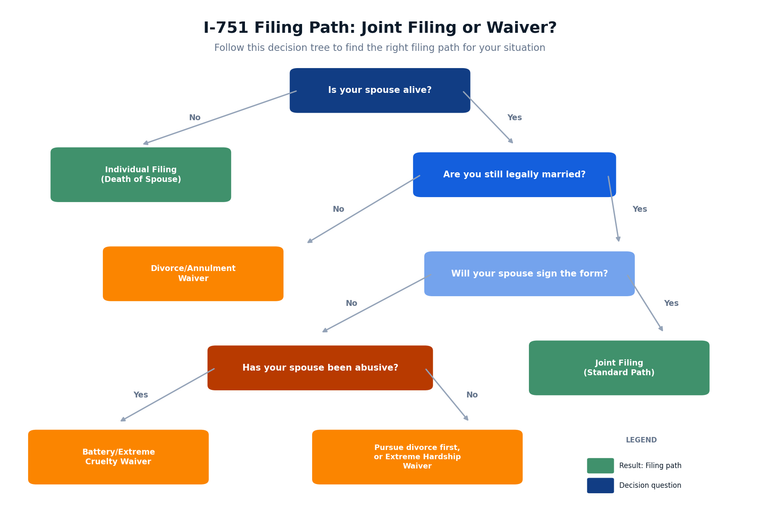
Is your spouse alive? If not, you qualify for the individual filing based on death of spouse.
Are you still legally married? If your divorce is finalized, the divorce/annulment waiver is your path. If divorce is pending, USCIS generally issues a request for evidence (RFE) asking for the final divorce decree; if the divorce is finalized during the RFE response period, you can submit the decree then.
Is your spouse willing to sign? If yes, joint filing is almost certainly your best option, even if you're living apart. USCIS cannot deny a joint petition solely because spouses are separated.
Has your spouse been abusive? If you or your child experienced battery or extreme cruelty, the battery or extreme cruelty waiver offers strong protections. You don't need to be divorced, and confidentiality protections apply. There is no filing fee and no biometrics fee for this waiver under 8 CFR § 106.2(a)(43).
None of the above? If your spouse won't cooperate and you're not divorced, you may need to pursue divorce first, or explore the extreme hardship waiver if deportation would cause unusually severe consequences.
Joint filing: the key details
Joint filing requires both signatures and must be filed during the 90-day window before your second anniversary of conditional residence. Miss this window and you'll face complications. See our guide on I-751 late filing if that's your situation.
You'll need evidence proving your marriage was genuine: joint tax returns, shared bank accounts, a joint lease or mortgage, birth certificates of children, and third-party affidavits. Our I-751 document checklist breaks down exactly what to gather, organized by strength.
If your divorce finalizes while a joint petition is pending, notify USCIS and request conversion to a divorce waiver. No additional filing fee is required.
Waiver filing: quick overview of each ground
Each waiver type has its own dedicated guide with detailed requirements and evidence strategies. Here's the quick version to help you identify which applies.
Divorce/annulment waiver requires a final decree (separation alone doesn't qualify). You can file while divorce is pending. Full guide.
Abuse/battery waiver: no divorce required, and no filing fee or biometrics fee (fully fee-exempt under 8 CFR § 106.2(a)(43)). Confidentiality protections also apply. Evidence may include police reports, medical records, and protective orders. Full guide.
Extreme hardship waiver: if you file solely based on extreme hardship, you are not required to submit evidence that the marriage was entered into in good faith. You must show that your removal from the United States would result in extreme hardship.
Death of spouse: an individual filing request (not a waiver) that excuses the general joint-filing requirement if the petitioning spouse dies after you became a conditional permanent resident. Full guide.
Six real scenarios
Scenario 1: Happily married, spouse cooperative. → Joint filing. File during the 90-day window with strong evidence.
Scenario 2: Separated, not divorced, spouse will sign. → Joint filing. Separation doesn't bar joint filing. Expect more scrutiny.
Scenario 3: Spouse refuses to cooperate. → Pursue divorce, then file divorce waiver. Or explore abuse/hardship grounds if they apply.
Scenario 4: Divorce finalized. → Divorce waiver. You can file a waiver-based I-751 at any time after becoming a conditional resident, even after your card expires, up until you're removed.
Scenario 5: Abusive spouse. → Battery or extreme cruelty waiver. Works whether you're married, separated, or divorced. There is no filing fee.
Scenario 6: Divorce pending, deadline approaching. → File divorce waiver now with pending evidence. USCIS may issue an RFE asking for the final divorce decree; if the RFE comes by mail, you have up to 87 days from the date USCIS mails it to get your response in.
What about fees, processing times, and status?
The standard Form I-751 filing fee is $750 by paper or $700 online. Battery or extreme cruelty waivers are fully fee-exempt under 8 CFR § 106.2(a)(43). Processing currently averages about 26 months as of early 2026 and varies by USCIS office and workload. For the latest estimate, see our I-751 processing time guide.
When USCIS receives your petition, your receipt notice (Form I-797) extends the validity of your Green Card for 48 months beyond the card's expiration date for a properly filed Form I-751. You can present the receipt notice with your expired Green Card as evidence of continued status, including for work authorization and travel, while your I-751 remains pending. And yes, if you are otherwise eligible, you may file Form N-400 while your I-751 is still pending. USCIS generally adjudicates the I-751 before or at the same time as the N-400 and typically must approve the I-751 before naturalizing you.
The bottom line
Your filing path isn't really a choice. Your circumstances determine it. If your spouse is alive and willing to sign, file jointly. If not, identify the right waiver ground, gather strong evidence, and file.
The end of your marriage does not mean the end of your green card. If you need help preparing your I-751, Immiva's guided platform walks you through every question in plain English and catches common mistakes automatically.