
As of March 1, 2026, premium processing on Form I-907 runs $1,780 for OPT applicants. Here's how to figure out if it's worth paying, or whether you can skip it and pocket the money.
For most F-1 students who file on time, I-765 premium processing for OPT isn't worth $1,780. But for a smaller group with rigid job start dates, urgent travel, or a stuck case, it can recover weeks of lost income and pay for itself several times over. The question is which group you're in. This guide covers the current fee, the 30-business-day clock, what premium really gets you, and a way to decide based on your situation.
If you need the broader process first, the complete OPT application guide covers eligibility, timing, and the I-765 itself end-to-end. This post zooms in on one specific decision: whether to add Form I-907.
What I-907 premium processing actually buys you
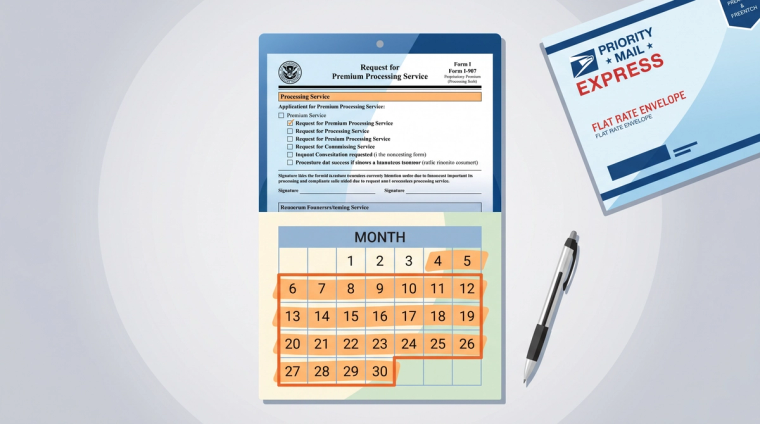
Premium processing is a paid statutory service that puts your I-765 on a guaranteed adjudication clock. When USCIS receives a properly filed Form I-907, it must take some adjudicative action (approval, denial, Request for Evidence, Notice of Intent to Deny, or opening a fraud investigation) within 30 business days (8 CFR § 106.4(e)). That's roughly six calendar weeks. If USCIS misses the window, the $1,780 is mandatorily refunded under 8 CFR § 106.4(f), and your case continues under premium handling anyway.
Two important things premium processing does not do:
It doesn't change the 30-business-day premium-processing clock, which covers adjudicative action rather than getting the card into your hand. After approval, USCIS says your EAD card should be printed within about 2 weeks, and they advise waiting up to 30 days from approval before inquiring if the card hasn't arrived.
It won't improve your chances of approval either. Premium speeds up the decision, not the merits. If your case has weak spots, you'll just get the RFE faster.
Who's eligible for I-765 premium processing, and who isn't
Premium processing is available for exactly three I-765 categories (USCIS premium processing page):
- (c)(3)(A): pre-completion OPT
- (c)(3)(B): post-completion OPT
- (c)(3)(C): 24-month STEM OPT extension
Every other I-765 category is excluded. That includes H-4 EAD ((c)(26)), L-2 EAD, asylum-based EAD ((c)(8)), AOS-based EAD ((c)(9)), TPS, and parolee-based EAD. If you're filing for a non-OPT category, premium processing simply isn't on the menu, though for some categories there are workarounds. Our H-4 EAD expedite and premium processing options guide covers the H-4 EAD route, and the J-2 EAD expedite request post explains the discretionary path for J-2 dependents.
You may file Form I-907 together with Form I-765, or later to upgrade a pending I-765 after USCIS has receipted it. For OPT and STEM OPT cases, USCIS permits Form I-907 to be filed online through myUSCIS or by paper mail, including in some pending paper-filed cases if the case is linked to a USCIS online account. Do not assume the I-907 filing method must always match the original I-765 filing method.
Premium processing vs. expedite request: they aren't the same thing
Premium processing (Form I-907) and an expedite request aren't the same thing. USCIS generally won't consider expedite requests for cases where premium processing is available, unless the petitioner is an IRS-designated nonprofit filing for a beneficiary whose services advance the cultural or social interests of the United States.
| Form I-907 Premium | USCIS Expedite Request | |
|---|---|---|
| Cost | $1,780 | Free |
| Availability | Any eligible OPT applicant | Must meet specific USCIS criteria |
| Decision guarantee | 30 business days | None |
| Criteria | None beyond eligibility | Severe financial loss, humanitarian, USCIS error, U.S. government interest, compelling need |
| How requested | Form I-907 filing | Online account inquiry or USCIS Contact Center |
| Refund if missed | Yes | N/A |
If premium processing is available for your OPT category, USCIS generally will not consider an expedite request on that case. Premium processing is the formal paid faster-processing option for eligible OPT and STEM OPT I-765 filings.
The fee in context: $1,780 effective March 1, 2026
The current $1,780 figure took effect on March 1, 2026, under the DHS Final Rule "Adjustment to Premium Processing Fees" (91 FR 1059, published January 12, 2026). It's the second biennial adjustment authorized by INA § 286(u)(3)(C), which lets DHS raise premium processing fees in line with the CPI-U without going through normal notice-and-comment rulemaking.
The fee history:
- $1,500: set March 30, 2022 by the USCIS Stabilization Rule
- $1,685: first CPI-U adjustment, effective February 26, 2024
- $1,780: current fee, effective March 1, 2026
The trigger is your postmark date, not the USCIS receipt date. Anything postmarked on or after March 1, 2026 must include $1,780 or it gets rejected. There is no nonprofit or small-employer discount for I-907. Those discounts apply only to certain I-129 and I-140 filing fees.
Add the underlying I-765 filing fee ($470 online, $520 on paper, per the USCIS fee schedule) and the all-in cost of OPT with premium processing comes to roughly $2,250 to $2,300. For payment options including credit card and ACH, see our guide to paying USCIS filing fees.
The decision framework
Here's a scenario table to help you decide if the $1,780 makes sense for your case:
| Your situation | Premium worth it? |
|---|---|
| Post-completion OPT, filed 60-90 days early, flexible start date | No. Standard processing will get you there |
| Post-completion OPT, filed late, job starts in under 6 weeks | Yes |
| STEM OPT extension, timely filed before current EAD expires | No. The 180-day auto-extension covers you |
| STEM OPT, filed late or current EAD already expired | Case-by-case, usually yes |
| Urgent international travel before job start, need physical EAD in hand | Usually yes |
| H-1B cap-gap case at risk | Often yes |
| Employer will reimburse the fee | Yes |
| Application stalled 4+ months with no RFE | Consider it, but call USCIS to inquire first |
The math is usually obvious once you do it. If your job pays $1,500 a week and premium gets your EAD six weeks faster, the net benefit is $9,000 minus $1,780, or $7,220. Even one week of recovered wages at typical post-graduate pay covers more than half the fee. The case for skipping premium is strongest when you have time to spare and weakest when you don't.
For STEM OPT applicants specifically: a timely filed STEM OPT extension still carries its own 180-day automatic extension of work authorization under 8 CFR 274a.12(b)(6)(iv). That STEM extension is separate from the up-to-540-day automatic extension that used to apply to certain EAD renewals. DHS removed that renewal auto-extension for applications filed on or after October 30, 2025 (90 FR 48799), and it never applied to OPT or STEM OPT in the first place. Your STEM 180-day extension is unaffected.
The RFE trap and other reasons the clock might not save you
A few recent USCIS policy shifts can chip away at the value of premium processing in ways that aren't obvious up front. Worth knowing before you put down $1,780:
RFE clock reset. When USCIS issues an RFE during premium processing, the 30-business-day clock stops completely. When you respond, a fresh 30-business-day clock starts. It does not "resume with remaining days," contrary to what some popular blogs claim.
Biometrics. USCIS may schedule a biometric services appointment when required, though it is not required for every I-765 applicant.
USCIS premium-processing guidance does state that opening a fraud or misrepresentation investigation counts as timely adjudicative action.
No refund on denial. If USCIS denies your case within the 30-day window, you don't get the $1,780 back. The refund applies only when USCIS misses the window without taking any action.
For broader context on how the USCIS backlog is shaping wait times generally, our USCIS backlog analysis gives the macro picture.
How to file Form I-907
Three things to get right:
- Use an accepted filing method for your case type. USCIS allows Form I-907 for OPT/STEM OPT to be filed online through myUSCIS or by mail, and some pending paper-filed OPT/STEM OPT cases may be upgraded online after the case is linked to a USCIS online account.
- File concurrently or after receipt. Include I-907 in your initial I-765 package, or upgrade later. You cannot file I-907 standalone before your I-765 is in the system.
- Track the clock. USCIS issues a separate I-907 receipt notice. Use that receipt number, plus our guide on checking EAD application status, to monitor the case. If 30 business days lapse without action, the refund is automatic.
Filing for a J-2 dependent instead of OPT? The field-by-field walkthrough in our I-765 J-2 instructions is the better starting point. Most form mechanics are the same, but the eligibility category and documentation differ.