
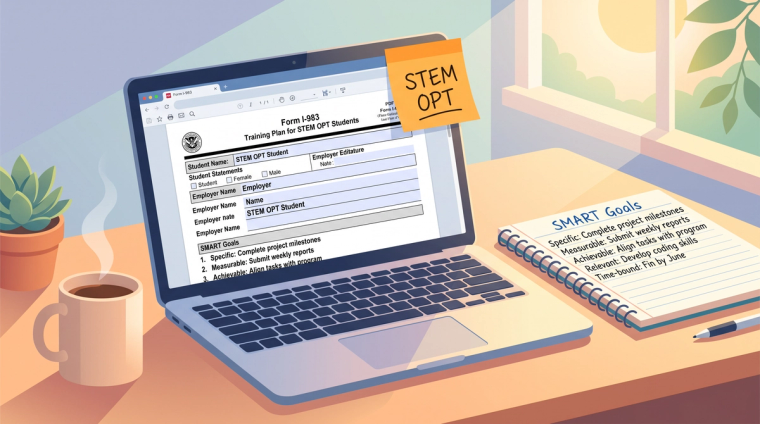
A complete walkthrough of every section of Form I-983, with finished sample paragraphs by STEM persona and the material-change rules no other guide consolidates.
The I-983 training plan is the number one reason DSOs send STEM OPT packets back. This guide walks every section, gives you sample paragraphs you can adapt, and lays out the material-change rules that trip students up mid-extension.
Most I-983s get rejected once. Plenty get rejected three or four times. What separates a Section 5 a DSO approves on first read from one that bounces back is rarely the form itself; it is the writing. Vague goals, copy-paste filler, and missing direct-relationship statements are what kill these. The training plan is a contract between you, your employer, and the school under 8 CFR § 214.2(f)(10)(ii)(C), and it needs to read like one.
This guide goes through every section of the current Form I-983 (Rev. 7/16), gives you narrative paragraphs for three common STEM personas, and pulls together the material-change, evaluation, and edge-case rules. If you want the broader OPT picture first, our no-nonsense OPT application guide covers the 12-month post-completion piece.
What the I-983 is, who completes it, and when
Form I-983 is the Training Plan for STEM OPT Students that an F-1 student and their employer must complete and sign before a Designated School Official (DSO) recommends a 24-month STEM OPT extension under category (c)(3)(C). The current edition is Rev. 7/16, OMB Control Number 1653-0054, 5 pages. SEVP extended the OMB collection without change in March 2025, so the same edition is still in use as of April 2026.
A few things worth knowing up front:
- You file the I-983 with your DSO, not USCIS. The DSO updates SEVIS, issues a STEM-recommended I-20, and then you file Form I-765 with USCIS within 60 days.
- Wet-ink scans and verified electronic signatures (DocuSign, Adobe Sign) have been accepted since SEVP Broadcast Message bcm2309-03 (September 2023). Typed-cursive signatures are not.
- Your school keeps the I-983 for 3 years after your program-completion date.
- Material changes during the 24 months trigger a new I-983 within 10 days.
The biometrics appointment guide covers the I-765 step that comes next. Since the October 28, 2025 check ban, STEM OPT applicants pay the I-765 fee electronically: by credit or debit card with Form G-1450 or by ACH bank transfer with Form G-1650.
Section 1: Student Information
Section 1 is on Page 1 and the student fills it out. Required fields: name (must match your I-20 character-for-character), email, recommending school, degree-granting school, SEVIS School Code (e.g. BOS214F00257000), DSO contact, SEVIS ID (N00 plus 10 digits), qualifying major and CIP code (e.g. "Computer Science 11.0701"), degree level and award date, "Based on Prior Degree?" yes/no, EAD number (the 9-digit number on the EAD card itself, not the I-797 receipt number), and STEM OPT requested period (From = day after your current EAD expires; To = exactly 24 months later).
The rejections that come back most often: putting the I-797 receipt number in the EAD field, CIP code mismatches, and a "From" date that just copies the original 12-month OPT start date. Our Alien Registration Number explainer covers where the A-number shows up across USCIS documents.
Section 2: Student Certification
Section 2 is your signature block. By signing, you certify five things. The one that matters most: your practical training is directly related to your qualifying STEM degree, and you will notify your DSO of material changes within 10 days. Date format is mm-dd-yyyy, signatures must be wet-ink scans or verified electronic, and any time you revise the form you have to re-stamp the signature date.
Section 3: Employer Information
Section 3 is the employer's job. Two things catch HR teams off guard:
- Employer legal name has to match E-Verify registration exactly. A "DBA" or marketing name will get the form bounced.
- EIN is the 9-digit IRS number (XX-XXXXXXX). The E-Verify Company Identification Number is a separate 4 to 7 digit number issued at E-Verify enrollment. They are not the same field. A missing or invalid E-Verify number is a regulatory bar under 8 CFR § 214.2(f)(10)(ii)(C)(5): no E-Verify, no STEM OPT. Our STEM OPT employer requirements guide covers E-Verify enrollment and how to find the Company ID.
Other required fields: 6-digit NAICS code, start date of employment (= STEM OPT start date, not your original hire date), hours per week (must be 20 or more), and a salary that lines up with similarly situated U.S. workers. Below-market salary is a growing RFE trigger in 2026, especially for staffing-firm placements.
Section 4: Employer Official Certification
Section 4 is signed by an Employer Official with Signatory Authority, meaning a manager, director, or HR head. The student cannot sign here, even if the I-983 is for your own entrepreneurial venture. The signatory attests that: (a) practical training is directly related to the STEM degree; (b) the student receives on-site supervision by experienced staff; (c) the employer has sufficient resources at the location(s) identified; (d) the student will not replace a U.S. worker and terms are commensurate; (e) training complies with all federal and state employment law.
Per PA-2024-22 (USCIS Policy Manual update of August 27, 2024), the people supervising STEM OPT training have to be employees of the employer or contractors directly retained by the employer, never employees of the employer's clients. Pure third-party staffing placements are getting RFEs in 2026 because of this.
Section 5: The Training Plan
Section 5 is Page 3, and roughly 80 percent of DSO rejections happen here. The form requires a header (site name, address, official's name, title, email, phone) and five narrative prompts:
- 5(a) Student Role. Tasks and how they relate to the STEM degree.
- 5(b) Goals and Objectives. Specific skills the student will learn or apply, with timeline.
- 5(c) Employer Oversight. How the employer supervises.
- 5(d) Measures and Assessments. How the employer measures progress.
- 5(e) Additional Remarks. Optional overflow for remote-work, multiple worksites, or third-party-site explanations.
Section 5 must be written in third person. First-person narratives signal that the student wrote it alone, which DSOs dislike. Below are sample paragraphs for three common STEM personas. Swap in your actual job, courses, and metrics, and your Section 5 will already be stronger than 90 percent of what reaches DSOs.
Persona A: Software Engineer, M.S. Computer Science (CIP 11.0701)
5(a) Student Role. "The student is employed as a Software Engineer II on the Platform Infrastructure team at [Employer]. The student designs backend microservices in Go and Python, authors and reviews pull requests, participates in on-call rotations, and contributes to distributed systems serving approximately 5 million daily active users. The work directly applies the M.S. in Computer Science (CIP 11.0701), including coursework in Distributed Systems (CS 244B), Database Systems (CS 245), Operating Systems (CS 240), and Algorithms (CS 161)."
5(b) Goals. Months 1 to 6: ship at least 3 production features at 85 percent or higher test coverage; cut p99 latency on a designated service by at least 15 percent. Months 4 to 12: complete the 12-week Distributed Systems Bootcamp; participate in at least 8 incident post-mortems. Months 6 to 18: AWS Solutions Architect Associate; migrate one legacy service to Kubernetes. Months 12 to 24: mentor a new-hire engineer; lead the design of one cross-service feature.
5(c) Employer Oversight. Daily 15-minute stand-ups; weekly 1:1s with the Engineering Manager; biweekly code reviews requiring two-reviewer approval; monthly career-development meetings; supplemental Senior Engineer mentorship. Supervision is in-person at the [City] office; on hybrid days, supervision continues via Zoom and Slack with documented daily check-ins.
5(d) Measures and Assessments. Weekly code-review metrics; quarterly Performance Reviews against the Engineering Career Ladder; sprint-level KPIs (velocity, defect-escape rate, on-call response); goal-completion checkpoints at months 6, 12, 18, and 24 feeding the Page 5 self-evaluations.
Persona B: Data Scientist, M.S. Data Science (CIP 30.7001)
5(a) Student Role. Data Scientist on the Risk and Fraud Analytics team at a fintech, reporting to the Lead Data Scientist; builds supervised ML models (gradient-boosted trees, deep neural networks) for real-time transaction-fraud scoring; designs A/B and multi-armed bandit experiments; develops causal-inference analyses; authors production Python (scikit-learn, PyTorch, PySpark) deployed via the company's MLOps pipeline. Applies STAT 502, CS 229 (ML), CS 230 (Deep Learning), and ECON 471 (Causal Inference).
5(b) Goals. Months 1 to 6: ship one retrained production fraud model with at least 5 percent precision improvement at 90 percent recall. Months 4 to 12: design and analyze at least 4 A/B experiments; publish one internal whitepaper. Months 6 to 18: prototype a transformer-based sequential anomaly model. Months 12 to 24: own quarterly Risk Business Review presentations; mentor a junior Data Scientist.
5(c) and 5(d). Daily stand-ups; weekly 1:1s; weekly model-review sessions; required Lead Data Scientist plus MLOps approval before production deploys. Performance is measured via model-quality metrics (precision, recall, AUC, calibration, fairness measures), quarterly experiment scorecards, and biannual reviews against the Data Science career ladder.
Persona C: Mechanical Design Engineer, M.S. Mechanical Engineering (CIP 14.1901)
5(a) Student Role. Mechanical Design Engineer I on the Powertrain Components team at an automotive OEM; performs 3D CAD in Siemens NX, FEA in ANSYS Mechanical, CFD in ANSYS Fluent; produces GD&T-compliant drawings to ASME Y14.5; supports DV/PV test planning. Applies ME 440 (FEM), ME 450 (Heat Transfer), ME 320 (Fluid Mechanics), and ME 380 (Machine Design).
5(b) Goals. Months 1 to 6: complete Powertrain Onboarding; pass internal CAD certification by month 4. Months 4 to 12: independently perform structural FEA on at least 5 components and CFD on at least 2 cooling-circuit designs. Months 6 to 18: own end-to-end design of one production sub-assembly through DV testing and PPAP. Months 12 to 24: lead one Critical Design Review; contribute to at least 1 patent disclosure.
5(e) Additional Remarks. Remote work is not permitted in the first 12 months due to physical-prototype access and ITAR/EAR-controlled-data requirements, disclosed explicitly here so the DSO and SEVP both have it on the record.
Side-by-side: a bad goal vs a good one
The bad version has no measurable outcome, no time bound, and no tie to specific courses. That is the whole problem with most rejected Section 5s.
Section 6: Employer Official Certification of the Training Plan
Section 6 is a second certification by an Employer Official with Signatory Authority. It can be the same person who signed Section 4, or someone different; either way it must be a real employee, not your company's outside immigration attorney. The official certifies they have reviewed the Plan, will make sure the supervising official follows it, will notify the DSO of material changes, and will report termination or departure within 5 business days. The name on the Section 5 header is recorded in SEVIS as your supervisor.
Page 5: 12-month and final 24-month evaluations
Page 5 holds two evaluation boxes: the student writes a self-evaluation, then an employer official signs it. SEVP is unambiguous about this: failing to submit a final evaluation is a violation of the Form I-983 and may jeopardize your nonimmigrant status.
The deadlines:
- 12-month evaluation: submit within 10 days of the 12-month anniversary of your STEM OPT start date.
- Final 24-month evaluation: submit within 10 days of the end of your STEM OPT period, or within 10 days if the opportunity ends early (termination, resignation, change of employer).
A final evaluation is required at every employer departure, not only at month 24. Switch employers at month 14 and you owe a final evaluation for the departing employer within 10 days of your last day, plus a brand-new I-983 for the new employer within 10 days of starting.
A clean self-evaluation paragraph spells out the date range, performance against the measures from Section 5(d) with specific numbers (e.g. "shipped four production features against a target of three; coverage 89 percent vs target ≥85 percent"), accomplishments, and any agreed modifications to the second-year objectives.
Material changes: when you need a new I-983
A material change is anything that meaningfully changes the training relationship described in Section 5. The non-exclusive list at 8 CFR § 214.2(f)(10)(ii)(C)(9) covers EIN changes, compensation reductions, hours drops, and changes to learning objectives, but DSOs apply broader triggers in practice.
The full reference table:
| Event | Action required |
|---|---|
| Change of EIN due to corporate restructuring or M&A | New I-983 within 10 days |
| Reduction in compensation not tied to reduced hours | New I-983 within 10 days |
| Significant decrease in hours | New I-983 within 10 days |
| Decrease below 20 hours/week | New I-983 plus report; potential noncompliance |
| Change of supervisor with no change in duties | SEVP Portal update only |
| Change of supervisor with change in duties | New I-983 within 10 days |
| Change of worksite (including remote↔in-office) | New I-983 within 10 days |
| Change of job title with change in duties | New I-983 within 10 days |
| Change of employer name | New I-983 within 10 days |
| Promotion with raise, no other changes | SEVP Portal update only |
| Change of employer | New I-983 within 10 days plus final eval for prior employer within 10 days of last day |
| Termination or resignation | Final eval within 10 days; report to DSO; employer reports within 5 business days |
The 10-day clock and the 5-business-day clock run independently, and tracking deadlines this granular is hard. Reporting and evaluations remain your responsibility with your employer and DSO. Immiva prepares the STEM OPT Form I-765 with the applicable checks and document list; it does not replace your I-983 reporting obligations.
Edge cases the form handles badly
A few situations live in SEVP guidance and the USCIS Policy Manual, Volume 2, Part F, Chapter 5 rather than on the form itself.
Self-employment. Permitted only if you are a bona fide W-2 employee of your own properly-registered, E-Verified business. A separate company official must sign Sections 4 and 6; sole proprietorships and "in name only" arrangements are out. You may never self-sign.
Multiple concurrent employers. Permitted, but each employer needs a separate I-983, must be E-Verified, and must offer at least 20 hours per week.
Change of employer mid-extension. New I-983 required; final evaluation for the departing employer within 10 days of the last day; new I-983 within 10 days of starting; the new employer must be E-Verified before you begin. If your EAD is pending while you are between employers, the EAD application status guide covers the five tracking methods.
Bona fide employer-employee and third-party placement. Per the August 2024 USCIS Policy Manual update, training personnel must be employees or directly-retained contractors of the employer, never employees of the employer's clients. Pure client-site placements are disqualifying. ICE may conduct site visits with 48 hours' notice.
Failure to evaluate. If your employer refuses to sign the 12-month or final evaluation, report it to your DSO. SEVP can withdraw the employer's authorization, and missed evaluations can come back to bite you in future H-1B or I-485 adjudications.
DSO rejection patterns: the top 10
Rejections concentrate in a small handful of patterns:
- Vague non-SMART goals ("learn software engineering").
- Missing or invalid E-Verify Company ID, or an EIN entered in the E-Verify field.
- One-sentence employer-oversight descriptions.
- Generic copy-paste content recycled across multiple students.
- Goals not tied to the qualifying STEM degree or specific coursework.
- Non-bona-fide employer relationship (third-party placement at client sites).
- Wrong start date (original 12-month OPT date instead of day after EAD expiration).
- Typed-cursive signatures.
- Section 5 written in first person.
- Form (7/16) signed and dated months apart with no signature re-stamp.
These are all preventable. Read the form once with a critical eye and write Section 5 like you actually mean it.
The 2026 enforcement context
The DHS Practical Training rulemaking under RIN 1653-AA97 is in active drafting and is expected to rework OPT and STEM OPT compliance standards. The August 2024 USCIS Policy Manual update tightened the bona-fide-employer-employee bar, and SEVP enforcement waves in May and August 2025 produced a documented uptick in third-party-placement RFEs. None of this changes the form. All of it changes how strictly DSOs and adjudicators are reading it.