
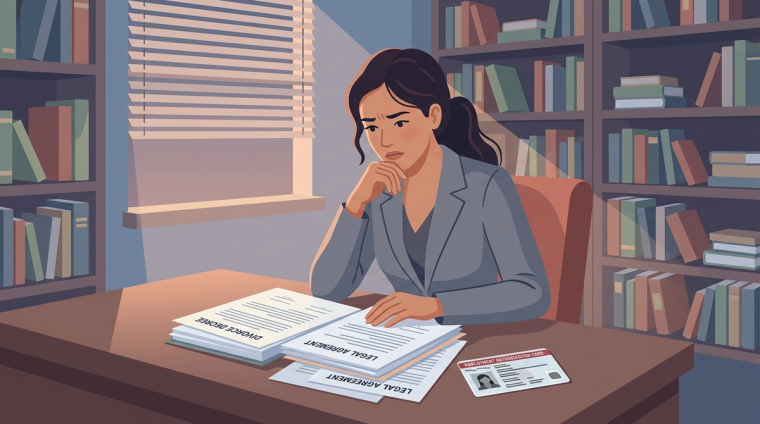
If you're a J-2 visa holder and your J-2 work authorization depends on your spouse's exchange visitor program, divorce changes everything. Your J-2 status exists only because of your spousal relationship to the J-1 principal (INA § 101(a)(15)(J)). Once a court finalizes the divorce, the legal basis for your J-2 classification is gone.
There's no ambiguity here. USCIS Policy Manual Volume 6, Part B, Chapter 2 says it plainly: a spouse who divorces the principal beneficiary no longer qualifies as a derivative beneficiary (USCIS Policy Manual, Vol. 6, Part B, Ch. 2).
Your EAD becomes invalid the moment divorce is finalized
Here's what trips people up most: the expiration date on your EAD card doesn't matter after your divorce is final. A J-2 EAD is authorized under 8 CFR § 274a.12(c)(5), which ties your employment authorization to your J-2 status. When that status ends, the EAD is no longer legally valid, even if the card itself hasn't expired.
What that looks like in practice:
- The physical card may still look valid, but once your J-2 status ends, you are no longer authorized to work. Continuing to work can create unauthorized-employment and unlawful-presence problems. The 3-year and 10-year bars under INA § 212(a)(9)(B) are triggered if you accrue sufficient unlawful presence and then depart the United States.
- If you filed Form I-765 and your divorce finalizes while USCIS is processing it, expect a denial. You no longer meet the eligibility requirements for category (c)(5).
- You should stop working immediately when the divorce is finalized and let your employer know. Continued employment after that is unauthorized for both of you.
For more on how J-2 EAD validity works, see our detailed guide.
There is no grace period after divorce
This surprises a lot of people. The 30-day grace period that J exchange visitors get under the State Department exchange-visitor regulations (22 CFR Part 62) only kicks in after the J-1 exchange program ends. It's a departure preparation window, not a post-divorce buffer.
The 60-day grace period under 8 CFR § 214.1(l)(2) covers H-1B, L-1, O-1, and some other employment-based classifications. J visa holders are excluded.
So when the divorce is finalized, your J-2 status ends that same day. There's no waiting period and no wind-down window.
Legal separation is different from divorce
Physical separation and legal separation don't end J-2 status by themselves. Only a finalized divorce does.
One thing to watch for, though: some states automatically convert legal separations into divorces after a certain period. In New York, for example, a legal separation can convert into a divorce after two years under some circumstances. If that happens, your J-2 status could end without you even realizing the conversion took place.
If you're separated but not divorced yet, your J-2 status and EAD are still valid. That gap gives you time to figure out next steps.
What you can do before and after divorce
Your best move is to file for a change of status (Form I-539) before the divorce is finalized, while you still have valid J-2 status. Filing I-539 while in valid status means you enter a "period of authorized stay" while the application is pending, which stops unlawful presence from building up (8 CFR § 214.2).
Your main options:
F-1 Student Visa. If you're accepted at a SEVP-certified school, you may be able to change to F-1 only if you are otherwise eligible for change of status. If you are subject to the two-year home residency requirement under INA § 212(e), you generally cannot change status to F-1 unless you first obtain a waiver or are not subject to that requirement.
B-1/B-2 Visitor Status. This is a temporary bridge, typically 6 months. It doesn't come with work authorization, and premium processing isn't available for B-2 changes.
H-1B Work Visa. Possible if you have an employer willing to sponsor you, but blocked if you're subject to the two-year home residency requirement unless you've obtained a 212(e) waiver through Form DS-3035.
U Visa. This applies if your spouse was abusive and the abuse qualifies as a covered crime. Unlike VAWA, the U visa doesn't require the abuser to be a U.S. citizen or permanent resident.
If you've already dealt with an EAD denial or want to understand how J-1 status changes affect your J-2, we've covered those separately.
The two-year home residency requirement survives divorce
If you were subject to INA § 212(e)'s two-year home residency requirement while married, divorce doesn't make it go away. It attached to you at the time of admission based on your J-1 spouse's program characteristics (22 CFR § 62.45).
After divorce, you can apply for a waiver on your own through the Interested Government Agency (IGA) route by filing Form DS-3035 with the State Department. That said, the State Department's own guidance (9 FAM 302.13-2(D)(1)) says it will act on behalf of divorced J-2 holders only rarely, and usually only for humanitarian reasons.
There is some good news, though. The December 2024 revised Exchange Visitor Skills List dropped many countries, so J-2 holders from those countries may no longer be subject to 212(e) based on the Skills List (Federal Register, December 9, 2024).