
What is a J-2 EAD request for evidence?
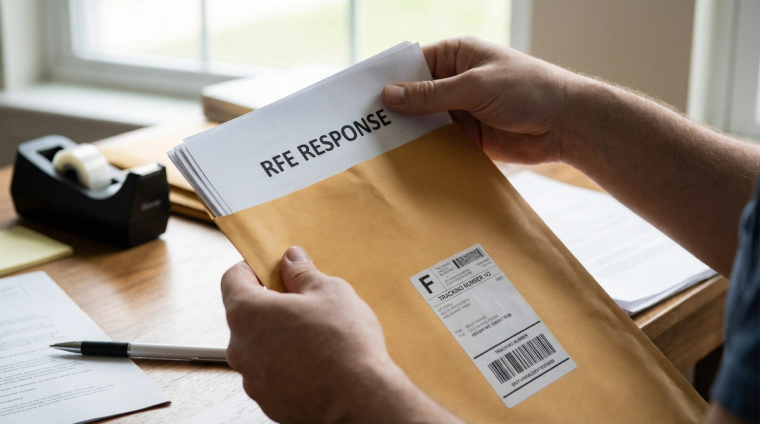
A Request for Evidence (RFE) is a formal notice from USCIS asking you to submit additional documentation for your Form I-765 application (USCIS Policy Manual, Vol. 1, Part E, Ch. 6). USCIS sends an RFE when your application is missing something or when the evidence you submitted wasn't sufficient to approve your case.
For J-2 EAD applicants, RFEs are increasingly common. Stricter adjudication standards in 2025 and 2026 mean officers are requesting more documentation than in prior years, even for items that weren't historically required.
What makes J-2 EAD RFEs especially stressful: J-2 dependents filed under category (c)(5) are not listed among the eligibility categories that qualify for the automatic EAD extension while a timely filed EAD renewal is pending. That means an RFE-related delay could leave you unable to work if your current EAD expires before USCIS decides your renewal. Responding quickly and completely is critical.
The 5 most common J-2 EAD RFE reasons
These are the most frequent reasons J-2 EAD applicants receive RFEs, based on I-765 instructions and recent adjudication trends.
1. Marriage certificate or relationship proof
This is the most common RFE for J-2 EAD applications. USCIS wants proof that you are the spouse (or minor child) of the J-1 principal. Even if you didn't need to submit a marriage certificate for a previous application, USCIS may request it now.
What to submit: A copy of your marriage certificate (or birth certificate for minor children). If the document is not in English, include a certified English translation with a translator's certification statement.
2. J-1 principal status verification
USCIS needs evidence that your J-1 spouse or parent is currently maintaining valid J-1 status (I-765 Instructions, Category (c)(5)). This is a core eligibility requirement.
What to submit: A copy of the J-1 principal's current DS-2019 showing valid program dates, their I-94 record, and a letter from the J-1 program sponsor confirming current active status.
3. DS-2019 documentation issues
USCIS requires a copy of your Form DS-2019, and evidence that the J-1 principal is currently maintaining status. If USCIS cannot confirm status from what you filed, it may issue an RFE requesting additional DS-2019s or other status documentation.
What to submit: Complete copies of every DS-2019 ever issued to both you and the J-1 principal. If a DS-2019 has been lost, contact the program sponsor for a reprint.
4. Support letter deficiencies
J-2 EAD applications must include evidence that any income from this employment authorization will not be used to support the J-1 principal. If your original statement was vague, missing, or suggested the income is needed to support the J-1, USCIS may request a corrected version.
What to submit: A signed letter explicitly stating that your employment income is for your own support, career development, personal interests, or family recreational and cultural activities, and that it will not be used to support the J-1 exchange visitor. For more on how J-2 work authorization works, see our complete guide.
5. Photo specification failures
USCIS requires two identical, unmounted, unretouched passport-style photographs (2"x2") with a white or off-white background. Digitally altered or incorrectly sized photos trigger RFEs.
What to submit: Two new photos meeting USCIS specifications. Get them taken at a professional photo service to avoid issues.
How to respond to your J-2 EAD RFE: step by step
Step 1: Calculate your exact deadline
Your RFE notice will include a response deadline. USCIS sets the deadline, but under federal regulations the maximum response period USCIS may provide in an RFE is 12 weeks (8 CFR § 103.2(b)(8)(iv)). If the notice is served by mail, 3 days are added to the prescribed period (8 CFR § 103.8(b)).
Step 2: Read the RFE notice carefully
The notice will list exactly which documents or evidence USCIS needs. Read every line. Sometimes an RFE asks for multiple items, and missing even one can result in a denial on the record.
Step 3: Gather the specific evidence requested
Collect only what was asked for, but be thorough. If USCIS requests a marriage certificate, provide the certificate plus a certified English translation if it's in another language. If they request J-1 status evidence, provide the DS-2019, I-94, and a sponsor letter.
If you need to obtain documents from overseas (like a marriage certificate from your home country), start immediately. This is where most of the 87 days gets consumed.
Step 4: Write a cover letter
Include a clear, organized cover letter with your response. What it should contain:
- Your full legal name and date of birth
- Your A-Number (Alien Registration Number) and receipt number
- The date of the RFE notice
- A numbered list of each document you're including, matched to each item USCIS requested
- Your signature and date
Step 5: Organize and submit your response package
Assemble your response in this order:
- Cover letter on top
- Original RFE notice (include it with your response)
- Evidence documents in the order requested
- Copies of any supporting documents
Mail the complete package to the return address printed on your RFE notice. Use a tracked shipping method (USPS Priority Mail, FedEx, or UPS) so you have proof of delivery. Keep copies of everything you send.
Step 6: Track delivery and monitor your case
After sending your response, save the tracking number and delivery confirmation. You can check your case status online using your receipt number at egov.uscis.gov/casestatus.
Sample RFE response cover letter
Here's a template you can adapt for your J-2 EAD RFE response:
[Your Full Legal Name]
A-Number: [Your A-Number]
Receipt Number: [Your Receipt Number]
Date: [Today's Date]
USCIS [Service Center Name]
[Address from RFE Notice]
Re: Response to Request for Evidence dated [RFE Date]
Form I-765, Category (c)(5) - J-2 Dependent Employment Authorization
Dear USCIS Officer,
I am writing in response to the Request for Evidence issued on [date] regarding my Form I-765 application for employment authorization as a J-2 dependent. Please find enclosed the following documents as requested:
- [Document 1 - e.g., Certified copy of marriage certificate with English translation]
- [Document 2 - e.g., Copy of J-1 principal's current DS-2019]
- [Document 3 - e.g., Updated support letter]
Please contact me if any additional information is needed.
Sincerely,
[Your Signature]
[Your Printed Name]
[Phone Number]
[Email Address]
Keep the letter short, professional, and factual. Don't include emotional appeals or unnecessary background information.
What happens after you submit your RFE response
Once USCIS receives your response, your case goes back into the processing queue. USCIS does not publish a guaranteed standard timeframe for how quickly it will decide a case after an RFE response is received. To estimate timing, check the USCIS processing times tool for Form I-765 and your case type.
During this time, you cannot work unless you hold a valid, unexpired EAD card. J-2 category (c)(5) applicants have no work authorization bridge while their case is pending. If your EAD has expired, you must wait for approval before accepting or continuing employment.
If your case is approved, you'll receive your new EAD card by mail. If it's denied, you'll receive a denial notice explaining the reason. For guidance on next steps after a denial, see our guide on what to do if your J-2 EAD is denied.
What if you miss the RFE deadline?
Missing the deadline is serious. Under 8 CFR § 103.2(b)(8), USCIS may deny your application outright or treat it as abandoned.
There is no way to request an extension. The regulation is clear: "Additional time to respond to a request for evidence or notice of intent to deny may not be granted."
If you've already missed the deadline, your options are limited:
- File a new I-765 application with a complete package of documents (including the correct Form I-765 filing fee). As of the current USCIS fee rule, the Form I-765 filing fee is $520 (unless a different fee applies to your specific category or filing scenario).
- Request expedited processing if you have an urgent basis, though J-2 EAD expedite requests are often denied
- Consult with an immigration attorney if you believe USCIS made an error
How to avoid J-2 EAD RFEs in the first place
The best way to deal with an RFE is to prevent it. A checklist of everything to include with your initial I-765 filing for category (c)(5):
- Completed Form I-765 (use the current acceptable edition listed under the Edition Date on the USCIS Form I-765 page at the time you file)
- Filing fee of $520 (under the current fee rule), payable via ACH debit (Form G-1650) or credit card (Form G-1450) for paper filings submitted after Oct. 28, 2025.
- Two passport-style photographs (2"x2", unmounted, unretouched)
- Copy of your passport photo and visa pages
- Copy of your I-94 record
- All current and previous DS-2019 forms (yours and J-1 principal's)
- Marriage certificate with certified English translation (for spouses)
- Birth certificate with certified English translation (for minor children)
- Evidence J-1 principal is maintaining valid status (sponsor letter, current DS-2019)
- Signed support letter stating income will NOT support J-1 principal
- Copies of any previous EAD cards (for renewals)