
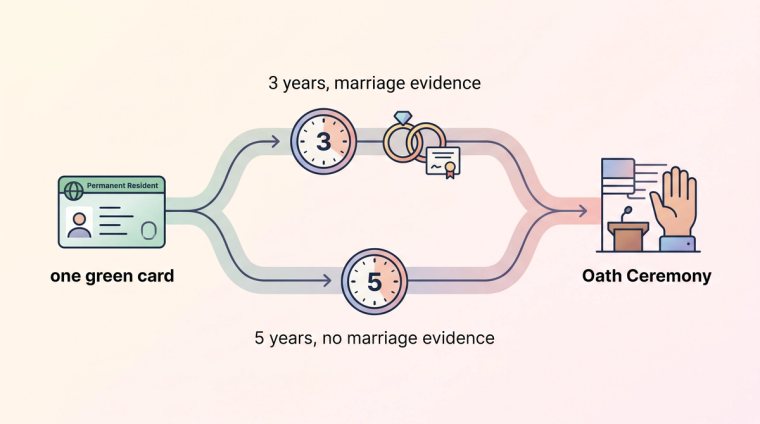
If you hold a green card and you are married to a U.S. citizen, you may qualify to apply for citizenship under two different provisions at once. One lets you file after three years as a permanent resident. The other makes you wait five. The usual answer stops at "the marriage one is faster" and moves on.
That answer is incomplete, and for a lot of people it is wrong. The shorter path asks for more evidence and can fail in a way the longer path cannot. If your green card is already close to five years old, filing under the marriage provision adds risk without saving you time.
The 3-year vs 5-year rule question is really a choice, not a formula. If you want the marriage-based path explained from the beginning, the 3-year rule guide covers it in full. What follows assumes you qualify under one or both and are working out which to file under.
The short answer
If you have held your green card for less than five years and your marriage is stable, file under the three-year provision. You get to citizenship roughly two years sooner, and that is worth the extra paperwork.
If you have already passed five years as a permanent resident, file under the five-year provision even though you are married to a citizen. You reach the same finish line and drop two conditions that can sink an otherwise good application. That is the part the usual comparison leaves out.
Everything below is the reasoning behind those two sentences, plus the situations where they flip.
What each rule actually requires
The two provisions sit in different sections of the law. The five-year path is INA 316, implemented at 8 CFR 316.2. The three-year path is INA 319(a), implemented at 8 CFR 319.1.
| Requirement | Five-year rule | Three-year rule |
|---|---|---|
| Time as a permanent resident | 5 years of continuous residence | 3 years of continuous residence |
| Physical presence in the U.S. | 30 months | 18 months |
| Residence in your state or district | 3 months | 3 months |
| Good moral character lookback | 5 years | 3 years |
| Marriage evidence | None required | Living in marital union for the full 3 years before filing |
| Spouse's status | Irrelevant | Must have been a U.S. citizen for the entire 3-year period |
Physical presence is half the qualifying period in both cases, so neither rule is proportionally easier on travel. The whole 3-year vs 5-year rule comparison comes down to the last three rows.
Continuous residence works the same way under both. Each provision uses the definition at 8 CFR 316.5, where a trip of six months to a year creates a presumption you broke continuity and a trip of a year or more breaks it outright. Our guide to continuous residence requirements covers how to rebut that presumption.
The three things that decide it for you
Will your marriage still be a marriage on the day you take the Oath?
There are two clocks here, and it is easy to treat them as one.
The first is living in marital union, meaning actually residing together. That is required for the three years before you file, and it stops at filing. USCIS says so directly in its Policy Manual: the regulation says the union must last until the examination, the statute says only until filing, and USCIS follows the statute. So a couple who separates after filing but stays married can still naturalize on this basis. A legal separation during the three years before filing does break the union, even if you share a roof.
The second clock is the marriage itself, and it runs until the Oath of Allegiance. A divorce or annulment ends eligibility whether it lands before or after you file, and marrying another citizen does not restore it. The same applies if your spouse dies or expatriates first.
Naturalization is not fast. If your marriage may not survive the wait, the five-year rule does not depend on it at all. If you are already there, what happens to an N-400 after a divorce covers the options.
Where does your good moral character risk sit?
Here the three-year rule has an advantage that is easy to miss. USCIS confirms in the Policy Manual chapter on good moral character that the provision you file under determines the lookback period. File under the five-year rule and an officer examines the last five years. File under the three-year rule and the window is three.
So if the thing that worries you happened four or five years ago, an arrest, a tax problem, a missed Selective Service registration, the shorter window may put it outside the statutory period. That does not make it disappear, since an officer can still weigh conduct outside the period and permanent bars apply regardless, but it changes the analysis. Our post on criminal records and citizenship eligibility covers what falls inside a conditional bar.
How much have you been travelling?
Thirty months out of sixty and eighteen out of thirty-six are both exactly half, but they behave differently. One bad year of travel is diluted across a five-year denominator and concentrated in a three-year one. Eight months abroad in 2024 hurts a three-year count far more than a five-year count.
Count the days before you decide. The N-400 residence calculator runs both windows, and how physical presence is counted explains what USCIS treats as a day in the country.
When the five-year rule is the better filing even though you qualify for both
Once you pass five years as a permanent resident, the shorter rule stops buying you time. You could file under either today, so the 3-year vs 5-year rule comparison is no longer about speed, and the five-year provision wins on nearly every remaining measure.
You drop the requirement to document three years of living together. You drop the requirement to prove your spouse held citizenship across that whole period. You drop the risk that a separation or divorce between filing and the Oath ends the case. Your interview stops covering the marriage, which means it is about you.
The exception runs the other way. If your good moral character exposure sits in years four and five, the three-year window protects you and the marriage evidence is a price worth paying. That is the one case where a five-year permanent resident should still file under the marriage provision.
If you are still a conditional resident, you can file the N-400 while an I-751 is pending. Filing an N-400 with a pending I-751 covers the timing.
What it costs under each rule
The same, either way. Under 8 CFR 106.2 the N-400 fee is $760 on paper or $710 online, since 8 CFR 106.1(g) applies a $50 online discount. There is no separate biometrics fee. Applicants at or below 400 percent of the Federal Poverty Guidelines pay a reduced fee of $380.
A rule published in the Federal Register on June 23, 2026 would end the reduced fee for the N-400 and remove fee waivers. It is still a proposed rule with no effective date, so the $380 fee remains available. If you would use the reduced fee or a waiver, that is an argument against waiting.
The rules differ in evidence, not money. A three-year filing means assembling proof of the marriage, joint documents and your spouse's citizenship evidence, then answering for all of it at interview. The document checklist shows what changes between the two.
Immiva prepares the N-400 under both provisions for $199 as one flat fee. You answer questions in plain English, get every answer checked as you go, and see the full pre-filing report before paying. If an Immiva preparation error causes USCIS to reject your packet, the fee comes back.
The 90-day rule applies to both
Whichever side of the 3-year vs 5-year rule you land on, you do not have to wait until the day you complete the residence requirement. 8 CFR 334.2(b) lets you file up to 90 days early, and USCIS confirms on the N-400 form page that the window applies whether you are filing on the five-year basis or the three-year basis.
The 90 days run against the residence requirement only. Physical presence and good moral character are still measured to the actual filing date. Filing 91 days early is one of the more common reasons an N-400 is denied, so count carefully.
Frequently Asked Questions
Not by amending. The basis you select drives which requirements USCIS applies. If you chose the marriage basis and it fails, you generally file again under the five-year rule once you meet it.
The five-year rule, unless you want to wait. INA 319(a) requires your spouse to have been a citizen for the entire three-year period, so the clock starts at their naturalization, not your wedding.
No. It shortens the wait to file. Both then sit in the same queue, and current N-400 processing times apply equally.
Not automatically. 8 CFR 319.1(b)(2)(ii)(C) treats separation caused by military service or genuine occupational demands differently from voluntary separation, though the burden is on you to show it.
Whichever gets you there sooner. Until you hit five years as a permanent resident, that is the three-year rule. After that the 3-year vs 5-year rule answer flips to the five-year provision.
Once you have picked a basis, the step-by-step N-400 guide covers the rest.