

Current N-400 processing times in 2026
Updated September 9, 2026: this guide uses USCIS monthly data through July 2026 and the FY2026 Q2 N-400 performance report, covering January 1 through March 31, 2026.
USCIS reported an average N-400 processing time of 11.4 months for July 2026, up from 6.4 months in July 2025. This service-wide monthly figure gives you a national picture; your field office's current estimate is more useful for planning your own wait. For the steps involved in the N-400 citizenship application process, see our guide from filing through the oath ceremony.
For a stage-by-stage walkthrough of every step from filing to oath, see our after filing N-400 timeline guide.
National figures from the latest USCIS reports available for this update:
| Measure | Reported value and period |
|---|---|
| Historical median processing time | 5.7 months, FY2025 |
| Service-wide monthly average processing time | 11.4 months, July 2026 |
| Total pending applications | 778,489, July 2026 monthly report |
| Applications pending over six months | 485,003, July 2026 monthly report |
| Approvals as a share of approvals plus denials | 84.7%, FY2026 Q2; describes that quarter's decisions |
These figures use different measures. The FY2025 median is the middle processing time for that fiscal year. The July 2026 figure is the service-wide average in USCIS's monthly report to Congress. The processing-times tool uses a separate measure: the time USCIS took to complete 80% of cases over the prior six months at a field office. Approval can be followed by a further wait for the oath ceremony.
Processing changes before 2026
The FY2025 median of 5.7 months describes an earlier period. Filing and processing changes during the preceding years included the following:
The annual median fell after FY2021. The historical processing-time table does not measure how much staffing or procedural changes contributed to that decline.
Biometrics reuse sped things up (until late 2025). Through 2024 and most of 2025, USCIS often reused fingerprints from previous applications, cutting weeks from the process. That ended for naturalization on December 12, 2025: new N-400 filings now require fresh biometrics, including a new photo (Policy Alert PA-2025-29).
Applicants can file N-400 online. The processing reports discussed here do not compare wait times by filing method.
Fee changes took effect April 1, 2024. The Form N-400 fee is $760 if filing by paper or $710 if filing online.
Field-office processing times and pending cases
USCIS assigns your field office based on where you live. Its processing-times tool provides a local estimate, while the quarterly performance report counts the applications each office handles. A pending count measures workload and cannot tell you how many months your case will take.
| USCIS measure | What it tells you | What it does not tell you |
|---|---|---|
| Field-office processing estimate | Time to complete 80% of cases over the prior six months | Your exact completion date |
| Quarterly pending count | How many applications were pending at an office on the reporting date | How many months you will wait |
| Service-wide monthly average | Average processing time reported nationwide for that month | The current estimate for your field office |
Read the quarterly counts as a snapshot. USCIS cautions that pending totals cannot be carried forward from earlier quarters: system updates and outcomes after adjudication can change the counts. Some applications approved, denied, or pending during the quarter were received in earlier periods.
Offices with the most pending cases in March 2026
The FY2026 Q2 report covers January through March 2026. Across all N-400 categories, USCIS received 140,767 applications, approved 83,459, and denied 15,022. It reported 660,692 pending applications at March 31. Houston had the largest field-office pending count at 30,125, followed by Dallas with 25,589 and Chicago with 19,893. The table below ranks offices by pending workload; it does not rank them by wait time.
| Field office | Pending N-400 cases, March 31, 2026 |
|---|---|
| Houston, TX | 30,125 |
| Dallas, TX | 25,589 |
| Chicago, IL | 19,893 |
| San Jose, CA | 16,455 |
| San Antonio, TX | 16,316 |
| Boston, MA | 15,855 |
| New York, NY | 15,707 |
| San Francisco, CA | 15,684 |
| Philadelphia, PA | 15,477 |
| Newark, NJ | 15,454 |
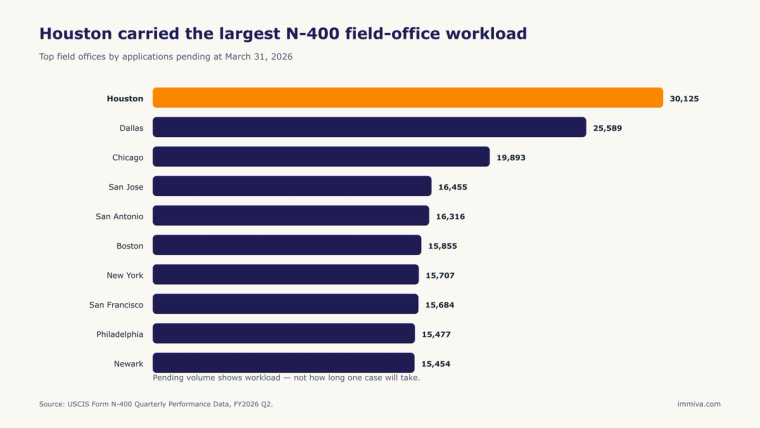
The ten field offices with the most pending N-400 applications on March 31, 2026. These are workload counts. Source: USCIS Form N-400 Quarterly Performance Data, FY2026 Q2.
How to find your field office processing time
You can check current processing times for your specific field office:
- Go to the USCIS Processing Times tool
- Select "N-400" as the form
- Enter your state or field office
- Read the processing-time estimate for your field office
The tool shows the time to process 80% of cases. Your actual timeline could be faster or slower depending on your specific situation.
How processing times have changed over time
The historical table shows annual median processing times. It lets you compare fiscal years using the same measure.
| Fiscal Year | Median Processing Time |
|---|---|
| FY2016 | ~5.5 months |
| FY2017 | ~7.5 months |
| FY2018 | 9.7 months |
| FY2019 | ~10.2 months |
| FY2020 | ~10.5 months |
| FY2021 | 11.5 months (peak) |
| FY2022 | ~10.5 months |
| FY2023 | ~8.5 months |
| FY2024 | 6.1 months |
| FY2025 | 5.7 months (official, fastest since 2016) |
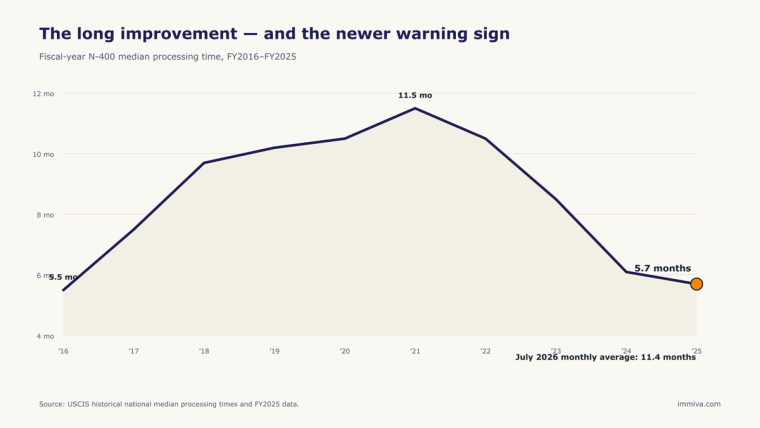
N-400 median processing times for FY2016 through FY2025. The FY2025 median was 5.7 months. The July 2026 monthly service-wide average was 11.4 months; it covers a different period and uses a different measure. Sources: USCIS Historical National Median Processing Times and USCIS Report to Congress.
The historical median peaked at 11.5 months in FY2021 and fell to 5.7 months in FY2025. These annual figures describe completed fiscal years, so they do not show the monthly changes during 2026.
For a direct comparison, use the monthly average from July in both years: 6.4 months in 2025 and 11.4 months in 2026. That is an increase of 5.0 months, or 78.1%. Comparing the FY2025 median with the July 2026 average would mix two measures as well as two time periods.
N-400 backlog: what the monthly data shows
USCIS reports service-wide processing data to Congress each month. The table below covers September 2025 through July 2026, the latest month available for this update.
| Month | Received | Approved | Denied | Total pending | Pending 6+ months | Avg. processing time (months) |
|---|---|---|---|---|---|---|
| Sep 2025 | 87,903 | 71,181 | 7,198 | 537,769 | 118,313 | 6.7 |
| Oct 2025 | 169,159 | 58,692 | 6,852 | 641,468 | 130,810 | 6.7 |
| Nov 2025 | 41,478 | 48,691 | 6,173 | 627,819 | 146,852 | 6.7 |
| Dec 2025 | 42,569 | 42,512 | 5,168 | 622,664 | 168,881 | 6.8 |
| Jan 2026 | 46,385 | 32,862 | 4,970 | 630,860 | 198,235 | 7.8 |
| Feb 2026 | 44,508 | 23,626 | 4,462 | 647,193 | 234,728 | 7.9 |
| Mar 2026 | 49,630 | 26,868 | 5,424 | 663,951 | 282,227 | 8.6 |
| Apr 2026 | 47,630 | 22,560 | 5,009 | 683,960 | 419,201 | 9.5 |
| May 2026 | 49,534 | 17,038 | 3,757 | 712,572 | 441,362 | 10.1 |
| Jun 2026 | 53,392 | 18,439 | 3,852 | 744,412 | 458,485 | 10.7 |
| Jul 2026 | 55,579 | 16,514 | 4,160 | 778,489 | 485,003 | 11.4 |
Source: USCIS Report to Congress, "Number of Service-Wide Forms by Month, Form Status, and Processing Time," through July 2026 (USCIS Immigration and Citizenship Data). Average processing time is reported in months.
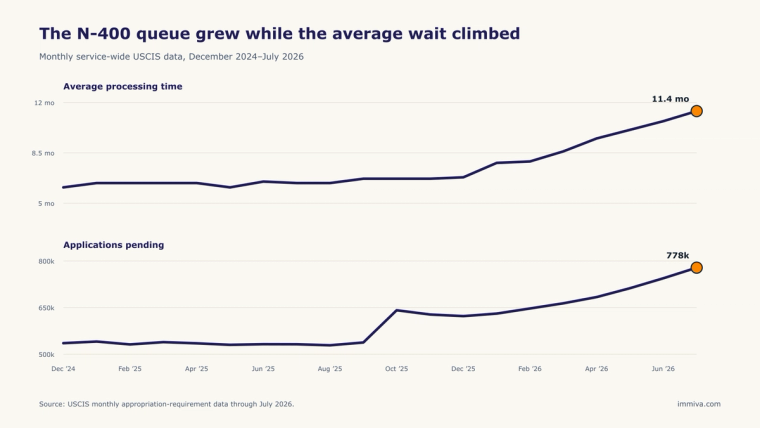
Monthly N-400 service-wide average processing time and total pending applications from December 2024 through July 2026. Source: USCIS Report to Congress.
October 2025 had the highest receipt count in this table: 169,159 N-400 applications, compared with 87,903 in September. Receipts fell to 41,478 in November. The report does not explain why filing volume changed.
Pending applications continued to rise during 2026, reaching 778,489 in July. A year earlier, the July total was 532,052. That is a 46.3% increase in pending cases.
USCIS reported 485,003 applications pending over six months in July 2026, up from 110,789 in July 2025. That count rose by 337.8% over the year. It shows how many pending cases had already passed six months, without predicting when those cases will finish.
USCIS approved 16,514 N-400 applications in July 2026, compared with 72,334 in July 2025. Denials were 4,160 and 7,743, respectively. These are monthly counts of decisions, which can concern applications filed in earlier months. Dividing a month's approvals by its receipts would not give you an applicant's chance of approval.
Planning if you are filing in September 2026
Start with the current estimate for the field office handling your case. The 11.4-month July average describes USCIS processing nationwide and gives no individual completion date. Leave room in your plans for the time between approval and the oath ceremony.
Both total pending applications and the monthly average processing time increased from January through July 2026. These reports do not forecast when that trend will change, so they cannot support a date when the backlog will ease.
If you qualify for early filing, you can submit up to 90 days before meeting the continuous residence requirement. Filing online is one way to submit your application. The reports discussed here do not compare online and paper processing times.
The five stages
After USCIS accepts your N-400, the process includes a receipt notice and biometrics, followed by background checks and interview scheduling. The interview includes the English and civics tests when required. If USCIS approves your application, the oath ceremony follows. Our after-filing N-400 timeline guide explains what to bring, how rescheduling works, and when same-day oaths are possible.
Where to check each stage of your timeline
| Stage | Where to check your timing |
|---|---|
| Receipt notice | Your USCIS account and receipt notice |
| Biometrics | Your appointment notice |
| Interview | Your interview notice; the field-office estimate gives broader context |
| Oath ceremony | Your ceremony notice after approval |
| Overall case | The current USCIS estimate for the field office handling your case |
Want to know where your application stands? Our guide on how to check your N-400 status online walks through the process and explains what each status message actually means.
What causes N-400 delays?
While most applications move through smoothly, certain situations can extend processing time.
Background check issues
The FBI background check typically takes weeks, but some cases require additional review:
- Common names that generate multiple matches
- Previous immigration violations
- Past criminal history (even minor offenses)
- Prior security concerns flagged in government databases
If your background check takes longer, you'll remain in "actively reviewing" status until it clears. There's little you can do to speed this up, but the delays are usually resolved without requiring action from you.
Pending I-751 (conditional green card removal)
If you have a conditional green card (2-year card) and filed your I-751 to remove conditions, your N-400 may be affected.
USCIS will process both applications together, but your N-400 cannot be approved until your I-751 is resolved. If your I-751 is still pending, this can add significant time to your citizenship process.
That said, you can still file N-400 while your I-751 is pending. Some applicants find this actually speeds up both cases because USCIS processes them at the same office.
Documentation problems
Missing or inconsistent information can delay processing:
- Incomplete application responses
- Missing supporting documents
- Discrepancies between your N-400 and previous applications
- Tax issues or missing returns
If USCIS needs additional information, they'll send a Request for Evidence (RFE). Responding promptly and completely helps get your case back on track.
Can you expedite N-400 processing?
Unlike some immigration applications, N-400 does not have premium processing. You cannot pay extra for faster handling.
However, USCIS may grant expedite requests in limited circumstances:
- Severe financial loss to a company or person
- Emergency situations
- Humanitarian reasons
- USCIS error causing delay
- National interest (rare)
These expedite requests are rarely approved for routine applications. In most cases, you'll need to wait for normal processing.
Real applicant timelines: what people actually experience
These applicant accounts describe earlier cases. They can show how individual experiences differ, but they do not establish current field-office wait times. USCIS's field-office estimate measures the time to complete 80% of cases over the prior six months.
Fast processing examples
Cincinnati, Ohio (3-year rule):
- Filed: December 1, 2024
- Biometrics: Reused same day
- Interview scheduled: December 16, 2024
- Interview date: January 22, 2025
- Total: 7 weeks filing to interview
Seattle, Washington:
- Filed: May 15, 2024
- Interview: November 2024
- Oath ceremony: November 19, 2024
- Total: 6 months
Houston, Texas:
- Filed under 3-year marriage rule (90 days early)
- Biometrics reused
- Interview: 9 days after 3-year eligibility date
- Oath: 2 weeks after interview
- Total: Under 3 months from eligibility
Moderate processing examples
Washington D.C.:
- Filed: May 10, 2024
- Biometrics: May 31, 2024
- This account does not include a final decision or oath date.
Anchorage, Alaska:
- Filed: May 18, 2024
- Interview and oath: January 21, 2025
- Total: 8 months
Delayed processing examples
Newark, New Jersey:
- Filed: June 2024
- Biometrics: Reused immediately
- As of October 2024: Still waiting for interview after 4+ months
- This account does not include a final decision or oath date.
San Francisco Bay Area (I-751 complication):
- N-400 filed: June 2020
- Oath ceremony: August 2021
- Total: 14 months (delayed by pending ROC at different office)
Compare the endpoint before comparing timelines: some accounts stop at the interview, while others include the oath ceremony. Check your field office's current estimate for information relevant to a new application.
N-400 fees in 2026
We cover filing fees, attorney costs, and the hidden expenses most people miss in our N-400 costs guide.