
Filing for bankruptcy does not bar you from becoming a U.S. citizen. The N-400 does not even ask about it. Here's what USCIS actually cares about when it comes to your money.
If you've filed for bankruptcy and you're anxious about what it means for your naturalization application, the short answer is that bankruptcy is a legal right under federal law, and it does not block you from U.S. citizenship. Form N-400 does not ask about bankruptcy filings, credit scores, debt levels, or foreclosure. USCIS does not pull your credit report. There are no reported cases of USCIS denying naturalization over a bankruptcy filing alone.
That said, specific financial issues can affect your good moral character determination, and the August 2025 USCIS policy memo raised the bar for how applicants demonstrate it. The rest of this guide walks through what matters and what doesn't.
Does bankruptcy bar you from U.S. citizenship?
No. Not under any provision of immigration law.
Good moral character is defined by two sources: INA § 101(f) and 8 CFR § 316.10. Between them, they list every category of conduct that permanently or conditionally bars you from establishing good moral character. Bankruptcy is not on either list. It does not appear in USCIS Policy Manual Volume 12, Part F, Chapter 4 (Permanent Bars) or Chapter 5 (Conditional Bars).
The stronger legal point: bankruptcy is not listed as a bar to naturalization in INA § 101(f), 8 CFR § 316.10, or the USCIS Policy Manual. 11 U.S.C. § 525(a) does bar certain forms of governmental discrimination based solely on bankruptcy, though the statute does not expressly mention naturalization.
If bankruptcy is the only financial event in your background, you can file Form N-400 the day after your discharge, the day before, or while your Chapter 13 repayment plan is still active. There is no waiting period.
What the N-400 actually asks about your finances
Form N-400, Edition 01/20/2025, contains zero questions about bankruptcy. There is no question about your credit score, your debt-to-income ratio, or whether you've ever had a home foreclosed. USCIS runs an FBI fingerprint-based criminal background check, not a financial one.
What the N-400 does ask about, in Part 9 (Additional Information About You), is a narrow set of financial questions tied to specific good moral character issues.
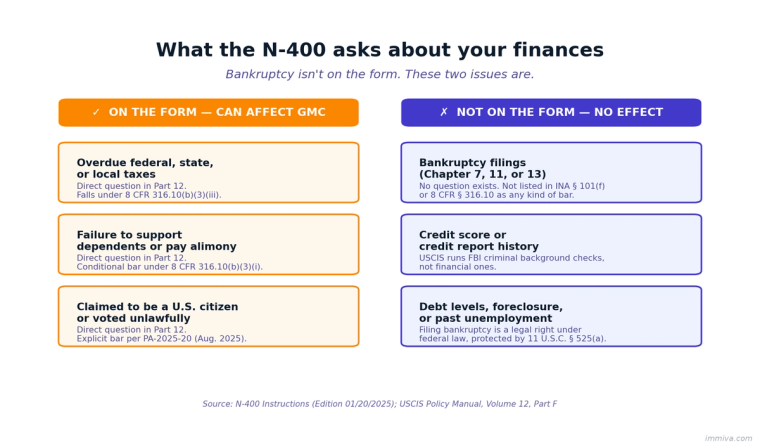
The two core financial questions in Part 9 are whether you owe overdue federal, state, or local taxes, and whether you have ever failed to support dependents or pay alimony. Neither is about bankruptcy.
When money problems can affect good moral character
Bankruptcy itself isn't the issue. The underlying conduct sometimes is. Three situations actually cause trouble.
Unpaid or unfiled taxes. The most common financial GMC issue. Tax debts less than three years old are generally not dischargeable in Chapter 7, so they can survive a bankruptcy. If you still owe the IRS after filing, that's a "yes" on the N-400 tax question, which falls under the catch-all "unlawful acts" provision at 8 CFR § 316.10(b)(3)(iii). You can still qualify, but you'll need to show you're on an IRS payment plan or have otherwise resolved the debt. Our guide on N-400 with tax issues covers the full strategy.
Unpaid child support or alimony. Also non-dischargeable in bankruptcy. Willful failure to support dependents is a conditional bar under 8 CFR § 316.10(b)(3)(i). USCIS looks for evidence of compliance: canceled checks, court payment records, wage garnishment orders, or a notarized letter from the custodial parent.
Bankruptcy fraud. Hiding assets, lying on schedules, or filing in bad faith is a federal crime and a crime involving moral turpitude. This scenario endangers your naturalization. The bankruptcy itself does not.
If none of these apply to you, bankruptcy is essentially irrelevant to your N-400.
How the August 2025 GMC memo changes things
On August 15, 2025, USCIS issued Policy Memorandum PM-602-0188, which shifted the good moral character evaluation from a checklist approach to a "totality of the circumstances" standard. Applicants must now affirmatively demonstrate positive attributes, not just the absence of bars.
For the full breakdown of how USCIS evaluates criminal records and conduct under this standard, see our guide to N-400 with a criminal record.
For bankruptcy filers, this cuts two ways. Filing alone still doesn't trigger a negative finding. But officers are now instructed to weigh positive factors like tax compliance, financial responsibility, and length of stable employment. If your bankruptcy was followed by a rebuild, be ready to show it. The memo specifically cites rehabilitation evidence as a positive factor.
How to prepare your N-400 after bankruptcy
Before filing, make sure you're current on federal and state tax returns for the full statutory period: three years if you're the spouse of a U.S. citizen, five years otherwise. Pull your IRS account transcripts at IRS.gov. If you have child support or alimony obligations, gather proof of payment for the same period.
Your N-400 document checklist should also include, optionally, a copy of your bankruptcy discharge order. You are not required to submit it, but it is useful to have at the interview.
At the naturalization interview, answer honestly if the officer asks. Officers generally will not bring up bankruptcy unless it surfaces through another question. If it does come up, a short factual answer is enough: "Yes, I filed Chapter 7 in [year]. It was discharged in [year]. I've been current on all tax and support obligations since."
If your finances are tight after the bankruptcy, you may qualify for the N-400 fee waiver via Form I-912, which covers the full $760 paper filing fee.
Frequently Asked Questions
No. Bankruptcy is not listed as a permanent or conditional bar in INA § 101(f) or 8 CFR § 316.10. The N-400 does not ask about it. If bankruptcy is the only financial event in your background, it will not affect your eligibility for citizenship.
No. USCIS runs FBI criminal background checks based on fingerprints. It does not pull consumer credit reports. Nothing in the N-400 requires financial disclosure beyond the specific Part 9 questions about overdue taxes and dependent support.
Yes. There is no prohibition on filing while a Chapter 13 plan is ongoing. In some ways, an active plan helps, because you are honoring a court-approved repayment schedule, which supports the "financial responsibility" factor under the 2025 GMC memo.
No. Neither chapter has any inherent immigration consequence. The only difference that matters for your N-400 is which debts survive. Chapter 7 cannot discharge most recent tax debts or any child support; Chapter 13 addresses those through the repayment plan. The difference matters only if surviving debts remain unpaid when you file.
A dismissal means your debts were never eliminated. If those debts include unpaid taxes or child support, USCIS may flag those specific obligations. The dismissal alone is not the issue. Resolve the underlying debts before you apply.
Possibly. The fee waiver is based on current household income, not past financial history. If your income is at or below 150% of the Federal Poverty Guidelines, you receive means-tested benefits, or you are facing extreme financial hardship, you qualify.