
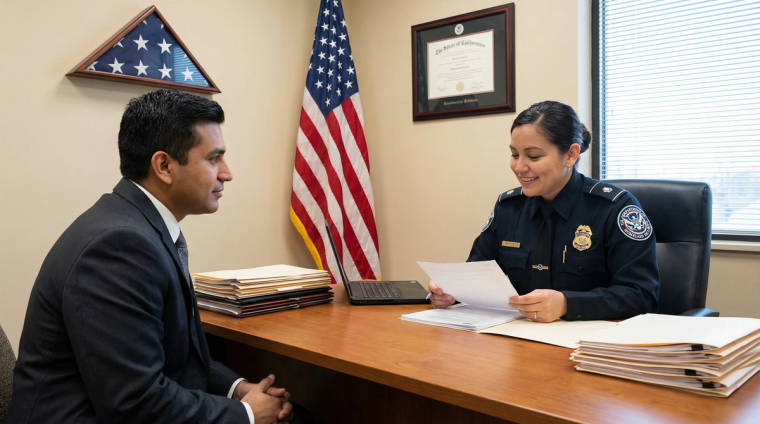
Most people preparing for their citizenship interview focus entirely on memorizing civics questions. That's a mistake. The civics test is just one part of a much longer conversation with your USCIS officer. See also our N-400 document checklist.
During your N-400 interview, the officer will review your entire application line by line, ask about your travel history, verify your employment, probe your criminal background, and test your English skills. They'll also ask questions designed to check whether your written answers match what you say out loud.
If you filed your N-400 application on or after October 20, 2025, you're facing the new 2025 civics test, which is significantly harder than the old version. But even applicants who took the older test need to understand every other question type that comes up during the interview.
This guide covers all of it. You'll learn exactly what questions officers ask, why they ask them, and how to prepare for each part of the interview.
The 2025 civics test
If you filed your N-400 on or after October 20, 2025, you take the new test: 128 questions in the study pool, 20 asked at the interview, 12 correct to pass. Filers before that date take the older 2008 test (100 questions, 10 asked, 6 to pass). The 65/20 exception (age 65+ with 20+ years as an LPR) still simplifies the test for senior applicants. For the full study list and how to prepare, see our 128 civics questions study guide.
N-400 Form Review Questions: The Heart of Your Interview
The civics test gets all the attention, but the form review is where most of your interview time goes. The officer will walk through your entire N-400, asking questions to verify accuracy and test your English comprehension at the same time (USCIS Policy Manual, Vol. 12, Part B, Ch. 3).
They're not just checking boxes. They're watching for inconsistencies between what you wrote and what you say out loud.
Biographical Questions
These seem simple, but answer them exactly as they appear on your application:
- "What is your full legal name?"
- "Have you ever used any other names?"
- "Do you want to legally change your name?" (Learn more about N-400 name changes if this applies to you)
- "When is your birthday?"
- "Where were you born?"
- "How tall are you?"
- "What color are your eyes?"
Travel History Questions
Officers pay close attention to your travel because extended trips outside the U.S. can affect your continuous residence and physical presence requirements.
Expect questions like:
- "How many trips have you taken outside the U.S. since becoming a permanent resident?"
- "Did any of your trips last six months or longer?"
- "What was the purpose of each trip?"
- "When did you leave and when did you return?"
- "Which countries did you visit?"
Employment History Questions
The officer will verify your employment over the past five years:
- "Where do you currently work?"
- "What is your job title?"
- "Where else have you worked in the past five years?"
- "Are you self-employed?"
Marriage and Family Questions
If you're married, especially if you're applying based on marriage to a U.S. citizen, expect detailed questions:
- "Are you currently married, divorced, or widowed?"
- "What is your spouse's full name?"
- "When and where were you married?"
- "Is your spouse a U.S. citizen?"
- "How many times have you been married?"
- "How many children do you have?"
- "What are their names and birthdates?"
Residence History Questions
- "Where do you currently live?"
- "How long have you lived at this address?"
- "Where else have you lived in the past five years?"
If you moved states while your application was pending, your case may have transferred. See our guide on moving states with N-400 pending for what to expect.
English Test: Reading, Writing, and Speaking
The English requirement has three parts, all handled during your interview (8 CFR § 312.1). The officer judges your speaking from how you understand and answer questions throughout the conversation. For reading, you read one of three printed sentences out loud. For writing, the officer dictates sentences and you write one correctly. Every word that can appear comes from the official reading and writing vocabulary lists.
English Test Exemptions
If you're 50 or older and have held a green card long enough, the 50/20, 55/15, or 65/20 rules may waive the English test under INA § 312(b). Our N-400 age exemptions guide explains who qualifies and what each rule covers.
If English is a concern, see our detailed guide on the N-400 English language test.
Good Moral Character Questions: The New 2025 Standard
In August 2025, USCIS updated its Good Moral Character (GMC) policy to evaluate the "totality of circumstances" rather than just looking for disqualifying factors (USCIS Policy Manual, Vol. 12, Part F). Officers now assess whether applicants demonstrate positive moral qualities, not just whether they avoided serious wrongdoing.
This means the GMC questions during your interview carry more weight than before.
Criminal History Questions
You must answer these honestly and completely. The requirement is to disclose everything, even if charges were dropped, expunged, or sealed (8 CFR § 316.10).
- "Have you EVER been arrested, cited, or detained by any law enforcement officer for any reason?"
- "Have you EVER committed a crime for which you were not arrested?"
- "Have you EVER been charged with, convicted of, or sentenced for any crime?"
- "Have you EVER received a suspended sentence, been placed on probation, or been paroled?"
Tax Compliance Questions
- "Have you filed federal, state, and local tax returns for every year since becoming a permanent resident?"
- "Have you ever claimed to be a 'non-resident' on a tax return?"
- "Do you owe any overdue federal, state, or local taxes?"
If you have tax issues, bring documentation showing you've resolved them or have a payment plan in place.
Child Support Questions
- "Have you EVER failed to support your dependents?"
- "Have you EVER failed to pay alimony?"
Selective Service Questions
If you're male and lived in the U.S. between ages 18 and 26:
- "Did you register with the Selective Service System?"
This question trips up many applicants. See our guide on N-400 Selective Service requirements if this applies to you.
For a closer look at the most common disqualifier, see our guide on criminal records and citizenship eligibility.
Oath of Allegiance Questions
Every applicant must demonstrate they understand and are willing to take the Oath of Allegiance (8 CFR § 316.11).
- "Do you understand the full Oath of Allegiance to the United States?"
- "Are you willing to take the full Oath of Allegiance?"
- "If the law requires it, are you willing to bear arms on behalf of the United States?"
- "If the law requires it, are you willing to perform noncombatant services in the U.S. Armed Forces?"
- "If the law requires it, are you willing to perform work of national importance under civilian direction?"
Conscientious Objector Accommodations
If your religious beliefs or moral convictions prevent you from bearing arms or performing military service, you can request a modified oath. You'll need to provide documentation of your beliefs, such as a letter from a religious leader or statement of conscience. USCIS accommodates these requests when they're based on sincerely held beliefs.
Other Attachment Questions
- "Have you EVER been a member of or affiliated with the Communist Party?"
- "Have you EVER advocated the overthrow of any government by force or violence?"
- "Have you EVER been associated with a terrorist organization?"
- "Have you EVER persecuted anyone because of race, religion, national origin, membership in a particular social group, or political opinion?"
"Gotcha" Questions: How Officers Test Your Truthfulness
Experienced officers use specific techniques to check whether you're being honest and whether your verbal answers match your written application.
Rephrased Questions
Officers deliberately rephrase N-400 questions using simpler language to see if you understand what you answered:
| Form Wording | Officer May Ask |
|---|---|
| "Have you EVER claimed to be a U.S. citizen?" | "Did you ever tell anyone you were American?" |
| "Are you willing to bear arms?" | "Will you fight for America if there's a war?" |
| "Do you owe any federal taxes?" | "Are you behind on any payments to the government?" |
Follow-Up Traps
After you answer a question, officers may dig deeper to verify accuracy:
- On travel: "What was the EXACT date you left the country?"
- On organizations: "What was the purpose of that group you belonged to?"
- On employment: "How many hours per week did you work at that job?"
- General: "Why do you want to become a U.S. citizen?"
Consistency Checks
Officers compare your verbal responses to what's written on your N-400. If there's a discrepancy, whether it's a different date, a forgotten trip, or an inconsistent job title, they'll ask about it.
The best way to prepare is to review your N-400 application thoroughly before your interview. Bring a copy with you and make sure you can explain everything you wrote.
We put together a separate citizenship interview checklist with everything you need to bring.
Interview Day: What to Expect Hour by Hour
Understanding the flow of interview day helps reduce anxiety.
Before You Arrive
- Arrive 15-30 minutes early
- Dress professionally (business casual is fine)
- Don't bring large bags, weapons, or prohibited items
- Plan for no cell phone use inside the building
Check-In Process
You'll go through security screening, check in at the reception desk, and wait to be called. Wait times vary from 15 minutes to over an hour depending on the office.
The Interview Itself
The interview itself typically runs about 20 to 30 minutes, though plan on a few hours at the office door to door. The officer will:
- Put you under oath to tell the truth
- Verify your identity
- Review your N-400 line by line
- Administer the English reading and writing test
- Ask civics questions
- Ask about the Oath of Allegiance
- Give you a decision
Possible Outcomes
- Approved (N-652 with "Congratulations"): You passed. You'll either take the oath the same day or receive a ceremony date.
- Continued: The officer needs more information or documents. You'll receive a request explaining what's needed.
- Denied: You did not qualify for citizenship. You'll receive a written explanation and information about appeal options.
Same-Day Oath Ceremonies
Some USCIS offices offer same-day oath ceremonies, often on specific days of the week (commonly Tuesdays or Thursdays). Ask your officer or check with the local office about availability. If you take the oath that day, you'll leave as a U.S. citizen.
If your oath is scheduled for later, remember: you are not a U.S. citizen until you take the Oath of Allegiance. Don't attempt to vote, apply for a U.S. passport, or claim citizenship benefits until after your ceremony.
What Happens If You Fail?
Failing part of your interview isn't the end. USCIS provides second chances.
Re-Test Procedure
If you fail the English or civics test, USCIS will schedule a re-test within 60-90 days. You only need to retake the portion you failed (8 CFR § 312.5).
If you fail the re-test, your application will be denied. At that point, you can:
- File Form N-336 to request a hearing with a different officer (essentially a third chance)
- Reapply from scratch with a new N-400
For detailed guidance, see our complete guide to failing the citizenship test.
Application Denied
If your N-400 is denied for reasons other than test failure, such as not meeting residency requirements or good moral character issues, you'll receive a written denial explaining why. You can appeal with Form N-336 within 30 days or address the issue and reapply later.
For denial next steps, see our guide on N-400 denied.
Real Interview Experiences: What Applicants Report
Based on reports from recent applicants:
Typical Successful Interview
- Lasted about 20 to 30 minutes
- Officer was professional and efficient
- N-400 review was straightforward with no surprises
- Read one sentence, wrote one sentence for English test
- Asked 6-10 civics questions (2008 test) or 12-14 questions (2025 test) before stopping
- Received "recommended for approval" immediately
- Some offices offered same-day oath
Tips From Approved Applicants
- Review your N-400 the night before so dates and details are fresh
- Bring every document that might be relevant, even if not strictly required
- Speak clearly and answer only what's asked
- If you don't understand a question, ask the officer to repeat it
- Bring a pen (some offices don't provide one for the writing test)
- Stay calm if the officer seems stern; it's not personal
Handling Difficult Officers
Not every officer is friendly. Some ask rapid-fire questions or seem impatient. If you encounter a difficult officer:
- Stay polite and professional
- Take your time answering
- Ask for clarification if needed
- Don't argue or get defensive
- Focus on accurate, truthful answers
Remember: The officer's demeanor doesn't determine your outcome. Meeting the legal requirements does.