

If you're age 55 or older and have been a lawful permanent resident for at least 15 years, or age 50 or older and have been a lawful permanent resident for at least 20 years, you may be exempt from the English test.
Three age-based exemptions exist under federal law. Which one applies depends on your age and how long you've held a green card. This guide covers all three, what each one does (and doesn't) cover, and what to expect if you qualify.
The Three Age-Based Exemptions
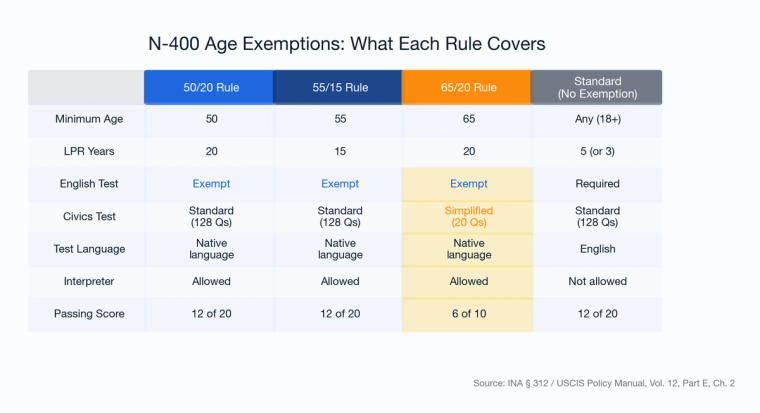
Congress created these exemptions at different points in time under INA § 312 / 8 U.S.C. § 1423. All three are confirmed in the USCIS Policy Manual, Vol. 12, Part E, Chapter 2.
How to count your qualifying years: LPR years run from your green card issue date and are cumulative, so time spent abroad doesn't erase prior years. You must meet both the age and the LPR requirements on the day you file Form N-400 (USCIS Policy Manual, Vol. 12, Part E, Ch. 2).
For a full walkthrough of the English proficiency test that non-exempt applicants must take, see our N-400 English language test guide.
How to Claim Your Exemption on Form N-400
You do not need separate pre-approval for an age-based English exemption. On the current Form N-400 edition, USCIS states its systems automatically calculate age-based English-test exemption eligibility based on your age, years of residence, and time of filing.
- The current Form N-400 no longer uses former Part 2, Item 13.a for the 50/20 exemption.
- The current Form N-400 no longer uses former Part 2, Item 13.b for the 55/15 exemption.
- The current Form N-400 no longer uses former Part 2, Item 13.c for the 65/20 exemption.
- If you are requesting a disability exception, submit Form N-648 with your Form N-400 or separately later, following the current Form N-400 and Form N-648 instructions.
USCIS verifies your qualifying age and LPR years against your application, your green card, and supporting documents at your interview. For a complete list of what to bring, see our citizenship interview document checklist.
What the 65/20 Simplified Civics Test Looks Like
If you qualify under the 65/20 rule, your civics exam draws from a smaller, designated set of questions. For applicants who filed Form N-400 before October 20, 2025, USCIS uses the 2008 civics test version; for applicants who filed on or after October 20, 2025, USCIS uses the 2025 civics test version.
- Study list: 20 designated questions (asterisked in the 2025 question bank)
- Questions asked at interview: 10 of those 20
- Passing score: 6 correct answers
For applicants who filed Form N-400 on or after October 20, 2025, the standard civics test draws from 128 questions and asks up to 20, requiring 12 correct answers. Applicants who filed before October 20, 2025, take the 2008 civics test instead.
For all 128 questions with the senior-specific ones marked, our 2025 civics test study guide has everything you need.
Interpreter Rules
All three age-based English/civics exceptions allow you to use an interpreter for the civics portion when you test in your language. Under USCIS interpreter rules and Form G-1256, your interpreter must:
- Be at least 18 years old
- Be fluent in both English and your language
- Complete Form G-1256 (Declaration for Interpreted USCIS Interview) at the appointment
- Not be your attorney or accredited representative
Adult children and other family members can serve as your interpreter. Your interpreter translates your answers but does not take the oath on your behalf. You and your interpreter attend the interview together.
Fees, Reduced Fees, and Fee Waivers
Current N-400 filing fees (effective April 1, 2024 per the USCIS fee schedule):
- Online: $710
- Paper: $760
- Reduced fee (household income at or below 400% of the Federal Poverty Guidelines): $380, requested in Part 10 of the current paper Form N-400.
- Fee waiver (at or below 150% FPG or qualifying benefit): $0 via Form I-912
Qualifying means-tested benefits can support a fee-waiver request, while regular Social Security retirement benefits and Medicare do not qualify by themselves.
For the full qualification criteria and how to apply, see our N-400 fee waiver guide.
Combining Age Exemptions with Form N-648
If you have a qualifying age-based exemption and a medical disability, you can use both. You can use an age exemption for the English test and file Form N-648 to seek a civics waiver based on a medical condition. They're not mutually exclusive.
This matters especially for applicants over 65 with fewer than 20 LPR years, who don't qualify for the 65/20 simplified civics test by age. A N-648 disability waiver may still be available if a licensed physician can document a qualifying condition. USCIS has tightened evidentiary standards to N-648 filings since mid-2025, so the certifying physician should be familiar with USCIS requirements.
For the full naturalization process, see our complete N-400 application guide. Or start your N-400 with Immiva today. We walk you through every part of the form.