
What Happens After Filing N-400: Your 2026 Timeline
From receipt notice to oath ceremony, here's every step of the naturalization process and how long each one actually takes.
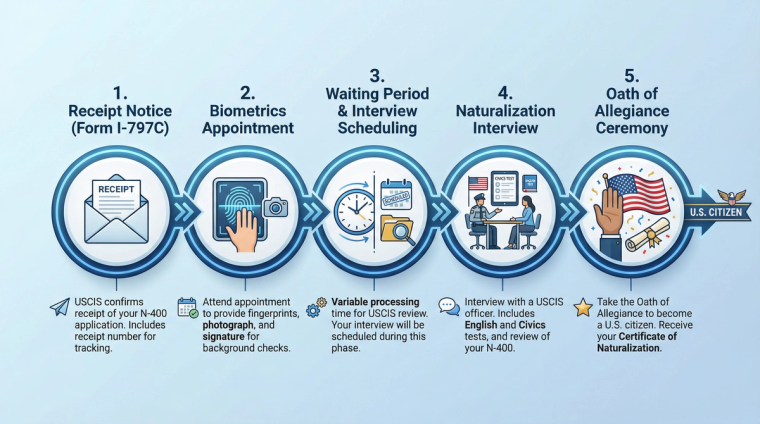
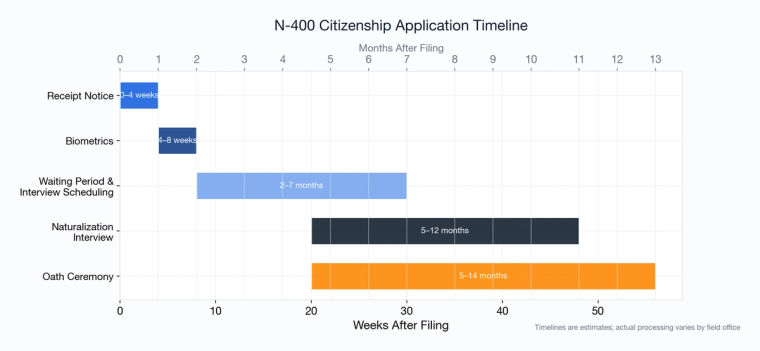
You just filed your N-400. Now what? The short answer: USCIS will walk your application through five steps before you become a U.S. citizen. How long the process takes varies widely by field office and your individual case. For the most accurate, up-to-date estimate, check the USCIS Processing Times tool for Form N-400 at your field office.
This guide breaks down exactly what happens after filing N-400, what to expect at each stage, and what's changed in 2025 and 2026 that could affect your timeline. If you're still preparing to file, start with our step-by-step N-400 application guide. And if you're not sure whether you meet the requirements for U.S. citizenship, check those first. For office-by-office wait times and real applicant timelines, see our N-400 processing times guide.
Step 1: Receipt Notice
The first thing you'll receive after filing N-400 is a receipt notice, formally called Form I-797C, Notice of Action. This confirms USCIS accepted your application and includes your 13-character receipt number.
If you filed online through your USCIS account, you may see this receipt the same day. Paper filers typically wait 2 to 4 weeks.
Your receipt number matters. You'll use it to track your case status on the USCIS case status tool. Receipt numbers for online filings start with "IOE."
What if you don't get a receipt? If your application was improperly filed (wrong fee, unsigned form, wrong form edition), USCIS sends a rejection notice and returns your package. This is not a denial. It means your application never entered the system. Fix the issue and refile. For guidance on avoiding common N-400 mistakes, make sure your application is complete before you submit.
Receipt vs. rejection: A receipt means your case is active. A rejection means USCIS never accepted it. If you haven't heard anything after 4 weeks (paper filing), you can submit a case inquiry.
Step 2: Biometrics Appointment
After your application is accepted, USCIS sends another I-797C scheduling your biometrics appointment at a local Application Support Center (ASC). For most applicants, that notice arrives within a few weeks to two months of filing.
The appointment itself takes about 15 to 20 minutes. USCIS collects your fingerprints, a photograph, and a digital signature. Your fingerprints go to the FBI for a criminal background check, which must clear before USCIS can schedule your interview (8 CFR § 335.2(b)).
Biometrics: Applicants who file Form N-400 must generally submit biometrics unless USCIS waives the requirement. USCIS will notify you if you must appear at an Application Support Center (ASC) for biometrics.
What to bring:
- Your biometrics appointment notice
- Your Permanent Resident Card (Green Card)
- A government-issued photo ID (driver's license, passport, or state ID)
For more on what happens at the appointment, read our biometrics appointment guide.
The good news: under the USCIS fee rule effective April 1, 2024, the separate $85 biometrics services fee for Form N-400 was bundled into the N-400 filing fee. You generally won’t pay anything extra at the biometrics appointment for an N-400.
Step 3: The Waiting Period and Interview Scheduling
After biometrics, your case enters the background check and review phase. This is where most of the wait happens.
USCIS will not schedule your interview until the FBI background check is complete (8 CFR § 335.2(b)). For most applicants, this happens within a few weeks. But if you have a common name or any flagged records, it can take longer.
Once cleared, USCIS mails an interview appointment notice with the date, time, and field office location. Interview scheduling timelines vary by field office and change frequently; check the USCIS Processing Times tool for current N-400 estimates in your location.
How long you wait depends on your field office. Processing times vary dramatically. You can check the current processing time for your specific field office using the USCIS Processing Times tool.
What to do while you wait:
- Start studying for the civics test. See our 128-question civics study guide.
- Gather documents you'll need for the interview.
- Don't panic if your case status says "actively reviewing" for months. That's normal.
- You can travel internationally, but make sure you're back for all appointments. Extended absences could affect your continuous residence (USCIS Policy Manual, Vol. 12, Part D, Ch. 3).
2025-2026 Changes That May Affect Your Wait Time
Several policy changes from 2025 could slow things down for some applicants:
Neighborhood investigations are back (Aug. 2025). USCIS policy memo PM-602-0189, dated August 22, 2025, ended a decades-old blanket waiver of the personal investigations required by INA 335(a). Officers now decide case by case whether to skip the investigation, which covers your residence and employment, and reports suggest USCIS began actually conducting them in November 2025. Most applicants still won't see one, but a case that gets picked can take longer.
A stricter good moral character review (Aug. 2025). Under policy memo PM-602-0188, dated August 15, 2025, officers look at your whole record instead of just checking for the absence of crimes. Positive contributions like steady work, family responsibilities, and community involvement now count in your favor, and problems weigh against you under a totality of the circumstances test. Our guide to applying for citizenship with a criminal record covers what this means in practice.
19-country processing hold (Dec. 2025). Multiple credible reports state USCIS issued Policy Memorandum PM-602-0192 on Dec. 2, 2025, placing a processing hold on pending benefit requests for people from the 19 countries listed in Presidential Proclamation 10949, and pausing adjudication of pending asylum applications. If you are affected, your N-400 case (including interview/oath scheduling) may be delayed.
Step 4: The Naturalization Interview
The interview is the step most applicants worry about, but it's usually straightforward. Most interviews last 10 to 20 minutes.
A USCIS officer will go through your N-400 application line by line to confirm your answers. This conversation doubles as the speaking portion of the English test. You'll also take a brief English reading test (read 1 of 3 sentences correctly) and a writing test (write 1 of 3 sentences correctly).
Then comes the civics test. Which version you take depends on when you filed:
- Filed before October 20, 2025: 2008 test. 10 questions from a bank of 100. You need 6 correct to pass.
- Filed on or after October 20, 2025: 2025 test. Up to 20 questions from a bank of 128. You need 12 correct to pass. The officer stops once you get 12 right or 9 wrong (USCIS 2025 Civics Test).
For more on what officers actually ask, read our N-400 interview questions guide. And for the packing list, see what to bring to your citizenship interview.
Three possible outcomes:
- Granted (approved). You move to the oath ceremony. Some offices offer same-day oaths.
- Continued. USCIS needs more evidence or wants to retest you within 60 to 90 days. This is not a denial.
- Denied. You receive written notice with the reason. You have 30 days to appeal using Form N-336 (INA § 336(a)).
Step 5: Oath of Allegiance Ceremony
Once approved, you're almost there. USCIS sends Form N-445 (Notice of Naturalization Oath Ceremony) with a short questionnaire you fill out before the ceremony. Depending on your field office, the ceremony happens anywhere from the same day as your interview to a few weeks after approval.
At the ceremony, you take the Oath of Allegiance, surrender your Green Card, and receive your Certificate of Naturalization. That certificate is your proof of citizenship until you get a U.S. passport.
Two types of ceremonies:
- Administrative ceremony (most common): Conducted by USCIS. Often held the same day as your interview at certain field offices.
- Judicial ceremony: Conducted by a federal judge. Required if you're requesting a name change. These take longer to schedule.
Same-day oath ceremonies are available at some field offices, including Atlanta, Fairfax (VA), Brooklyn, Garden City (NY), and certain Texas offices. But availability is not guaranteed, and not all offices participate (USCIS Naturalization Ceremonies).
After the oath: your first day as a U.S. citizen
You'll walk out of the ceremony with a Certificate of Naturalization. A few next steps are time-sensitive. You can apply for a U.S. passport the same day at any passport acceptance facility (bring the certificate and a photo). Update your Social Security record, register to vote, complete a new Form I-9 with your employer, and start any family petitions you're now eligible to file. For the full new-citizen checklist (including REAL ID, certificate replacement, and the steps most guides skip), see our after-oath new-citizen guide.