
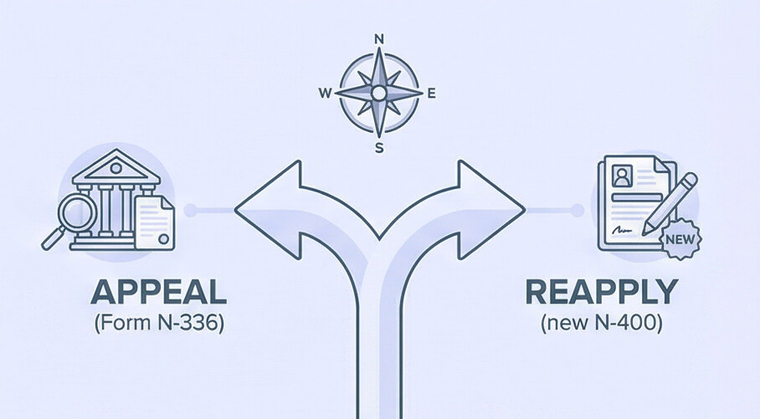
Getting your N-400 denied is stressful. You've put months into your citizenship application, and now you're staring at a letter that says no. But a denial is not the end. Over 50% of citizenship denial appeals are approved, according to data from the Immigrant Legal Resource Center (ILRC Practice Advisory). And yet only about 6% of denied applicants actually file one.
That gap between success rates and filing rates tells us something important. Most people don't appeal because they don't know how, or they assume it won't work. This guide covers all your options. Whether you choose to appeal through Form N-336, file a new N-400, or pursue federal court review, we'll walk you through each path so you can make the best decision for your situation. If you're starting the citizenship process from scratch, our step-by-step N-400 guide covers everything from eligibility to the oath ceremony. And if you want to check whether you're eligible before deciding your next move, try our free N-400 eligibility checker.
Why was your N-400 denied?
Applications get denied for all sorts of reasons: missing documents, unreported criminal history, eligibility issues. We cover the full list in our guide to the 12 most common N-400 mistakes. This article picks up from the denial itself: what your options are and how to move forward. Many denials come after an unanswered Request for Evidence. If you receive one, see our guide to responding to an N-400 RFE.
Your Three Options After N-400 Denial
When USCIS denies your N-400, you have three main paths forward (USCIS Form N-400 Page):
- File Form N-336 to request a hearing (appeal) on the denial
- File a new N-400 application to start over
- Request judicial review in federal district court (after exhausting the N-336 process)
There's also a fourth, less common option: filing Form I-290B as a motion to reopen or reconsider. But for most people, the real choice comes down to appeal (N-336) vs. reapply (new N-400).
Option 1: Appeal with Form N-336
Form N-336, officially called "Request for a Hearing on a Decision in Naturalization Proceedings," lets you ask for a second review of your denied application (8 CFR § 336.2).
The 30-Day Deadline
You must file your N-336 within 30 calendar days of receiving your denial notice. If USCIS mailed the decision, you get 33 days (USCIS N-336 Instructions). Miss this deadline, and USCIS will reject your filing and won't refund the fee.
Filing Fees
The N-336 filing fee is $830 for paper filing or $780 if you file online through your USCIS account (USCIS Fee Schedule). Military applicants under INA §328 or §329 pay nothing. Fee waivers are available if your household income is at or below 150% of the Federal Poverty Guidelines (8 CFR § 106.3). Note that USCIS stopped accepting paper checks and money orders for paper-filed forms starting Oct. 28, 2025; paper filings must be paid by credit/debit card (Form G-1450) or ACH debit (Form G-1650).
What Happens at the N-336 Hearing
USCIS must schedule your hearing within 180 days from the date the N-336 appeal is filed (8 CFR § 336.2(b)). In practice, most hearings happen within 3 to 6 months. What to expect:
A different USCIS officer reviews your case. This officer must be at the same grade level or higher than the officer who denied you (USCIS Policy Manual, Vol. 12, Part B, Ch. 6). The reviewing officer can conduct a full new (de novo) examination or a less formal review, depending on the situation.
The key advantages of the N-336 hearing:
- You can submit new evidence and testimony that wasn't in your original application
- If you failed the English or civics test, you can retake the test at the hearing
- The officer reviews your entire file fresh, which means errors from the first review can be corrected
If you're retaking the civics test during an N-336 hearing, be aware that USCIS administers the 2025 naturalization civics test to applicants who file Form N-400 on or after Oct. 20, 2025. The 2025 civics test draws 20 questions from a list of 128 civics questions, and you must answer 12 correctly to pass. Which test version applies depends on the N-400 filing date, not the hearing date.
N-336 Success Rates
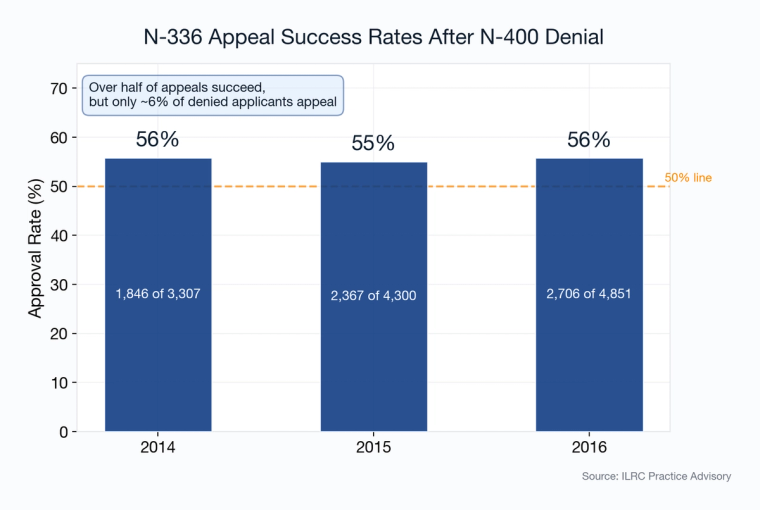
Between 2014 and 2016, N-336 approval rates consistently ranged from 55% to 56% (ILRC Practice Advisory):
- 2014: 56% approved (1,846 of 3,307 cases)
- 2015: 55% approved (2,367 of 4,300 cases)
- 2016: 56% approved (2,706 of 4,851 cases)
These are strong odds. More than half of the people who appealed their citizenship denial were ultimately approved.
Option 2: File a New N-400 Application
If you don't want to appeal, or if your 30-day window has passed, you can file a completely new N-400. There's no limit on how many times you can reapply, and there's no mandatory waiting period unless your denial was for a time-based requirement (like physical presence or continuous residence).
A new N-400 costs $760 for paper filing or $710 online (USCIS Fee Schedule). Reduced fees and fee waivers are available. For a full breakdown, see our guide on N-400 filing fees, attorney costs, and alternatives.
Reapplying makes the most sense when:
- Your denial was for a timing issue (physical presence, continuous residence) that you can fix by waiting
- The problem is easily correctable (missing documents, application errors)
- You've missed the 30-day N-336 deadline
- Your circumstances have changed (criminal case resolved, tax debt paid)
If you're reapplying on your own, our guide to filing N-400 without a lawyer walks you through the entire process. When you're ready, you can start your N-400 application with Immiva.
Option 3: Federal Court Review
If your N-336 appeal is also denied, you can take your case to federal district court (8 CFR § 336.9). You have 120 days from the date of the N-336 decision to file.
The federal court conducts a de novo review, meaning the judge makes an independent determination based on the facts and law. You are not limited to the arguments or evidence presented at the USCIS hearing.
A few things to know about judicial review:
- You must exhaust administrative remedies first (file N-336 before going to court)
- You are not required to have an attorney for this step, but many people hire one because federal court procedures are complex.
- It's relatively rare: TRAC reported that in FY 2013, there were 274 naturalization-related federal court filings compared to 83,112 naturalization petition denials (about 0.33%).
- Courts can order USCIS to grant naturalization if they find the denial was wrong
Federal court review is the right path when you believe USCIS misapplied the law or ignored evidence, and the N-336 hearing didn't fix it.
Appeal or Reapply? How to Decide
Choosing between filing an N-336 and filing a new N-400 depends on your specific situation. Here's a framework:
File an N-336 appeal when:
- USCIS made a factual or legal error in your denial
- You have new evidence that supports your eligibility
- You failed the English or civics test and want to retake it
- Your denial was based on good moral character and you can present a stronger case under the new "totality of circumstances" standard
- You're still within the 30-day deadline
File a new N-400 when:
- Your denial was for a timing issue you can resolve by waiting
- The problem was a simple, correctable mistake on your application
- Your 30-day N-336 deadline has passed
- Circumstances that caused the denial have changed (resolved criminal case, paid taxes)
Cost comparison: An N-336 appeal costs $780 to $830 and keeps your original case alive. A new N-400 costs $710 to $760 but starts the process over from the beginning, including a new citizenship interview and potentially a new biometrics appointment.
2025-2026 Changes That Affect Denied Applicants
Several recent policy changes directly impact what happens after an N-400 denial:
New Civics Test (October 2025). The civics test expanded from 100 to 128 questions, with applicants now needing 12 correct out of 20 (Federal Register, September 2025). If you were denied for failing the old test and are retaking during an N-336 hearing, which test version applies depends on your original N-400 filing date, not the hearing date.
Stricter Good Moral Character Standard (August 2025). The new "totality of circumstances" approach means USCIS officers evaluate your overall character more thoroughly (USCIS Policy Memo PM-602-0188). This can work for or against you on appeal. If you have strong positive evidence like community involvement, steady employment, and tax compliance, it may actually help your case at an N-336 hearing.
Fee Increases (April 2024). Current fees are $830/$780 for N-336 and $760/$710 for N-400 (USCIS Fee Schedule). Many online resources still show outdated fees. Make sure you pay the correct amount, or your filing will be rejected.
Rising Denial Rates (2025). N-400 denial rates increased in 2025, according to ILRC and other advocacy groups. Use our free eligibility checker to confirm you still qualify before you reapply.