
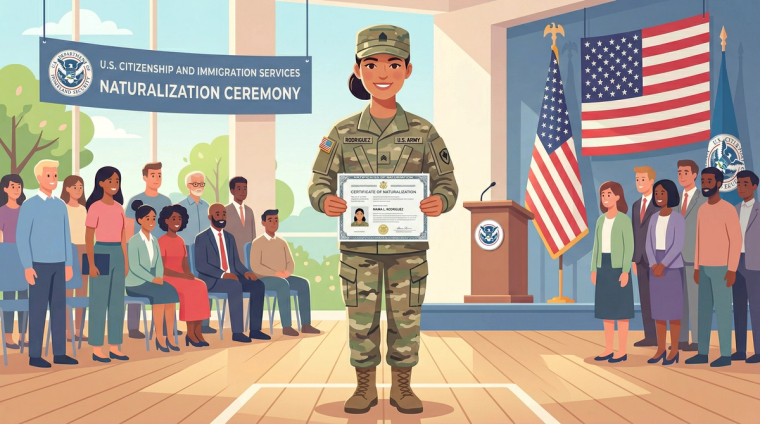
Does Military Service Automatically Give You Citizenship?
No. USCIS flags this as the most common misconception about military naturalization. Time in uniform doesn't make you a citizen, no matter how long you've served.
What service does give you:
- A $0 filing fee (vs. $760 for civilian paper filers)
- Waived continuous residence and physical presence requirements in most cases
- Walk-in biometrics using your military ID, with no scheduled appointment needed
- Typically faster processing than the civilian track, though USCIS doesn't publish a separate military timeline
You still need to file Form N-400, pass the English and civics tests, attend an interview, and take the Oath of Allegiance.
Your Two Paths: INA §328 vs. INA §329
Military members qualify under one of two statutes depending on when and how they served.
INA §328: Peacetime Service
You qualify under INA §328 (8 CFR Part 328) if you've served honorably for at least 1 year in any branch: Army, Navy, Marines, Air Force, Coast Guard, Space Force, or federally recognized National Guard.
Requirements:
- At least 1 year of honorable service
- Must hold a green card (LPR status) at time of interview
- Good moral character for the past 5 years
- At least 18 years old
- Pass the English and civics tests
If you file while still serving or within 6 months of honorable separation, the standard 5-year continuous residence and physical presence requirements are waived (USCIS Policy Manual, Vol. 12, Part I, Ch. 2).
INA §329: Service During Hostilities
You qualify under INA §329 (8 CFR Part 329) if you served honorably during a designated period of hostilities. The current period runs from September 11, 2001 through the present, per Executive Order 13269.
Requirements:
- Any amount of honorable active-duty or Selected Reserve service during a designated period
- Green card NOT required. You qualify if you were physically present in the U.S. at enlistment, or if you later became an LPR
- Good moral character for only 1 year (not 5)
- No minimum age requirement
- Fully exempt from all residence and physical presence requirements
| INA §328 (Peacetime) | INA §329 (Hostilities) | |
|---|---|---|
| Service required | ≥ 1 year | Any amount |
| Green card required? | Yes | No (if present at enlistment) |
| Residence waived? | Yes, if filing within 6 months | Fully exempt |
| Moral character period | 5 years | 1 year |
| Minimum age | 18 | None |
Not sure which path applies? Use Immiva's N-400 eligibility checker to find out in under 2 minutes.
How to Apply for Military N-400: Step by Step
Step 1: Confirm your eligibility path
Figure out whether you're filing under INA §328 or §329. This affects which checkboxes you select in Part 1 of Form N-400 and what documents you need.
Step 2: File Form N-400
Military applicants use the same Form N-400 as civilians. There's no separate military version. You can file online through a USCIS online account or by paper. If you file by paper, mail your package to the dedicated military address at the Chicago Lockbox (USCIS, Attn: Military N-400, P.O. Box 4446, Chicago, IL 60680-4446), listed on the USCIS direct filing addresses page.
Step 3: Submit Form N-426 (if currently serving)
If you are currently serving, you must include a signed and certified Form N-426 with your N-400. USCIS states that only authorized military personnel may certify Form N-426; certification authority is generally an officer in pay grade O-6 or above, or the civilian equivalent, subject to your service branch's policy.
Veterans with a DD Form 214, NGB Form 22, or other official discharge documents don't need N-426, per Policy Alert PA-2023-09 (March 2023). Include your discharge paperwork instead.
Step 4: Gather your documents
Along with N-400 and N-426 (if applicable), you'll typically need:
- Copy of your green card (§328 applicants)
- Military service records or DD-214
- Two passport-style photos, but only if you reside outside the United States
- Court records for any arrests or convictions
The N-400 document checklist covers everything to include.
Step 5: Biometrics
USCIS allows current and former service members to submit fingerprints at a USCIS Application Support Center in the United States before filing Form N-400. Bring your A-Number and evidence of current or prior military service, such as a military ID, official orders, enlistment contract, or discharge documents.
Step 6: Interview and civics test
You'll attend an interview and take the English and civics tests. N-400s filed on or after October 20, 2025 get the new 2025 civics test; earlier filings get the 2008 version. Our 128 civics questions study guide covers the current format and every question.
Step 7: Oath of Allegiance
If approved, you take the oath, often the same day as your interview at military ceremonies.
2025 and 2026 Policy Changes That Affect Military Applicants
Several updates took effect in the past year.
Uncharacterized discharges (effective guidance issued September 26, 2025): USCIS now states that an uncharacterized discharge issued before August 1, 2024 meets the separation 'under honorable conditions' requirement for military naturalization, while an uncharacterized discharge issued on or after August 1, 2024 does not.
New civics test (October 2025): Applications filed on or after October 20, 2025 take a tougher test drawn from a 128-question pool instead of the old 100.
Good moral character standards (August 15, 2025): USCIS issued policy guidance adopting a more rigorous, holistic good moral character review. A separate memo issued August 22, 2025 (PM-602-0189) resumed neighborhood investigations of naturalization applicants; reports indicate USCIS began conducting them in November 2025.