
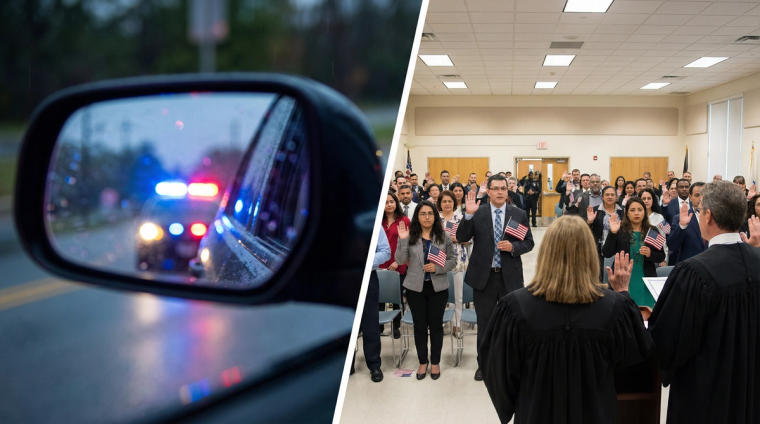
What the N-400 Actually Asks About Traffic Tickets
The question that causes the most confusion is Part 9, Item 15.b. of the N-400 form, part of the broader N-400 naturalization process. It asks:
That word "cited" is the key. A traffic citation counts. If a police officer pulled you over and gave you a speeding ticket, you were cited. That means you need to answer "Yes" to this question, even if the ticket was minor, even if you just paid the fine, and even if it happened 15 years ago (USCIS Form N-400 Instructions).
But here's the part most people get wrong: there's a separate rule about documentation. The current N-400 instructions say you generally do not need to submit documentation for traffic incidents unless the incident involved alcohol or drugs, led to an arrest, or seriously injured another person (Form N-400 Instructions, 01/20/25 edition). For arrests beyond traffic citations, see our guide on N-400 with a criminal record.
If you're unsure whether you meet the basic citizenship requirements, use our free N-400 eligibility checker to find out before you file.
Which Traffic Violations Affect Good Moral Character?
To become a U.S. citizen, you must demonstrate "good moral character" (GMC) during the statutory period, which is typically 5 years before filing (or 3 years if you're applying through marriage to a U.S. citizen). USCIS evaluates this under INA 101(f) and 8 CFR 316.10.
Not all traffic offenses are treated equally. Here's how USCIS categorizes them:
Generally not an issue:
- Speeding tickets (if isolated and fines paid)
- Stop sign or red light violations
- Expired registration or inspection
- Seat belt violations
- Most fines under $500 with no arrest
May raise concerns (case-by-case):
- Reckless or habitual traffic infractions (explicitly listed by USCIS as an example of conduct that may be inconsistent with civic responsibility)
- Driving without a valid license
- Multiple tickets showing a pattern of violations
- Unpaid fines or failure to appear in court
- Hit-and-run (could be classified as a crime involving moral turpitude under USCIS Policy Manual, Vol. 12, Part F, Ch. 5)
Serious problems:
- DUI/DWI (treated as a criminal offense, not a simple traffic ticket)
- Vehicular manslaughter (could trigger a permanent bar)
- Two or more DUI convictions during the statutory period (creates a rebuttable presumption of lack of GMC under Matter of Castillo-Perez, 27 I&N Dec. 664)
If you have a DUI on your record, that's a separate and more complex issue. See our guide on applying for citizenship with a DUI.
The catch-all provision in 8 CFR 316.10(b)(3)(iii) gives USCIS officers discretion to consider any "unlawful acts that adversely reflect upon the applicant's moral character." This means that even offenses not specifically listed in the statute can be held against you, especially if there's a pattern.
The 2025 USCIS Policy Change That Affects Drivers
On August 15, 2025, USCIS adopted a "totality of the circumstances" standard for good moral character (policy memo PM-602-0188), and the memo names "reckless or habitual traffic infractions" as conduct that can count against you. One old speeding ticket is still a non-issue; five or six tickets in a few years may read as a pattern.
Officers now also weigh what you have done right, so a longer driving record is easier to overcome with proof of steady work, community ties, and paid taxes at your citizenship interview. For the full breakdown of the 2025 GMC policy change, see our guide to N-400 with a criminal record.
Common Scenarios Explained
Here are the specific situations applicants ask about most:
"I got a speeding ticket last year. Am I OK?"
Almost certainly yes. A single speeding ticket with a fine paid on time is about as common as it gets. Disclose it on the N-400, and don't worry about it. Under the current N-400 instructions, you generally only need traffic-incident documentation if the incident involved alcohol or drugs, led to an arrest, or seriously injured another person.
"I have several speeding tickets over the past few years."
You'll need to disclose all of them. Under the August 2025 memo, a pattern of repeated violations could draw additional scrutiny. Pay all outstanding fines before filing and bring your driving record to the interview. The more tickets you have, the more important it is to also show positive moral character evidence.
"I got a red light camera ticket. Does that count?"
This is a gray area. In many jurisdictions, automated camera tickets are civil infractions issued to the vehicle owner, not criminal citations issued to a driver. Because the N-400 asks about being "cited by a law enforcement officer," a camera ticket may not technically qualify. But to be safe, disclose it. It's always better to over-disclose than under-disclose.
"My ticket was dismissed. Do I still report it?"
Yes. The N-400 asks if you were ever cited, not whether you were convicted. A dismissed ticket still happened. Disclose it and note that it was dismissed.
"I have unpaid traffic tickets."
Pay them before you file your N-400. Unpaid fines can signal a lack of respect for legal obligations, which USCIS may view negatively under the catch-all provision. An unpaid ticket that has gone to collections or resulted in a bench warrant is an even bigger problem. Before applying, check your N-400 document checklist to make sure everything is in order.
"I got a ticket between my interview and oath ceremony."
You are required to disclose any new citations or arrests that occur between your interview and your oath ceremony. At the oath ceremony, you'll be asked if anything has changed since your interview. Answer honestly. A single minor ticket received during this period will almost never delay or prevent your oath.
"I have tickets from another country."
The N-400 asks about citations by "any law enforcement officer," which includes foreign law enforcement. Disclose foreign traffic tickets just as you would domestic ones. You likely won't need to provide foreign court records for minor violations, but mention them on the form.
"I got a reckless driving charge."
Reckless driving is more serious than a basic speeding ticket. In some states, like Virginia, driving 20+ mph over the limit is automatically classified as reckless driving, which is a criminal misdemeanor. The 2025 GMC memo explicitly flags reckless driving. If you have a reckless driving conviction, bring all court documents and consider consulting an immigration attorney before filing.
What Happens If You Don't Disclose Traffic Tickets
This is where things get serious. Failing to disclose a traffic ticket on your N-400 can be far more damaging than the ticket itself.
Consider the case of Hemza Lefsih. He had never committed a crime, but he answered "No" to the citation question on the N-400 because he didn't realize that "cited" included traffic tickets. When USCIS discovered the undisclosed citations, it was treated as false testimony. He spent 30 months in federal custody (MLFA Case Study).
False testimony is a conditional bar to good moral character under INA 101(f)(6). If USCIS determines that you deliberately concealed information on your application, even something as minor as a traffic ticket, it can be grounds for denial.
What if you already filed and forgot to include a ticket? Bring it up at your interview. The USCIS officer will go through your N-400 with you, and you'll have the opportunity to make corrections. Volunteering the information shows good faith and is almost always viewed more favorably than having the officer discover it through a background check. Avoiding common N-400 mistakes like this can save you a lot of stress.
How to Prepare for Your Interview With a Traffic Record
If you have traffic violations on your record, here's how to prepare for your citizenship interview:
Before you file:
- Pay all outstanding traffic fines
- Request your driving record from your state DMV (and any previous states where you held a license)
- Gather court disposition records for any ticket involving a fine over $500, an arrest, alcohol/drugs, or injury to another person
- Resolve any bench warrants or failure-to-appear issues
At the interview:
- Bring your complete driving record, even if not technically required
- Have copies of paid fine receipts
- Be honest and straightforward about every citation
- If you have multiple violations, prepare evidence of positive moral character: community involvement, employment history, volunteer work, educational achievements, and tax returns
USCIS may require you to provide biometrics (including fingerprints) to conduct background and security checks, including a check of criminal history records maintained by the FBI. Don't assume a ticket won't come up during the process. It's always safer to disclose everything truthfully.
Frequently Asked Questions
Most minor traffic tickets, like speeding or running a stop sign, will not affect your N-400 citizenship application. However, you must disclose them on the form. The August 2025 USCIS policy change means officers now pay closer attention to patterns of "habitual traffic infractions." A few isolated tickets are generally not a problem, but a long history of violations could trigger additional scrutiny under the good moral character requirement. Use our N-400 eligibility checker if you're not sure where you stand.
Yes. The N-400 Part 9, Item 15.b asks if you have EVER been arrested, cited, detained or confined by a law enforcement officer (including certain military or immigration officials) for any reason, or been charged with a crime or offense. A speeding ticket is typically a citation, so you must answer "Yes" and list it. Under the current N-400 instructions, you generally only need traffic-incident documentation if the incident involved alcohol or drugs, led to an arrest, or seriously injured another person.
USCIS conducts FBI fingerprint-based background checks on all N-400 applicants during the biometrics process. Officers may also have access to state DMV databases. Don't assume that a traffic ticket won't show up. It's always safer to disclose everything voluntarily.
Usually not. Most parking tickets are civil penalties issued to the vehicle by mail or left on the windshield, not citations from a law enforcement officer, so they fall outside what Item 15.b. asks about. But if an officer stopped you and cited you in person, even for something minor, disclose it. When in doubt, disclose: listing a harmless ticket costs you nothing, while omitting one can raise questions later.
Bring it up at your citizenship interview. You'll have the opportunity to review and correct your application with the USCIS officer. Voluntarily disclosing information you missed shows good faith. Deliberately hiding a citation can be treated as false testimony under INA 101(f)(6), which is a conditional bar to good moral character.
Potentially, yes. While the ticket itself may be minor, leaving fines unpaid suggests disregard for legal obligations. Under the 2025 totality-of-circumstances standard, an officer may weigh unpaid fines as a negative factor. Pay all outstanding tickets before filing your N-400 application.
There's no specific number that automatically disqualifies you. USCIS looks at the overall pattern. Two or three minor speeding tickets over a five-year period are unlikely to cause issues. But ten or more violations, especially if they include reckless driving or unpaid fines, could raise concerns under the "habitual traffic infractions" language in the August 2025 GMC memo.
Yes. The N-400 asks whether you were ever cited, not whether you were convicted. A dismissed ticket still means you were cited. Disclose it and note that it was dismissed. See our N-400 interview questions guide for how to explain this to the officer.
You must disclose it. At the oath ceremony, you'll be asked whether anything has changed since your interview. A single minor traffic ticket received during this period will almost never delay your oath, but you must answer honestly.
No. DUI is treated as a criminal offense with entirely different consequences. A single DUI is evaluated case-by-case, and two or more DUIs during the statutory period create a rebuttable presumption of lack of good moral character under Matter of Castillo-Perez. For detailed guidance, see our guide on applying for citizenship with a DUI.