
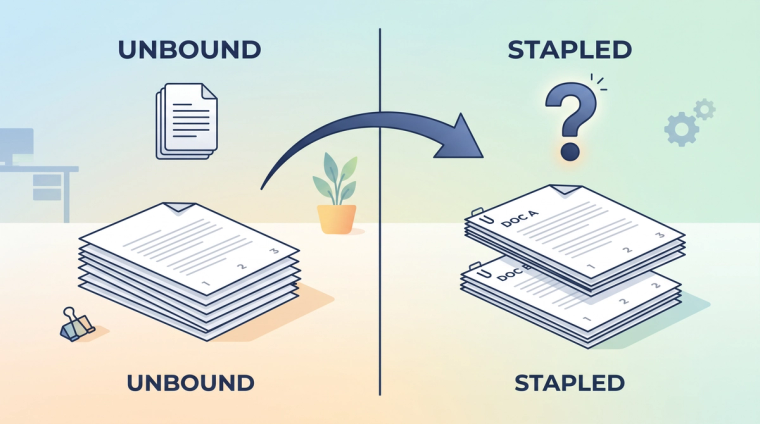
If you are an H-4 spouse trying to get a work permit, you have probably come across advice to file Form I-539 and Form I-765 together so everything moves at once. That advice held up through most of 2024. It does not hold up now. H-4 EAD concurrent filing still has real uses, but it stopped being an automatic speed boost when a court settlement expired in early 2025.
This guide covers what bundling actually does today, walks through the three situations H-4 spouses run into, and gives you a concrete standalone-versus-bundled decision. If you want the basics of the work permit itself first, our complete H-4 EAD guide and our H-4 visa overview for H-1B spouses cover the foundations.
What "concurrent filing" actually means for H-4 spouses
Three different forms come up in these conversations, and mixing them up is the source of a lot of confusion:
- Form I-129 is your spouse's H-1B petition. It belongs to the principal worker, not to you.
- Form I-539 is your application to get or extend H-4 dependent status. This one is yours.
- Form I-765 is your application for the Employment Authorization Document, filed under category (c)(26). This is the work permit itself.
"Concurrent" or "bundled" filing means submitting these together in one package, at the same time and to the same address, rather than one after another. The common combinations for an H-4 spouse are the I-539 plus the I-765, and sometimes all three forms at once when the principal is also filing an I-129.
The eligibility rule behind the EAD is narrow. Under 8 CFR 274a.12(c)(26), an H-4 spouse can work only when the H-1B principal either has an approved Form I-140 or holds H-1B status extended past the sixth year under AC21. If you are not sure which track applies to you, our post on the H-4 EAD and I-140 connection breaks down both options.
The three filing scenarios
Most H-4 spouses fall into one of three situations. Which one applies to you determines what you actually file.
| Scenario | What you file | When it applies |
|---|---|---|
| 1. Standalone EAD | I-765 only | You already hold valid H-4 status that is not expiring soon |
| 2. Extension bundle | I-539 (extension) + I-765 | Your H-4 status is valid but your I-94 is running out |
| 3. Change-of-status bundle | I-539 (change of status) + I-765 | You hold a different status now and need to become H-4 |
The first scenario is the simplest. If your H-4 status is already valid and your I-94 has plenty of time left, you do not need the I-539 at all. You just renew or apply for the EAD on its own.
The rule that decides everything: your EAD is gated by your I-539
When you file an I-765 together with an I-539, USCIS adjudicates the I-765 only after it has approved the I-539 and granted you H-4 status (USCIS, Employment Authorization for Certain H-4 Dependent Spouses). That is the part most people filing a bundle miss.
Your work permit cannot arrive faster than the status it depends on. The EAD is gated. USCIS also will not backdate the card to the day your H-4 status was granted; it runs from the date the I-765 is approved or the date you actually acquire H-4 status, whichever is later.
With that in mind, the standalone-versus-bundled question becomes a lot cleaner. Bundling does not let you skip ahead of your status. It keeps the two applications physically linked, nothing more.
Edakunni expired on January 18, 2025: what changed
For two years, a court settlement made bundling genuinely valuable. Under the Edakunni v. Mayorkas settlement, effective January 2023, USCIS was required to adjudicate a properly bundled H-4 I-539 and H-4 I-765 alongside the principal's I-129. That requirement ended when the settlement expired on January 18, 2025 (Berry Appleman & Leiden).
This is where most other articles get it wrong. You will still find pages and forum posts claiming that bundling with H-1B premium processing gets your EAD in about 15 days. That was the pre-2025 reality. After the expiration, bundling is discretionary. USCIS may still process the package together, but it is not required to, and it has made no commitment to keeping the old timing.
The myth to drop: Filing your I-539 and I-765 with a premium-processed I-129 does not put your EAD on a 15-day track anymore. Premium processing speeds up your spouse's I-129. USCIS is no longer obligated to move your dependent forms on the same clock.
One thing that has not changed: the program is secure. The Supreme Court declined to hear a challenge to the H-4 EAD rule in October 2025, so the work permit itself is not going away. The question in 2026 is not whether you can work. It is how to file so you get the card with the least delay.
Standalone vs. bundled: the 2026 decision framework
Given the gating rule and the post-Edakunni reality, here is how to think through the choice.
If your H-4 status is valid and not expiring soon, file the I-765 on its own. If your I-94 has eight or more months left, attaching an I-539 only adds a second application that has to clear before your EAD can move. It slows things down rather than speeds them up. This covers most renewals. Our H-4 EAD renewal guide covers the timing details, which matter more now that the automatic 540-day extension no longer applies to renewals filed on or after October 30, 2025.
If your H-4 status is valid but your I-94 is running out, bundle the I-539 extension with the I-765. You need both: a fresh period of H-4 status and a work permit that lines up with it. Filing them together keeps the package linked and means one submission to track instead of two.
If you are switching into H-4 from another status, bundle the I-539 change of status with the I-765. Moving from F-1, L-2, or another classification requires you to establish H-4 status before the EAD can issue. Bundling is the natural approach, but the gating rule still applies: the card waits for the status.
Premium processing on the principal's I-129 costs $2,965 as of March 1, 2026 and returns a decision in 15 business days (Federal Register, Adjustment to Premium Processing Fees). It can move your spouse's case quickly, but post-Edakunni it does not drag your dependent forms along on the same timeline. USCIS also designates H-4 Form I-539 for premium processing, with a $2,075 Form I-907 fee and a 30-business-day processing time, but that speeds only the H-4 status application; it does not create premium processing for the H-4 (c)(26) I-765. For the full picture on speed options, see our breakdown of H-4 EAD premium processing and expedite options.
If you are not sure which scenario applies to you, Immiva's free H-4 bundle eligibility check asks a few questions and points you to the right filing path.
Fees, form editions, and filing mechanics
The money and paperwork side trips people up almost as often as the timing. As of 2026:
- Form I-765: $520 by paper (8 CFR Part 106), current edition dated 04/01/24. For the bundled scenario this guide covers, the I-765 has to be filed by paper together with the I-539. The lower online rate does not apply when filing concurrently.
- Form I-539: $470 by paper, current edition 08/28/24. The separate $85 biometric services fee was eliminated under the April 1, 2024 fee rule (USCIS alert), so there is no biometrics fee for a standard H-4 I-539 today, and biometrics are generally not required for H-4 dependents, though USCIS can still schedule an appointment case by case.
A self-filed H-4 bundle runs about $990 total, paid as two separate amounts since USCIS may reject a single combined payment. Mail both forms in one package to the H-4 lockbox listed in the I-539 filing instructions. USCIS stopped accepting paper checks in late 2025; our guide on how to pay USCIS filing fees covers what is accepted now.
Attorney fees for an H-4 bundle typically run $1,500 to $3,000. If you would rather not pay that, Immiva walks you through the I-539 and I-765 question by question for a flat fee, building both forms from one set of answers so they cannot contradict each other. For the field-by-field mechanics, our walkthrough on how to fill out Form I-539 is a good companion.
Three pitfalls that get H-4 EADs rejected or denied
These three issues cause a large share of avoidable problems.
1. The (c)(9) versus (c)(26) trap. Category (c)(26) is for the H-4 EAD. But if you file Form I-765 based on a pending green card application (Form I-485), the I-765 category is generally (c)(9), not (c)(26), and the I-765 fee depends on when and how the I-485 was filed. If you send a (c)(26) H-4 EAD request to an I-485 filing address or use the wrong category for the benefit you are requesting, USCIS may reject the filing or delay the case. Getting the category code wrong is one of the more expensive small errors in this process.
2. Traveling while a change-of-status I-539 is pending. If you filed an I-539 to change into H-4 status and you leave the United States while it is pending, USCIS treats the application as abandoned and denies it, which takes your bundled I-765 down with it. This rule applies specifically to change-of-status filings. Our guide on traveling while your H-4 EAD is pending covers the details for extensions and standalone cases.
3. Expecting premium processing to save your EAD. There is no premium processing for an H-4 (c)(26) EAD. USCIS does designate H-4 Form I-539 for premium processing, but that speeds only the H-4 status application, not the H-4 EAD itself. Premium processing on the principal's I-129 can still move the H-1B case quickly, but as covered above, post-Edakunni it no longer pulls your dependent forms along automatically.
Immiva's filing logic flags the (c)(9)/(c)(26) category and travel-timing issues before you submit; you can see how that works on the H-4 EAD application page. Once your case is in, checking your EAD status keeps you from missing an RFE.