
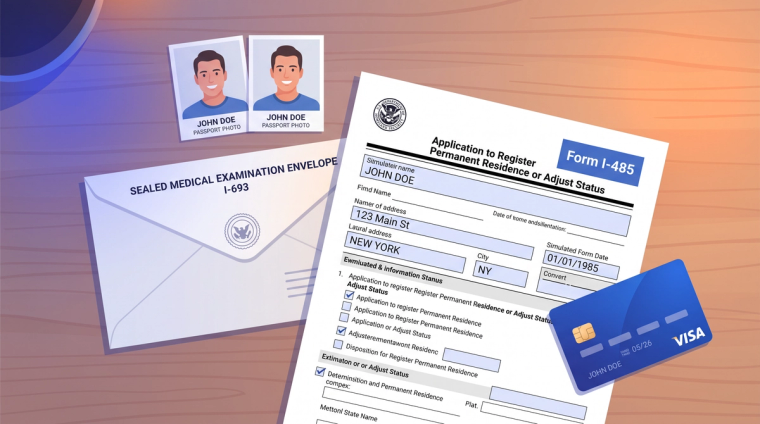
The short version of how to file I-485 in 2026: complete the 01/20/25 edition until September 18, 2026 and the 09/18/26 edition from that date, attach your I-693 medical exam when required, pay each form fee separately using an accepted payment method, and send the package to the correct USCIS lockbox. The longer version: at least a dozen USCIS rule changes took effect between December 2024 and January 2026. A guide written even a year ago might still tell you to submit the medical at the interview, pay by check, or use an older edition that USCIS will now return unopened.
This walkthrough is for self-filers. It follows the order you actually do things in, and flags every 2026 trap we have seen applicants fall into. If you would rather have a guided tool check each field as you go, Immiva's adjustment-of-status builder does that for a flat fee instead of attorney rates. You can see how Immiva works before you sign up.
Before you start: 3 changes that can get your I-485 rejected in 2026
These three rule changes rolled out quietly, and most free I-485 instructions 2026 guides still miss at least one. Read them before you touch the form.
You must submit the medical exam (I-693) with your I-485
Effective December 2, 2024, if you are required to submit Form I-693, USCIS requires you to submit it with Form I-485. If a required I-693 is missing, USCIS may reject the Form I-485.
A second, quieter change took effect on June 11, 2025: an I-693 is now valid only for the specific I-485 it was submitted with. If that I-485 is denied and you refile, you need a brand-new medical exam.
USCIS only accepts electronic payments
Effective October 28, 2025, USCIS generally requires paper filers to pay by card using Form G-1450 or by ACH using Form G-1650, unless they qualify for a paper-payment exemption.
Every form in a concurrent filing needs its own separate payment. One combined payment covering the I-485 plus the I-765 plus the I-131 gets the whole package rejected. Our guide to paying USCIS filing fees walks through G-1450 field by field.
You need the 01/20/25 form edition
File the 01/20/25 edition of Form I-485 if your packet is postmarked before September 18, 2026. From September 18 USCIS accepts only the 09/18/26 edition, revised for the new public charge rule, and there is no grace period. USCIS also lists a 09/04/26 edition, published on September 4, 2026 for a narrow interim final rule and blocked for now by a preliminary injunction, so it is not the one to file. USCIS announced a revised Form I-485 on December 10, 2024, and beginning April 3, 2025, USCIS accepted only the 01/20/25 edition. That edition folds the old I-864W exemption into the main form, updates the public-charge-related questions, and asks the applicant to identify the immigrant category on the form itself. Always download the PDF fresh from the official USCIS I-485 page.
Step 1: Confirm your eligibility and visa availability
Adjustment of status has two gates. You must be eligible under INA §245 and 8 CFR §245.1, and an immigrant visa must be immediately available to you in the month you file.
On the eligibility side, there are seven questions. You should be able to answer yes to all of them, or yes with a documented exception:
- Are you physically present in the United States?
- Were you inspected and admitted or paroled at the border? (VAWA self-petitioners, SIJ, and §245(i) grandfathered applicants are exceptions.)
- Are you the beneficiary of an approved or pending immigrant petition (I-130, I-140, I-360, I-526/526E, or an approved asylum grant)?
- Is a visa number immediately available in your category, or are you an immediate relative (where numbers are always available)?
- Are you free of the bars in INA §245(c)? Common bars include unauthorized employment, failure to maintain status, and Visa Waiver entries (the last one has exceptions for immediate relatives).
- Are you admissible, or do you have a waiver for any ground of inadmissibility that applies?
- Does your case merit a favorable exercise of discretion?
Visa availability is set by the State Department's monthly Visa Bulletin. USCIS decides each month whether adjustment filers use the Final Action Dates chart or the more generous Dates for Filing chart. For April 2026, USCIS is using Dates for Filing for both family-based and employment-based cases. Our visa bulletin walkthrough explains how to read the two charts, and the April 2026 Visa Bulletin analysis covers the current dates category by category.
If consular processing abroad would be faster than adjustment, compare the two paths before you decide. Our I-130 vs I-485 comparison lays out the trade-offs in timing and cost.
Step 2: Select your Part 2 category (where most self-filers get stuck)
Part 2 is the most-missed section of the form. It asks which adjustment-of-status basis you qualify under, and it routes your application to the right USCIS queue. Pick the wrong box and you get an RFE at best, a rejection at worst.
Part 2 splits into seven groups (3.a through 3.g), with roughly 27 subcategories inside them. Almost every self-filer falls into one of these real situations:
Do you need to check the §245(i) box?
INA §245(i) is a narrow exception that lets some applicants adjust status even though they entered without inspection or fell out of status. It applies only if you were the beneficiary (or derivative) of a qualifying labor certification or immigrant petition filed on or before April 30, 2001, and you pay a $1,000 penalty using Supplement A to the I-485 (8 CFR §245.10). If that does not describe you, leave Item 2 blank. Most applicants do.
Principal vs. derivative applicants
If you are the person the underlying petition was filed for, you are the principal, and you check the category that matches that petition. If you are the spouse or unmarried child under 21 of a principal, you are a derivative: you file your own I-485, you usually mirror the principal's category, and you list the principal's receipt number on your form. Every family member files a separate I-485. There is no single household application.
If you are not sure which box to check, Immiva's guided flow asks a handful of questions about your situation and fills Part 2 for you. That removes the most-common source of I-485 RFEs.
Step 3: Complete the medical exam (Form I-693)
Find a USCIS-designated civil surgeon on the USCIS Find a Doctor tool. Any other provider's report will not be accepted. The exam typically costs $200 to $500 and is not included in the USCIS filing fees. Vaccination gaps are the top reason for medical-exam delays, so bring your full vaccination record to the appointment.
Since January 22, 2025, USCIS has waived the COVID-19 vaccination requirement for adjustment applicants (USCIS alert). The other standard vaccinations still apply: MMR, polio, varicella, tetanus-diphtheria, Tdap, influenza, and hepatitis B.
Timing matters because of the new single-use validity rule. Plan the exam for 30 to 60 days before you file the I-485. The civil surgeon will seal the form in an envelope with their signature across the flap. Leave the envelope sealed and send it inside your I-485 packet. If you open it, USCIS will not accept it.
Step 4: Gather your supporting documents
Every I-485 needs the same core set of documents, plus a category-specific stack on top.
Every applicant sends:
- The completed Form I-485 (01/20/25 edition)
- Two U.S. passport-style photographs taken within the last 30 days
- A copy of your birth certificate, with a certified English translation if it is in another language
- A copy of the photo page of your passport and every page showing admission stamps
- A copy of your Form I-94 Arrival/Departure Record
- A copy of the receipt or approval notice for the underlying petition (I-797)
- The sealed Form I-693 medical exam
- Copies of any court or police records for every arrest, regardless of how the case was resolved
Family-based cases add: the marriage certificate (if spouse-based), divorce or death certificates ending prior marriages, and Form I-864 Affidavit of Support from the petitioning U.S. citizen or permanent resident. Our I-130 documents checklist lays out the relationship evidence USCIS looks for.
Employment-based cases add: the I-140 approval notice, Supplement J confirming the job offer still stands (not required for EB-1A or NIW self-petitioners), a recent employment verification letter, and the PERM labor certification if one was required.
If any of these documents is in a language other than English, USCIS requires a word-for-word certified translation. The translator signs a statement that they are competent in both languages. You do not need a licensed translator, but you cannot translate documents for your own case.
Step 5: Fill out Form I-485
The form is 24 pages and has 14 parts. Work through it in order. Three rules apply to every answer: answer every question, use "N/A" or "None" instead of leaving blanks, and keep every name, date, and address consistent with what you wrote on the I-130 or I-140.
Part 1 is your identity and status history. Part 2 is the filing category you selected in Step 2. Part 3 applies only if you are claiming an exemption from the Affidavit of Support. Skip it if you are not. Parts 4 through 8 collect your address and employment history, your parents, your marital history, your children, and six lines of biographic detail.
Part 9 asks the eligibility and inadmissibility questions, and it is the longest part of the form. Answer yes to anything that applies. Lying in Part 9 is a permanent bar to immigration benefits and grounds for removal. Parts 10 through 14 cover your signature, the interpreter and preparer sections, the signature you add at the interview, and the continuation space for answers that did not fit.
For what each field asks and how to word an answer, our part-by-part guide to filling out Form I-485 walks through all 14 parts.
This is the part of the I-485 step by step where Immiva's builder earns its fee. Every field is validated against the I-130 or I-140 on file, so a mismatched date or middle initial shows up before you submit, not four months later as an RFE.
Step 6: Prepare your companion forms
Most I-485 applicants file at least two companion forms in the same envelope. These are optional on paper but almost always worth it.
- Form I-765 (Application for Employment Authorization) gets you an EAD so you can work while the I-485 is pending. The filing fee is $260 when filed with a pending or concurrent I-485. The EAD validity was cut to 18 months on December 5, 2025, down from the previous five years.
- Form I-131 (Application for Travel Document) may be used to request Advance Parole while Form I-485 is pending. The filing fee for advance parole is $630, and USCIS warns that advance-parole requests are not an online-filed I-131 category.
- Form I-864 (Affidavit of Support) is required in most family-based cases and in some employment-based cases where the petitioner is a qualifying relative. The sponsor generally must show income at or above 125 percent of the Federal Poverty Guidelines, subject to recognized exemptions and special rules.
- Supplement J confirms that the job offer underlying an I-140 is still valid. Required in most employment-based cases, not required for EB-1A or NIW self-petitioners.
- Supplement A is required only for §245(i) applicants paying the $1,000 penalty.
A reminder on the payment rule: each of these forms needs its own G-1450 or G-1650 sheet. Combining payments rejects the whole package.
Step 7: How to file I-485 online or by mail
USCIS offers online filing for Form I-485 only in a narrow case: a stand-alone, employment-based application. If that describes you, you can file by uploading the completed PDF through your myUSCIS account, as long as you are not bundling the I-485 with anything other than Form G-28, the I-693 medical, or the 245(i) Supplement A. Every other I-485 goes in by mail.
File online only if:
- Your case is employment-based and you are filing the I-485 by itself (not concurrently with an I-140)
- You are not submitting it with any other form except G-28, the I-693 medical, or Supplement A for 245(i)
- You can upload the completed I-485 PDF and your underlying I-140 receipt notice through myUSCIS
File by mail (this covers most people) if:
- You are family-based. Family-based I-485s cannot be filed online yet, including marriage and immediate-relative cases
- You are filing concurrently, such as an I-130 or I-140 together with the I-485, or filing with any form other than the three exceptions above
- Your category has not been enabled for online filing, such as EB-5 and certain special immigrant categories
Paper filers send the package to one of the USCIS lockboxes. The correct address depends on your category and which state you live in. Check the current direct filing addresses before mailing. Addresses change roughly once a year.
If you are filing the I-485 concurrently with an I-130 or I-140, both forms go in the same envelope to the same address. See our complete I-130 guide for how concurrent filing works on the I-130 side. Premium processing is available for the I-140, but not for the I-485 itself.
Step 8: After you file: what happens next
After USCIS accepts the filing, it issues a receipt notice (Form I-797C). USCIS receipt numbers are 13-character identifiers that begin with a three-letter prefix such as EAC, WAC, LIN, SRC, NBC, MSC, or IOE.
If biometrics are required, USCIS will schedule a biometrics appointment notice after filing. At the appointment, USCIS collects fingerprints, a photograph, and a signature. Our biometrics appointment walkthrough covers what to bring and what actually happens in the room.
If you filed the I-765, your EAD typically arrives 2 to 5 months after filing. If you filed the I-131, your Advance Parole approval lands on the same rough timeline. USCIS often issues the EAD and Advance Parole as separate documents now, so plan for two documents arriving on separate timelines.
Current Form I-485 processing times vary by category and office, so applicants should check USCIS's Processing Times tool and, where relevant, USCIS's pending employment-based Form I-485 inventory resources. USCIS policy also states that adjustment interviews may be waived on a case-by-case basis, while family-based applications generally require the Form I-130 petitioner to appear for the interview with the principal applicant.
If USCIS sends you a Request for Evidence, you usually have 87 days to respond. Do not miss the deadline. The agency processes more than 11 million pending cases across form types, and missed deadlines move to the denial pile quickly.
Common mistakes that get I-485 applications rejected
After reviewing thousands of self-filed packets, these are the ten most common errors:
- Forgetting to include Form I-693 since the December 2024 rule change
- Using an outdated form edition (01/20/25 before September 18, 2026, then 09/18/26)
- Paying with a personal check after October 28, 2025
- Combining payments for multiple forms instead of paying each separately
- Picking the wrong Part 2 category or leaving it blank
- Name, date, or address inconsistencies between the I-485, I-130, and I-864
- Leaving fields blank instead of writing "N/A" or "None"
- Missing signatures (every form needs a handwritten signature in blue or black ink)
- Missing certified English translations for non-English documents
- Mailing to the wrong USCIS lockbox address for your state and category
Any one of these triggers a rejection or an RFE. Half of them would be caught by a basic validator.
The bottom line
Filing I-485 in 2026 really comes down to two things: using the current form edition with every required attachment, and getting Part 2 right. Everything else on the 24 pages is mechanical. The applicants who get their packets rejected are almost never failing at the mechanics; they are tripping on a December 2024 rule change or an October 2025 payment rule they did not know about.
If you want a second set of eyes on the whole packet without the attorney bill, start your I-485 with Immiva. The guided builder picks your Part 2 category, validates every field against your supporting petition, and flags every 2026 rejection risk before you mail.