
Filing Form I-130 to petition for a family member's green card starts with one question: what documents do I actually need? That depends entirely on your relationship to the person you're petitioning for. A spouse petition looks nothing like a sibling petition. Below is the I-130 documents checklist broken down by relationship type, so you can put together a complete package on your first try and avoid Requests for Evidence. Immiva's I-130 preparation builds this list around your specific relationship type.
Documents Every I-130 Petitioner Needs
Regardless of who you're petitioning for, your I-130 package needs these items.
Form I-130 itself. Use the current edition dated 04/01/24. USCIS rejects petitions filed on outdated form versions (USCIS Form I-130 Page).
Filing fee. The fee is $625 if you file online through myUSCIS, or $675 if you file by mail (USCIS Fee Schedule). Since October 28, 2025, paper filings require electronic payment: ACH debit with Form G-1650 or a credit, debit, or prepaid card with Form G-1450. USCIS grants limited exemptions that allow paper payment with Form G-1651.
Proof of your immigration status. U.S. citizens need one of the following: a copy of your U.S. birth certificate, Naturalization Certificate, Certificate of Citizenship, Consular Report of Birth Abroad (Form FS-240), or the bio page of an unexpired U.S. passport (8 CFR 204.2). Lawful permanent residents need a copy of the front and back of their Permanent Resident Card (Form I-551). If you need help locating your green card number or A-Number, those guides explain where to find them.
Passport-style photographs (if applicable). USCIS currently lists "2 passport-style photographs (if applicable)" for Form I-130 supporting evidence. Follow the current Form I-130 page, form instructions, and online filing prompts to determine whether photos are required in your case.
Certified English translations. Every document in a foreign language must include a full English translation with a signed certification statement from the translator. The translator doesn't need to be a professional or ATA-certified. Any competent bilingual person can translate and sign the certification. Notarization is not required, despite what many applicants assume (USCIS Policy Manual, Vol. 6, Part B, Ch. 4).
I-130 Documents Checklist for Spouse Petitions
Spouse petitions require more paperwork than any other I-130 category because you need to prove both the legal marriage and that the marriage is real. This is true whether the petitioner is a U.S. citizen (IR1/CR1 visa category) or a lawful permanent resident (F2A category).
Core Required Documents
Beyond the universal documents above, spouse petitions require:
- Form I-130A (Supplemental Information for Spouse Beneficiary). This is a separate form your spouse fills out and signs. If the beneficiary is outside the U.S., it can be submitted unsigned (USCIS I-130 Instructions).
- Marriage certificate. A copy of your civil marriage certificate issued by the government authority where the marriage took place.
- Proof of termination of all prior marriages for both you and your spouse. That means divorce decrees, annulment decrees, or death certificates for every previous marriage either of you had.
- Passport-style photographs of you and your spouse. The Form I-130 instructions call for photos in spousal cases; follow the current instructions and online filing prompts for the exact specs.
Bona Fide Marriage Evidence
This is where most petitioners come up short. Your marriage certificate proves you're legally married, but USCIS also wants proof that the marriage is real, not entered into for immigration purposes.
Primary evidence (carries the most weight): joint property ownership documents like deeds or titles, joint lease agreements, joint bank account statements, joint tax returns, joint insurance policies (health, auto, life), birth certificates of children born to the couple, and joint mortgage documents.
Secondary evidence (still useful): utility bills at the same address in both names, government IDs showing the same address, photographs together from different events and dates, travel records for trips taken together, wedding ceremony photos, communication records, joint memberships or subscriptions, and affidavits from people who know your marriage is real.
If you married less than two years before your spouse gets their green card, they'll receive conditional permanent resident status and will later need to file Form I-751 to remove those conditions.
LPR Petitioners: Additional Scrutiny
If you're an LPR who married within five years of getting your green card, USCIS applies a higher bar. You need to show by "clear and convincing evidence" that your earlier marriage (the one that led to your green card) wasn't entered for immigration evasion (8 CFR 204.2). If this applies to you, expect to put together a stronger-than-usual evidence package.
I-130 Documents Checklist for Parent Petitions
Only U.S. citizens who are 21 or older can petition for a parent. Parents of U.S. citizens are immediate relatives (IR5), so there's no visa backlog or priority date wait (USCIS Form I-130 Page). You don't need Form I-130A or photographs of the beneficiary for parent petitions.
Filing for Your Mother
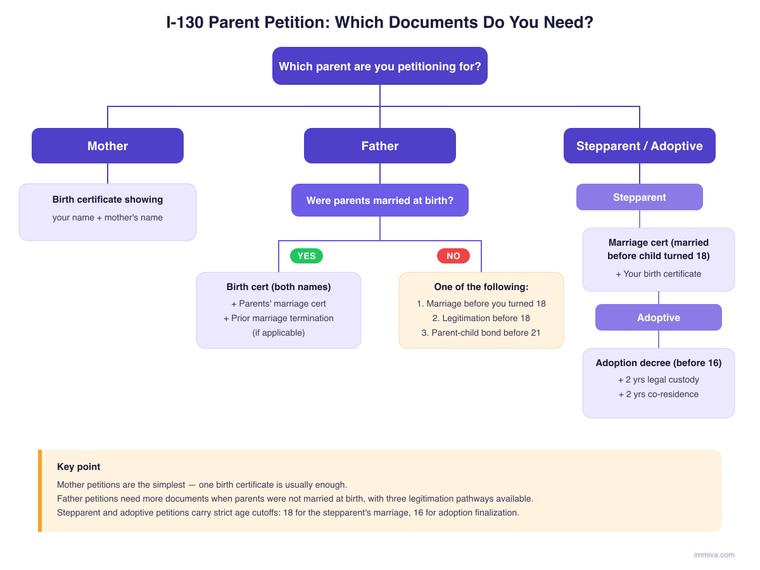
This is the easiest I-130 relationship to document. You need a copy of your birth certificate showing both your name and your mother's name. That's it.
Filing for Your Father
More paperwork here, depending on the circumstances of your birth.
If your parents were married when you were born: your birth certificate showing both parents' names, plus your parents' marriage certificate and proof of termination of any prior marriages.
If your parents were not married (born out of wedlock): you need to show that your father married your mother before you turned 18, that you were legitimated under the law of your country before 18, or evidence of a bona fide parent-child relationship established before you turned 21. That evidence can include records of co-residence, financial support (tax returns listing you as a dependent, money transfers), school records, medical records, and correspondence (8 CFR 204.2).
Stepparent and Adoptive Parent
Stepparent: your birth certificate, plus the marriage certificate showing the stepparent married your natural parent before you turned 18, plus termination documents for any prior marriages.
Adoptive parent: the adoption decree (adoption must have happened before you turned 16), plus evidence of at least two years of legal custody and two years of co-residence with the adoptive parent.
I-130 Documents Checklist for Children
What you need depends on which parent is petitioning and whether the child was born in or out of wedlock.
Mother Filing for a Child
A copy of the child's birth certificate showing the mother's name and the child's name. Nothing else.
Father Filing for a Child
Child born in wedlock: birth certificate showing both parents' names, marriage certificate to the child's mother, and proof of termination of any prior marriages by either parent.
Child born out of wedlock: the father needs to show one of the following: that he married the child's mother before the child turned 18, that the child was legitimated under applicable law before 18, or evidence of a bona fide parent-child relationship before the child turned 21. Evidence includes co-residence records, financial support documentation (tax returns listing the child as a dependent, bank transfer receipts), medical or insurance records that include the child, school records, correspondence, and third-party affidavits (8 CFR 204.2).
Stepchild
A copy of the marriage certificate showing the stepparent married the child's natural parent before the child turned 18, plus the child's birth certificate and termination documents for any prior marriages.
Adopted Child
The adoption decree (adoption must have happened before the child turned 16, or before 18 if the child is a sibling of another child already adopted by the same parent), plus evidence of two years of legal custody and two years of co-residence with the adoptive parent.
U.S. citizen vs. LPR petitioners: U.S. citizens can petition for children of any marital status and any age. LPRs can only petition for unmarried children. Children of U.S. citizens who are under 21 and unmarried are immediate relatives with no visa wait. All other child categories fall under preference categories subject to visa bulletin priority dates, which can mean multi-year waits.
I-130 Documents Checklist for Siblings
Only U.S. citizens who are 21 or older can petition for a sibling. Siblings fall under the F4 preference category, which has the longest backlogs in the family immigration system right now. Check the latest visa bulletin analysis for current F4 wait times.
Siblings sharing the same mother: a copy of each sibling's birth certificate showing the same mother's name.
Siblings who are both legitimate children of the same father: birth certificates for both siblings showing both parents' names, the father's marriage certificate to each sibling's mother (if different mothers), and termination documents for any prior marriages.
Half-siblings through a father (born out of wedlock): you need to prove a bona fide parent-child relationship between the father and each sibling. The same out-of-wedlock evidentiary standards from the parent and child sections above apply here.
Step-siblings: the marriage certificate showing the common parent's marriage happened before the relevant child turned 18, plus birth certificates for both siblings.
Online Filing vs. Mail Filing: What Changes
USCIS now allows online filing for all I-130 relationship categories through myUSCIS. Here's what's different between the two:
Fee: $625 online vs. $675 by mail. You save $50 by filing online (USCIS Fee Schedule).
Photos: The requirement is the same either way. Follow the current Form I-130 instructions and the online filing prompts for your case.
Form I-130A: For spouse petitions, you must submit Form I-130A with Form I-130. If filing by mail, include the completed paper Form I-130A. If filing online, follow the current USCIS online prompts and upload requirements for Form I-130A.
Payment: Online filing is paid electronically through the USCIS online system. For mail filing, USCIS has required electronic payment since October 28, 2025, usually by Form G-1450 (credit/debit/prepaid card) or Form G-1650 (ACH debit). Filers who qualify for an exemption can still pay on paper with Form G-1651.
Document upload: Online filers upload scanned copies directly. Mail filers send physical photocopies to the appropriate USCIS lockbox (USCIS I-130 Filing Addresses).
Receipt and tracking: Online filers get instant receipt confirmation and can track their case in real time. Mail filers typically wait several weeks for a receipt notice (Form I-797C).
Missing a Document? Secondary Evidence Options
Not everyone has a standard birth certificate or marriage certificate on hand. USCIS knows this and accepts alternative evidence in a formal hierarchy (8 CFR 103.2(b)(2)).
Missing Birth Certificate
USCIS follows a three-tier evidence hierarchy:
Tier 1 (Primary): A civil-authority-issued birth certificate. This is the standard.
Tier 2 (Secondary): If no birth certificate is available from the issuing authority, you can submit church or baptismal records, school records showing date and place of birth, census records, hospital birth records, or a doctor's or midwife's certificate.
Tier 3 (Affidavits): If neither primary nor secondary evidence exists, you can submit sworn affidavits from two people who were alive at the time of your birth and have personal knowledge of the event. Each affidavit needs the affiant's full name, address, date of birth, relationship to you, and a detailed explanation of how they know the facts stated (USCIS Policy Manual, Vol. 1, Part E, Ch. 6).
Missing Marriage or Divorce Certificate
If your marriage certificate is unavailable, alternatives include religious marriage records, tribal records, census records, and affidavits from people who attended the ceremony. For missing divorce or death certificates, you can use court records, religious documents, obituaries, or sworn affidavits from people with personal knowledge.
Documents from Countries with Poor Civil Records
If you're from a country where civil registration is unreliable or where records have been destroyed by conflict, USCIS expects you to provide whatever secondary evidence you can get, along with an explanation of why primary documents aren't available. Affidavits carry more weight in these situations.
5 Common Document Mistakes That Trigger RFEs
A Request for Evidence from USCIS can delay your case by months. USCIS may also deny petitions outright without issuing an RFE in some cases if essential initial evidence is missing or there is no legal basis for approval. Watch out for these:
- Submitting a marriage certificate without bona fide marriage evidence. The marriage certificate proves the legal marriage. It doesn't prove the marriage is real. USCIS wants joint bank statements, shared leases, photos together, and similar evidence showing your life together.
- Missing or incomplete certified translations. Every foreign-language document needs a full English translation with the translator's signed certification. Leaving out the certification statement, or only translating part of the document, will trigger an RFE.
- Not documenting termination of ALL prior marriages. If either the petitioner or beneficiary was previously married, you need divorce decrees, annulment decrees, or death certificates for every prior marriage, not just the most recent one.
- Name discrepancies across documents. If your name appears differently on your birth certificate, marriage certificate, and passport, include legal name change documentation explaining the differences.
- Using the wrong form edition. USCIS only accepts the current form edition (04/01/24). Check the USCIS I-130 page before filing to make sure you have the right version.
After I-130 Approval: What Documents Come Next
The I-130 is just the first step. After approval, the case moves to either adjustment of status (if the beneficiary is in the U.S.) or consular processing through the National Visa Center (if the beneficiary is abroad). Both paths require more documents, none of which are part of the I-130 filing itself:
Affidavit of Support (Form I-864): This financial sponsorship form, along with tax returns and income evidence, gets filed at the next stage, not with the I-130. A lot of applicants try to include financial documents with their I-130 petition. Don't. Financial evidence isn't needed until the adjustment or NVC stage (USCIS Form I-864).
Consular processing documents include police certificates, a medical exam from a panel physician, DS-260 (Immigrant Visa Application), and original civil documents for the visa interview (DOS Civil Documents Guide).
For preference category petitions (F1, F2A, F2B, F3, F4), the wait between I-130 approval and the next stage depends on your priority date and the visa bulletin. Immediate relatives (spouse, unmarried child under 21, and parent of a U.S. citizen) can move forward right away. For the full roadmap, see our guide to the next steps after I-130 approval.
You can also check whether your category and country are current in the Visa Bulletin Checker before you start gathering documents.