
People with criminal records are approved for green cards every year. But filing an I-485 with a criminal record the wrong way now carries a risk it did not two years ago, and the rules tighten again on September 18, 2026. Our adjustment of status guide covers the process itself; this covers the record.
Which offenses can block a green card
Criminal grounds of inadmissibility come from INA 212(a)(2), at 8 U.S.C. 1182(a)(2). Not every offense triggers one. The categories that do:
- Crimes involving moral turpitude. Offenses treated as inherently dishonest, violent or depraved: fraud, theft, embezzlement, perjury, assault with a weapon.
- Controlled substance violations. Any drug conviction, or an admission to the conduct, regardless of age or severity. Marijuana counts under federal law even where a state has legalized it.
- Two or more convictions with an aggregate sentence of five years or more.
- Trafficking, prostitution and money laundering, covered separately under 212(a)(2)(C) through (I).
A narrow petty offense exception covers a single crime involving moral turpitude carrying a maximum possible sentence of one year, where the actual sentence was six months or less. By statute it reaches one crime only, so two or more never qualify.
Whether the ground is waivable is the question that matters most:
| Generally waivable with Form I-601 | No waiver available |
|---|---|
| Crimes involving moral turpitude | Drug trafficking |
| Simple possession of 30g or less of marijuana | Human trafficking |
| Multiple convictions totaling five years or more | Murder or torture |
| Prostitution and commercialized vice | Aggravated felony after admission as an LPR |
DUIs sit in their own category. A single DUI with no drug element is not a crime involving moral turpitude in most circuits (USCIS Policy Manual, Volume 8, Part D). Multiple DUIs, or one with a drug element, weigh against you on the discretionary call. Our guide on applying for citizenship with a DUI covers how the same record resurfaces at the N-400 stage.
What counts as a conviction
This is where applicants get caught out. Under INA 101(a)(48)(A) (8 U.S.C. 1101), you have a conviction whenever a court found you guilty, you pled guilty or no contest, or you admitted facts sufficient to support a finding of guilt, and a judge then imposed any punishment, penalty or restraint on your liberty.
That captures plea deals, diversion programs and deferred adjudication. Outcomes your defense lawyer accurately called "not a conviction" in state court are often convictions for immigration purposes.
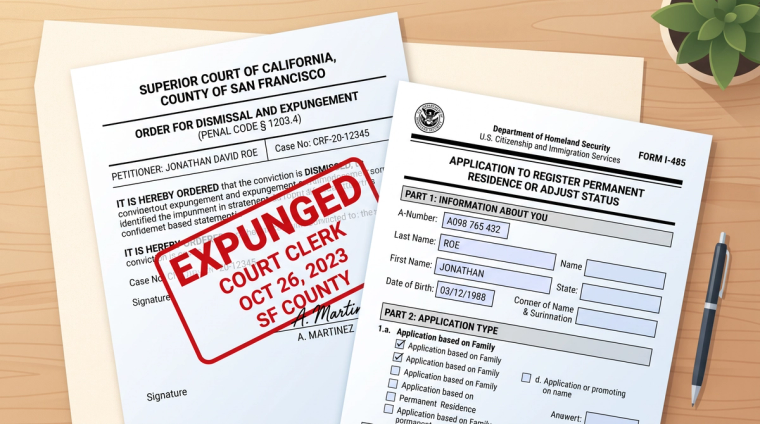
Expungement generally does not help. A state expungement granted for rehabilitative reasons does not erase a conviction federally, and the fingerprint check surfaces the arrest regardless. A vacatur granted on legal or constitutional grounds is the narrow exception.
How to disclose criminal history on Form I-485
Part 9 of Form I-485 asks whether you have ever been arrested, cited, charged, detained or convicted. That includes dismissed cases and deferred adjudications. Juvenile arrests generally require disclosure, even though a juvenile delinquency adjudication is not itself a conviction.
Answer yes where yes is true, then attach:
- A certified court disposition for every arrest, charge or conviction, from every jurisdiction
- The police report where you can obtain one
- A written statement explaining the circumstances and what has changed since
- Proof the sentence is complete: fines paid, probation discharged, classes finished
Non-disclosure is worse than disclosure in every case. A material misrepresentation is its own ground of inadmissibility under INA 212(a)(6)(C)(i), often a larger problem than the underlying offense. Your biometrics appointment reveals the record whatever the form says.
When you need a waiver
If your record triggers a 212(a)(2) ground, you will generally need Form I-601 alongside the I-485. The authority is INA 212(h), the fee is $1,050 (USCIS Form G-1055, edition 05/29/26), and approval is never automatic.
For a waivable ground you must establish one of two things:
- Extreme hardship to a qualifying U.S. citizen or lawful permanent resident spouse, parent, son or daughter of any age. Ordinary family separation does not meet it. You need documented financial, medical, educational or country-condition hardship beyond what any family would face.
- Fifteen years since the triggering conduct, plus rehabilitation and a finding that admission would not be contrary to the national welfare.
Winning a waiver takes legal argument and evidence, and that is a lawyer's job. Immiva prepares the I-485 but not I-601 waivers.
What changed, and why a denial costs more now
Notices to Appear after denial. USCIS policy memorandum PM-602-0187, issued February 28, 2025, directs officers to issue a Notice to Appear when a benefit request is denied and the applicant is not lawfully present (USCIS). A denial that once meant refiling can now mean immigration court.
Discretion is a separate hurdle. Policy alert PA-2025-16, issued August 19, 2025, restates that discretion is analyzed separately after threshold eligibility is met, weighing conduct, character, family ties and immigration history in the totality of the circumstances (USCIS). An arrest that never became a conviction can still count against you at that stage.
A new form edition with no grace period. From September 18, 2026, USCIS accepts only the 09/18/26 edition of Form I-485 and rejects the 01/20/25 and 09/04/26 editions postmarked or submitted on or after that date. The revision updates the form for the Public Charge Ground of Inadmissibility final rule, 91 FR 45324, effective the same day, which rescinds the 2022 regulations and restores broader officer discretion. Our 2026 public charge explainer has the detail.
Mandatory detention, but narrower than headlines suggest. The Laken Riley Act, Public Law 119-1, amended INA 236(c) to require detention of people arrested for or charged with burglary, theft, larceny, shoplifting, assault of an officer, or an offense causing death or serious injury. It reaches only those also inadmissible under INA 212(a)(6)(A), (6)(C) or (7): entry without inspection, fraud, or lack of valid documents. It does not sweep in every applicant with a shoplifting arrest.
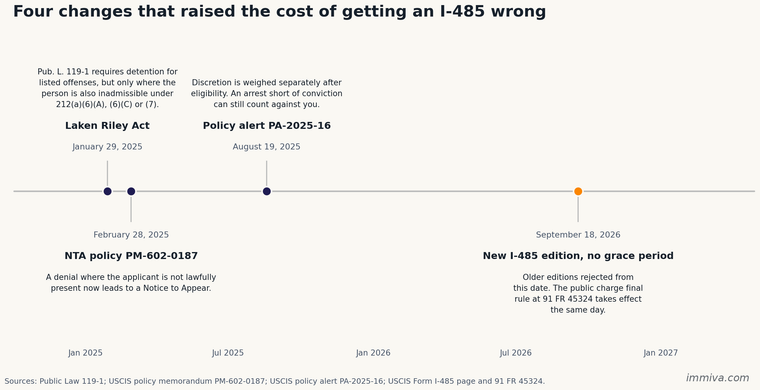
Three enforcement and discretion changes landed inside eight months of 2025, and the form itself changes in September 2026.
Before you file
Pull certified dispositions from every court, juvenile matters included. Request your FBI identity history summary so you know what USCIS will see. Gather rehabilitation evidence: employment records, tax compliance, counseling, character letters. File any I-601 together with the I-485 so the timelines stay aligned. If you have not confirmed you are eligible to adjust at all, the free eligibility check settles that first.
Then have the answers checked. Immiva's I-485 preparation runs up to 37 pre-filing checks, including criminal history grounds, removal and immigration court history, fraud and misrepresentation, and the full block of inadmissibility questions, each read against the rest of your answers. Every flag comes back with its reason, and you see the whole report before paying anything. Where something belongs with an attorney, the report says so, and you arrive at a consultation with the issue identified instead of an unfilled form.