
The official name is the Application to Register Permanent Residence or Adjust Status. Most people just call it the I-485, or "adjustment of status." It is a 24-page application that turns an existing immigration petition (an I-130 from a relative, an I-140 from an employer, an asylum grant, etc.) into a physical green card without you leaving the country.
The rules around I-485 changed more in the last 18 months than in the previous decade. Mandatory medical exams at filing, a new form edition, expanded enforcement after denials, the end of EAD auto-extensions, a 75-country immigrant visa freeze. If you read up on this two years ago, much of what you remember is wrong now. This guide is current as of April 2026.
What changed in 2025 and 2026
Here are the policy shifts that matter most if you are filing now or about to file. Skip the ones that do not apply to you.
Medical exam (Form I-693) is generally required at filing for applicants who must submit it. Effective December 2, 2024, USCIS may reject a Form I-485 if a required Form I-693 or partial Form I-693 is not included with the filing. As of June 11, 2025, a Form I-693 signed on or after November 1, 2023 is valid only while the application it was submitted with remains pending; if that application is denied or withdrawn, a newly filed I-485 requires a newly completed Form I-693.
The I-485 form edition changes again on September 18, 2026. USCIS made the 01/20/25 edition mandatory on April 3, 2025. Filing the old version gets your package rejected. The 01/20/25 edition folds in the I-864W exemption request, removed the "X" sex marker, and added new public charge questions. From September 18, 2026, USCIS accepts only the 09/18/26 edition, and there is no grace period.
Denial can lead to removal proceedings. USCIS issued updated Notice to Appear guidance on February 28, 2025, expanding when officers may issue NTAs after denying a benefit request. If you do not have a lawful basis to remain in the United States when your I-485 is denied, USCIS may place you in removal proceedings. USCIS said on June 12, 2025 that it had initiated removal proceedings against more than 26,700 people since the February 28, 2025 guidance.
The CSPA age calculation reverted. A 2023 rule used the more generous Dates for Filing chart to lock in a child's age under the Child Status Protection Act. USCIS reversed that on August 15, 2025. Officers now use the Final Action Dates chart, which is later. More children are aging out as a result, especially in EB-2 and EB-3 India backlogs. Cases pending before August 15, 2025 are grandfathered in.
The 540-day EAD auto-extension ended for new renewals. DHS published an interim final rule ending automatic extensions for EAD renewals filed on or after October 30, 2025. Separately, adjustment-based EADs issued on or after December 5, 2025 are capped at 18 months, down from five years. File renewals as early as the rules allow or you risk a gap in work authorization.
75-country immigrant visa freeze. As of January 21, 2026, the State Department paused immigrant visa issuance for nationals of 75 countries on public charge grounds. This blocks consular processing abroad but does not directly stop USCIS from approving I-485s domestically. For people from affected countries who are already in the U.S., adjustment of status may be the only realistic path right now.
USCIS generally stopped accepting paper checks and similar paper payments for mailed filings after October 28, 2025, unless you qualify for an exemption. For most paper filings, payment is made by card using Form G-1450 or ACH using Form G-1650. If you qualify for an exemption, USCIS allows paper payment with Form G-1651.
I-485 eligibility: who can file and who cannot
Adjustment of status comes from INA Section 245 and 8 CFR Part 245. To file an I-485, you need to clear seven gates:
- You are physically present in the United States.
- You were inspected and admitted, or paroled, at a port of entry. (Exceptions exist for Section 245(i) grandfathered applicants, VAWA self-petitioners, and Special Immigrant Juveniles.)
- You are eligible for an immigrant visa under one of the recognized categories.
- A visa number is available right now (immediate relatives are always considered "current").
- You are not barred under INA Section 245(c).
- You are admissible to the U.S., or you have a waiver for any inadmissibility ground.
- The officer decides, in their discretion, that you deserve a green card.
The decision tree below shows how those gates fit together for the most common applicants.
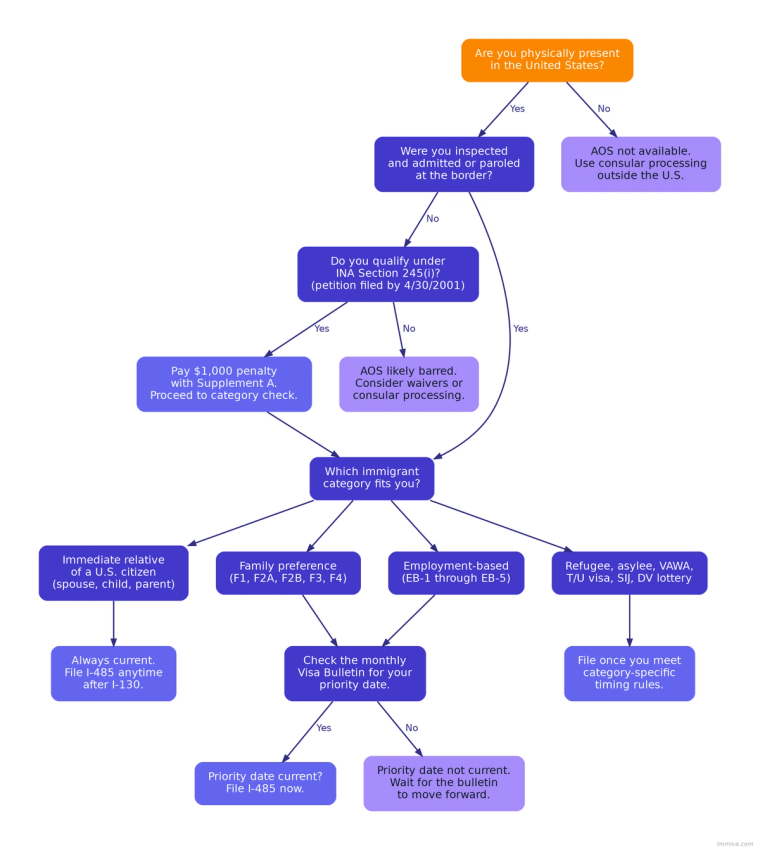
A simplified path through I-485 eligibility, from physical presence in the U.S. to whether you can file today or have to wait for a visa number.
Categories that can adjust status
Immediate relatives of U.S. citizens. Spouses, unmarried children under 21, and parents of U.S. citizens 21 or older. Visa numbers are always current, which means these applicants can file I-485 the day the I-130 petition is filed (or even concurrently with it).
Family preference categories. F1 (adult unmarried sons and daughters of citizens), F2A (spouses and minor children of permanent residents), F2B (adult unmarried sons and daughters of permanent residents), F3 (married sons and daughters of citizens), and F4 (siblings of citizens). All are subject to annual caps and per-country limits, which is what creates the backlogs you see on the Visa Bulletin.
Employment-based categories. EB-1 covers people of extraordinary ability, outstanding researchers, and multinational managers. EB-2 covers advanced degree professionals and the National Interest Waiver. EB-3 covers skilled workers and professionals. EB-4 is for special immigrants like religious workers. EB-5 is for investors.
Special categories. Refugees can adjust one year after admission. Asylees can adjust one year after the asylum grant. Diversity visa lottery winners, VAWA self-petitioners, T and U visa holders, Special Immigrant Juveniles, Cuban Adjustment Act applicants, and certain Afghan and Iraqi SIV holders all have their own paths.
Bars to adjustment
INA Section 245(c) lists who cannot adjust. The big ones: anyone who entered without inspection (EWI), anyone who worked without authorization, anyone who failed to maintain lawful status since their last entry, and most Visa Waiver Program visitors. Immediate relatives and some special immigrants are exempt from many of these bars.
The two important exceptions
Section 245(i) lets people who would otherwise be barred adjust status if a qualifying petition or labor certification was filed for them on or before April 30, 2001. You pay an extra $1,000 penalty using Supplement A. The petition has to have been "approvable when filed."
Section 245(k) is the exception practitioners rely on most for employment-based applicants. If you are filing in EB-1, EB-2, EB-3, or EB-5 and any period of status violation did not exceed 180 days since your last lawful admission, you can still adjust even if you have technically violated the bars in 245(c)(2), (c)(7), or (c)(8).
How the Visa Bulletin determines when you can file
The State Department publishes the Visa Bulletin every month. It tells you whether visa numbers are available right now in your category and country of birth. If you are filing family preference or employment-based and your priority date is not current, you cannot file the I-485 yet, no matter how strong your case is.
USCIS publishes its own Adjustment of Status Filing Charts page each month telling applicants which of the two charts to use:
- Final Action Dates are the cutoffs for actually approving a green card.
- Dates for Filing are usually earlier and let you submit the I-485 (and lock in your EAD and Advance Parole) before your case can be approved.
For April 2026, USCIS allowed use of the Dates for Filing chart for both family-sponsored and employment-based adjustment filings. But F2A was not current across the board in the April 2026 Visa Bulletin. In the Department of State's April 2026 bulletin, F2A showed listed cutoff dates rather than 'C,' and EB-2 Rest of World was current under Final Action Dates while EB-2 India was at July 15, 2014 under Final Action Dates.
If you are new to all this, our complete guide to how the Visa Bulletin works covers priority dates, retrogression, and the difference between the two charts in plain language. One thing to know: if demand spikes or policies tighten, retrogression can happen mid-year. Your I-485 stays pending if that happens, just on hold until your number is current again.
I-485 filing fees and costs in 2026
The base I-485 filing fee is $1,440 for most applicants 14 or older filing on paper, and $950 for certain children under 14 filing with a parent. Biometrics is included in the I-485 fee. Form I-485 is currently filed on paper, not through a general myUSCIS online filing workflow, so there is no discounted online filing fee.
That is the floor. Most people pay more.
If a family member is sponsoring you, our green card cost calculator adds up the I-130, I-485, and any work permit or travel document fees.
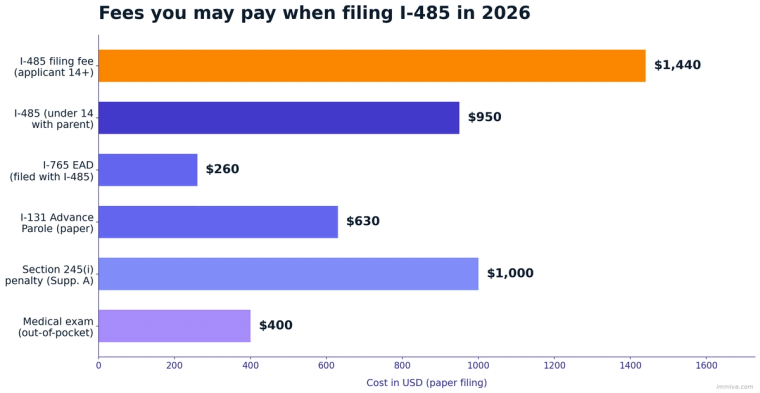
The fees an I-485 applicant may pay in 2026, including the core filing fee, work permit, travel document, and the optional Section 245(i) penalty.
If you want to work and travel while your case is pending, you will typically file Form I-765 ($260 if you have a concurrently filed or pending fee-paid I-485 filed on or after April 1, 2024) and Form I-131 ($630 for advance parole). Online filing for Form I-131 is category-specific, and for applicants with a pending I-485 it is available only in limited circumstances, such as when the I-485 receipt number begins with IOE. Section 245(i) applicants add a $1,000 penalty payment with Supplement A. The medical exam itself is paid out of pocket directly to the civil surgeon and varies by provider.
A family of four filing concurrently can easily clear $5,500 to $6,000 between government fees, work permits, travel documents, and medicals. The petition fee for the underlying I-130 sits on top of that for family-based cases. There are no USCIS payment plans for I-485, and standard family-based and employment-based applicants do not qualify for fee waivers. The Form I-912 fee waiver is limited to VAWA, T/U visa, SIJ, and other protected categories.
Each form needs its own payment now. USCIS rejects combined payments. Acceptable methods: credit or debit card (Form G-1450), ACH bank transfer (Form G-1650), or Pay.gov for online filings.
Premium processing is not available for I-485. There is no way to pay extra to speed things up. The only real options to escape the queue are mandamus litigation, USCIS expedite criteria (which are very narrow), or a congressional inquiry.
What you need to file an I-485
Every I-485 needs the same core package, plus extras that depend on your category. The universal list:
- The completed Form I-485 (edition 01/20/25 before September 18, 2026, then 09/18/26), signed and dated
- Filing fee payment (Form G-1450 or G-1650, or Form G-1651 if you qualify for an exemption to the electronic-payment requirement)
- Two passport-style photos
- Copy of your government-issued photo ID and birth certificate (with certified English translation)
- Copy of your most recent I-94 arrival/departure record
- Copy of every passport page with U.S. visas, admission stamps, or entry markings
- Form I-693 medical exam in a sealed envelope from a USCIS-designated civil surgeon
- Documentation of your underlying immigration category (the I-130 or I-140 receipt or approval, the asylum grant, the diversity visa selection notice, etc.)
Family-based applicants add proof of the qualifying relationship: marriage certificate, birth certificate, prior marriage termination documents if applicable, and substantial evidence of a bona fide marriage if the relationship is the basis of the petition. You will also need Form I-864 Affidavit of Support from the petitioner with current income evidence. The I-130 documents checklist covers what the petitioner side looks like.
Employment-based applicants generally submit the I-140 approval notice (or receipt for concurrent filing) and, when required, Form I-485 Supplement J to confirm the qualifying job offer or portability request. EB-1A and NIW self-petitioners do not file Supplement J.
Asylees and refugees need their I-94 showing asylum grant or refugee admission, evidence of one year of continuous physical presence, and confirmation they still qualify (have not been firmly resettled, asylum has not been terminated, etc.).
All foreign-language documents need certified English translations. The USCIS evidence checklist is the most authoritative source if you want to double-check.
Step-by-step: how to file Form I-485
This is the short version of the process. For a part-by-part walkthrough of the form itself, including the Part 2 category choices that trip up most self-filers, see our step-by-step guide to filing I-485.
In brief, the sequence is: confirm your priority date is current on the Visa Bulletin (immediate relatives can skip this), complete the medical exam with a USCIS-designated civil surgeon, and pull together your supporting documents with a cover letter and tabs. Then fill out the right Form I-485 edition in full (01/20/25 before September 18, 2026, then 09/18/26), add any companion forms you need (I-765 for a work permit, I-131 for travel, I-864 from your sponsor if family-based), pay each form separately by card (G-1450) or ACH (G-1650), and mail the package to the correct USCIS filing address for your category. Family-based I-485s are filed by mail; only a stand-alone employment-based I-485 can be filed online. Immiva's I-485 preparation walks that sequence question by question and audits the packet before you file.
If you are filing concurrently with I-130 or I-140, both petitions and the I-485 ship in the same package. Concurrent filing saves months because you do not wait for the underlying petition to be approved before starting the green card clock. (For context on the underlying petition itself, our I-130 processing time guide covers what to expect when filing it separately.)
What happens after you file
USCIS receipts the package within a week or two and mails Form I-797C, your receipt notice with a case number. From there:
- Biometrics appointment. USCIS schedules biometrics within three to five weeks of filing. You go to an Application Support Center, get fingerprinted and photographed, and that is it. No interview, no questions. Our biometrics appointment guide covers what to bring and what really happens.
- EAD and Advance Parole. If you filed I-765 and I-131, the work permit and travel document usually arrive in two to five months. USCIS often issues the EAD and Advance Parole as separate documents now, so plan for two documents arriving on separate timelines. New EADs are valid for up to 18 months.
- Interview notice (if required). Family-based interviews almost always happen. Employment-based interviews are waived in roughly 72% of cases as of 2026, which is a big jump from 45% in 2022.
- The interview itself. Six to fourteen months out, on average. The officer reviews your file, confirms identity, asks about the basis of your petition, and either decides on the spot, asks for more evidence, or takes the case under advisement.
- Decision. Approval comes as a Form I-797 notice, then your green card arrives in the mail two to three weeks later. Denial comes as a written explanation that includes your appeal or motion options. RFEs come on Form I-797E and give you 87 days to respond.
You can check your case status online with your receipt number through the USCIS Case Status tool. Sign up for e-notifications using Form G-1145 when you file so you get text or email alerts at each step.
I-485 processing times in 2026
Processing times depend heavily on category, service center, and field office. The numbers below are medians from USCIS data for early 2026:
- Employment-based, Nebraska Service Center: around 9.8 months (the fastest in the country right now)
- Employment-based, Texas Service Center: around 13.5 months
- Employment-based, National Benefits Center: 15 to 17 months
- Immediate relative, national average: 10 to 13 months
- Marriage-based in high-volume cities (NYC, LA, SF): 19 to 26 months
- Family preference categories: 17 to 23 months
- EAD and Advance Parole: 2 to 5 months
The pending I-485 backlog has dropped from a peak of about 885,000 cases in 2023 to around 720,000 in early 2026. The total USCIS backlog still tops 11 million cases across all forms, but I-485 specifically is moving in the right direction. Interview waivers are doing a lot of the heavy lifting on the employment side.
If your case sits well past the published processing time, options include a USCIS service request, a congressional inquiry, or a federal mandamus lawsuit. Mandamus actions have ballooned to over 7,000 per year against USCIS and typically resolve within 60 to 90 days.
Working and traveling while your I-485 is pending
Filing I-485 does not automatically give you the right to work or travel. Those come from separate forms.
Form I-765 gives you a work permit (EAD). The fee is $260 if your fee-paid I-485 was filed on or after April 1, 2024, and the category code for adjustment-based EADs is (c)(9). The rules changed several times in 2025: new cards are capped at 18 months and the automatic renewal extension is gone, so plan renewals early.
Form I-131 gives you Advance Parole. This is your permission to leave the U.S. and come back without abandoning the I-485. Leaving without an approved Advance Parole almost always means USCIS treats your application as abandoned. Two big exceptions: H-1B and L-1 holders with valid status and visa stamps can travel using their nonimmigrant status without abandoning the I-485, and people with TPS or other special protections may have their own rules.
AC21 portability under INA Section 204(j). If your I-485 has been pending 180 days or more and your I-140 is approved, you can change to a same-or-similar occupation with a new employer without restarting the green card process. You file Supplement J to confirm the job offer is still valid, or to notify USCIS of a portability move.
H-1B and EAD interaction. Using your EAD-based work authorization can terminate H-1B status. If you might want to keep H-1B as a backup (for example, in case the I-485 is denied), do not use the EAD as your primary work authorization. Talk to your employer's immigration team before making the switch.
The I-485 interview
Most I-485 applicants get interviewed. The officer's job is to confirm your identity, verify the petition basis, and check that nothing in your background or current circumstances disqualifies you.
Marriage-based interviews. The officer will ask about how you met, your wedding, daily life, finances, and shared experiences. Bring updated bona fide marriage evidence: joint bank statements, lease or mortgage documents in both names, joint utility bills, photos across multiple years and contexts, joint tax returns, and affidavits from people who know you as a couple. Bring originals of all civil documents you filed copies of.
Employment-based interviews. When required, the officer asks about your role, the employer, your duties, and how you continue to qualify for the I-140 category. Bring an updated employment verification letter, recent pay stubs, your current resume, and Supplement J if you have changed jobs.
Interview waivers. USCIS waives interviews on a case-by-case basis. Common waiver categories: unmarried children under 21 of U.S. citizens, parents of citizens, and a large share of employment-based EB-2 and EB-3 cases since 2024. You do not request a waiver. USCIS decides.
If both spouses are interviewed in a marriage case, expect a Stokes interview only when the officer suspects fraud. The standard joint interview is much shorter. Be honest, do not guess, and ask for clarification if you do not understand a question.
I-485 denials and RFEs: how to respond
About 9% of I-485 cases are denied. The most common reasons:
- Inadmissibility (criminal history, missing vaccinations, prior immigration violations, fraud)
- Failure to maintain status or unauthorized employment (with no 245(k) or 245(i) cure)
- Incomplete documentation (wrong form edition, missing signatures, missing I-693)
- Insufficient bona fide marriage evidence
- Missing the 87-day deadline to respond to an RFE
- INA 245(c) bars with no exception
- Public charge concerns or insufficient I-864
- The underlying I-130 or I-140 was denied or withdrawn
RFEs (Requests for Evidence) come on Form I-797E and tell you exactly what is missing. You have 87 days. Read it three times. Provide everything asked for, plus a cover letter explaining what you are submitting and where to find it. Do not include unrelated material. Do not go past the deadline. If you genuinely cannot get a document in time, you can ask for an extension, but USCIS rarely grants it.
Post-denial options. A motion to reopen or reconsider on Form I-290B within 30 days. Refiling if the denial reason is fixable. Appeal in limited circumstances. Removal defense if USCIS issues a Notice to Appear (which is now far more common after February 2025).
The bigger risk under the expanded NTA policy: a denial of your I-485 can put you straight into immigration court if you do not have valid status. That makes self-filing risky for cases with any complications. If you are not sure your case is clean, get it reviewed before you submit, not after.
I-485 vs. consular processing
Adjustment of status happens inside the U.S. with USCIS. Consular processing happens outside the U.S. with the State Department. Both end with the same green card. Which path is right for you depends mostly on where you are right now and what your category looks like.
AOS makes more sense when you are already in the U.S. in valid status, want to work and travel while waiting, and your case is straightforward. Consular processing makes more sense when you are abroad, when your category moves faster overseas, or when interview backlogs in the U.S. are worse than at your local consulate.
The 75-country immigrant visa freeze tilted this calculation. If you are a national of an affected country and you are already in the U.S., AOS may be the only realistic path right now. Consular cases for those nationals are stuck. The Trump travel ban update covers which countries are affected and how the rules apply at consulates.
Common mistakes to avoid
What gets I-485s rejected, RFE'd, or denied:
- Filing the wrong form edition (01/20/25 before September 18, 2026, then 09/18/26)
- Forgetting to include I-693 in the initial package
- Combined payments instead of separate payments per form
- Missing or unsigned forms (every form has a signature line, every line matters)
- Untranslated foreign-language documents
- Traveling without an approved Advance Parole
- Letting an EAD lapse and continuing to work
- Filing before your priority date is current
- Stale employment verification letter (must be within 30 days of filing for EB cases)
- Underestimating total cost and running out of money mid-process
The single most expensive mistake is traveling without Advance Parole. There is no path back from an abandoned I-485 except to start over from a new entry, which most people cannot do.