
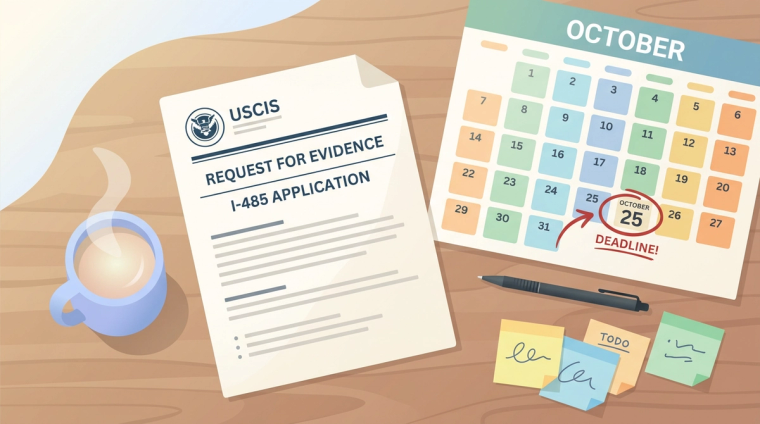
The mail comes, or the email lands in your USCIS online account, and you see "Request for Evidence" or, worse, "Decision." It's a bad feeling. But an RFE is routine, not a red flag, and most well-prepared responses do lead to approval. A denial hurts, but depending on why it happened, you may still have options: a motion, refiling, or renewing the case in immigration court.
USCIS scrutiny has shifted in some categories, but denial rates vary by filing category, office, quarter, and form type. USCIS publishes Form I-485 quarterly data by category, and there's separate guidance for EB-2 National Interest Waiver petitions, so any broad percentage claim should be tied to a current, form-specific official source. Most applications are still approved, and most RFEs are fixable. What matters is responding precisely, on time, and with the right evidence. This guide explains why I-485 RFEs and denials happen, how to respond to each, and which recent policy changes matter for your case.
If you're still getting ready to file, our step-by-step guide to adjustment of status explains how the I-130 and I-485 fit together, and our I-130 petition guide covers the underlying family petition.
What is an I-485 Request for Evidence?
An I-485 RFE is a written notice from USCIS asking for more documents or clarification before they decide your case. It is not a denial. It is not a pre-denial. USCIS is telling you the file in front of them isn't quite enough to approve, and they're giving you a chance to fill the gap.
RFEs are governed by 8 CFR § 103.2(b)(8), and current policy under USCIS Policy Manual, Vol. 1, Part E, Ch. 6 tells officers to issue an RFE rather than deny outright when a deficiency could reasonably be cured. Since July 2018 (PM-602-0163), officers can also deny without issuing an RFE in some cases. That's why precision on the original filing matters so much.
Three documents often get confused:
- An RFE asks for more evidence before a decision
- A Notice of Intent to Deny (NOID) warns you USCIS plans to deny and gives you a chance to respond
- A denial is the final decision
If you aren't sure which one you got, look at the top of the notice. The title tells you.
Where I-485 RFEs actually come from
Immigration attorneys who track RFE patterns across thousands of cases see a fairly consistent distribution. Medical exam issues lead by a wide margin.
Medical exam issues (Form I-693)
The biggest RFE category by far. As of December 2, 2024, applicants who must file Form I-693 have to submit it with Form I-485 at filing, not later at the interview. USCIS also updated policy effective June 11, 2025 to clarify that a Form I-693 signed on or after November 1, 2023 is valid only while the application it was filed with stays pending. The usual triggers: a civil surgeon who forgot to sign or date the form, a missing or broken seal, incomplete vaccination records, or TB screening that needs follow-up.
Employment verification and job portability
Employment-based RFEs typically ask for an updated employer letter confirming the job still exists, a Form I-485 Supplement J if you're porting under INA § 204(j), or evidence the job offered matches the labor certification. Supplement J mistakes and missing "ability to pay" evidence come up again and again.
Affidavit of support (Form I-864)
Common gaps on family-based cases: sponsor income below 125% of federal poverty guidelines, missing or incomplete IRS tax transcripts, the wrong form edition, or a joint sponsor whose household math doesn't add up.
Bona fide marriage evidence
Under Policy Alert PA-2025-12 (effective August 1, 2025), USCIS updated family-based immigrant petition guidance and made clear that petitioners have to establish the qualifying relationship and, where it applies, the bona fides of the marriage before Form I-130 approval. Couples without joint accounts, leases, or titled assets can face heavier scrutiny on the evidence. The fix is usually better, more probative evidence of a shared life, not necessarily more money.
Missing or deficient civil documents
Birth certificates, marriage certificates, divorce decrees, or police certificates that are missing, untranslated, or in a format USCIS won't accept. If your country of birth has specific requirements under the State Department reciprocity tables, those apply, and officers do check.
How to respond to an I-485 RFE, step by step
Most I-485 RFEs are winnable. The pattern that works isn't about volume; it's about matching each item USCIS asked for with clearly labeled, organized evidence.
Step 1: Read the notice carefully, end to end
Every RFE has two parts: a general description of the deficiency and a specific, numbered list of items requested. Don't skip anything. Missing even one item gets treated as a "partial response," which is allowed under 8 CFR § 103.2(b)(11) but usually ends badly unless you affirmatively request a decision on the record.
Step 2: Calendar the deadline. Today.
87 calendar days from the issue date, not the date you received it. Put it in your calendar with a 14-day buffer, then a second reminder 7 days earlier. If the last day falls on a weekend or federal holiday, the deadline rolls to the next business day, but don't rely on that. Get it there early.
Step 3: Gather evidence that matches each item
For each numbered item in the RFE, write down what USCIS asked for, what document answers it, and when you can have that document in hand. If an item needs something you don't have yet (a tax transcript, a new civil surgeon appointment, an updated employment letter), request it the day you read the notice. A lot of these items take weeks to produce. Your deadline does not move.
Step 4: Write a cover letter that matches the RFE order
Your cover letter is the most important document in the response. Restate each RFE item using the same numbering, answer each one in one to three sentences, and reference the exhibit (Exhibit A, B, C, and so on). Sign and date it. Don't philosophize. Don't explain why the original filing was "reasonable." Answer the question.
Step 5: Organize with tabs and a table of contents
Officers review hundreds of files. Make yours easy: cover letter, one-page table of contents, tabbed or clearly labeled exhibits, and a copy of the RFE itself on top. Use a single binder clip or fastener, not a binder. Many service centers reject binders.
Step 6: Ship by trackable delivery and keep a complete copy
Send to the exact address on the RFE notice via FedEx, UPS, or USPS Priority Mail with tracking. Keep a full copy of everything you sent. If USCIS later says they can't find it, your tracking confirmation is your proof.
If you've responded to an RFE for a different form before, the structure is the same. Our N-400 RFE guide, I-751 RFE guide, and I-130 RFE guide walk through the same format applied to different forms.
The most common reasons USCIS denies an I-485
When USCIS denies an I-485, the notice includes a written basis under INA § 245 or INA § 212. The most frequent grounds:
- Inadmissibility under INA § 212. Health, criminal, security, public charge, fraud, or prior immigration violations.
- Failure to maintain lawful status. Unless you're an immediate relative of a U.S. citizen or covered by the INA § 245(k) exception for EB applicants (≤180 days aggregate violation), the § 245(c) bars can block adjustment.
- Visa number not available. Your priority date has to be current the month USCIS adjudicates your case. Priority dates can retrogress; our guide to the Visa Bulletin and latest April 2026 analysis explain how this works.
- Public charge determination. Only cash assistance programs (SSI, TANF, state general assistance) and long-term institutional Medicaid count. Most non-cash benefits do not.
- Failure to respond to an RFE or appear for biometrics or the interview. Non-response gets treated as abandonment. If you missed biometrics, our biometrics appointment guide covers rescheduling.
- Discretionary denial. Even if you meet every eligibility rule, INA § 245(a) gives USCIS discretion to deny based on adverse factors like unauthorized employment or serious misrepresentations.
- Marriage fraud determinations. A finding under INA § 204(c) permanently bars future immigrant petitions.
One thing to be aware of: a denial may now trigger a Notice to Appear (NTA) putting you in removal proceedings if USCIS considers you removable. In June 2025, USCIS said that under its February 28, 2025 NTA memorandum, it is generally defaulting toward issuing NTAs after an unfavorable benefit decision where the noncitizen is removable, and that it had started removal proceedings against more than 26,700 individuals since February 2025.
There's also a real difference between a rejection and a denial. A rejection means USCIS returned your package without adjudicating it (wrong fee, missing signature, wrong form edition) and you can refile. A denial means USCIS adjudicated the case and said no, which has lasting consequences. The $1,440 filing fee is not refunded on denial; it is refunded on rejection.
What to do after your I-485 is denied
USCIS denied your I-485. Now what? It depends on why. The decision matrix below is the one most immigration attorneys walk through with clients.
Motion to reopen or motion to reconsider (Form I-290B)
Both are filed on Form I-290B within 30 days of the denial (33 if mailed). The filing fee is $800.
- A motion to reopen is based on new facts or evidence not previously submitted, supported by affidavits or documentary evidence.
- A motion to reconsider is based on USCIS misapplying the law or policy. You have to cite the legal authority they got wrong.
Processing times are nominally 90 days but often stretch to 6 months or more.
File an appeal (sometimes)
This part confuses almost everyone: most I-485 denials cannot be appealed. 8 CFR § 245.2(a)(5)(ii) says that as a general rule no appeal lies from an I-485 denial, though USCIS lists limited exceptions for certain I-485 categories. Form I-290B is most often used for motions to reopen or reconsider in I-485 cases. The underlying I-130 petition can be appealed separately through the appropriate review channel.
Refile a new I-485
For a lot of denied applicants, refiling is faster, cheaper, and more likely to succeed than a motion. You pay the $1,440 fee again and need an unexpired basis (approved or pending I-130, unexpired I-140, current priority date). Refiling is often the right move when the denial was correctable, like an expired medical exam or a fixable I-864 issue.
Renew your application in immigration court
If USCIS issued an NTA alongside the denial, you now have a removal case in front of an immigration judge. Under 8 CFR § 1245.2(a)(1), the judge has independent authority to adjudicate your adjustment of status de novo. This is often the better forum for complex or discretionary denials, though it requires an attorney and can take years.
If your denial came with an NTA, the USCIS backlog explainer covers the broader enforcement picture. Two recent actions are worth keeping straight. USCIS placed pending benefit applications, including the I-485, on hold for nationals of the roughly 39 countries named in Proclamation 10998 (PM-602-0192, PM-602-0194, and PA-2025-26). A federal court struck those USCIS holds down on June 5, 2026, so they are not in effect, though the government may still appeal. Separately, the State Department's immigrant visa pause for 75 countries applies at the consular stage abroad and is still active, and the underlying 2025 travel ban remains in place. If you are a national of an affected country, talk to an attorney about how these pieces apply to your case.
What happens to your EAD and Advance Parole?
They are not automatically cancelled on the day of denial. Under 8 CFR § 274a.14, USCIS has to serve written notice to revoke an EAD. In practice, both stay valid until their printed expiration dates or until USCIS affirmatively revokes them. Traveling on Advance Parole after a denial, though, is risky. Talk to an attorney before leaving the country.
Filing fees can be paid by credit, debit, or prepaid card using Form G-1450 or by ACH using Form G-1650. For paper filings, USCIS generally stopped accepting personal or business checks, money orders, and cashier's checks after October 28, 2025, unless the filer qualifies for an exception and uses Form G-1651.
Policy changes in 2025 and 2026 that affect your case
A few policy shifts in the last 18 months directly affect I-485 RFEs and denials:
- PA-2025-12 (August 1, 2025): Family-based petitions face stricter marriage evidence review and more frequent interview triggers. USCIS may issue NTAs even when denials are on unrelated grounds.
- PA-2025-23 (October 17, 2025): Bona fide marriage has to be established before the I-130 is approved.
- USCIS updated its CSPA age-calculation policy on August 8, 2025, with guidance effective August 15, 2025. For adjustment applications filed on or after August 15, 2025, USCIS uses the Final Action Dates chart to determine when a visa becomes available for CSPA purposes.
- NTA surge (since February 28, 2025): USCIS reported a 2,811% increase in fraud-related NTAs per month and said it is generally defaulting toward issuing NTAs after an unfavorable benefit decision where the noncitizen is removable.
- Mandatory I-693 at filing (December 2, 2024).
- End of automatic EAD extensions (October 30, 2025): renewal applications filed on or after this date no longer receive the up-to-540-day automatic extension that a December 2024 rule had briefly made permanent.
If your I-485 is pending, check the USCIS processing times page monthly. The USCIS "hold and review" holds for nationals of the affected countries were vacated by a federal court on June 5, 2026, so cases that stalled under them should resume, though the government may appeal.
The bottom line
An I-485 RFE is not a denial, and a denial is not the end. The difference between a case that gets approved and one that doesn't usually isn't the underlying facts. It's how the response is organized, how deadlines are tracked, and how precisely each USCIS request is answered. Read your notice closely, calendar every deadline today, and respond with a clear, numbered, exhibit-linked package.
If you're still preparing your I-485 or want a system that catches the mistakes most likely to trigger an RFE before you file, get started with Immiva and we'll guide you through the documents and the common pitfalls step by step.