

September 2026 I-485 processing-time update, using July monthly averages and FY2026 Q2 workload data.
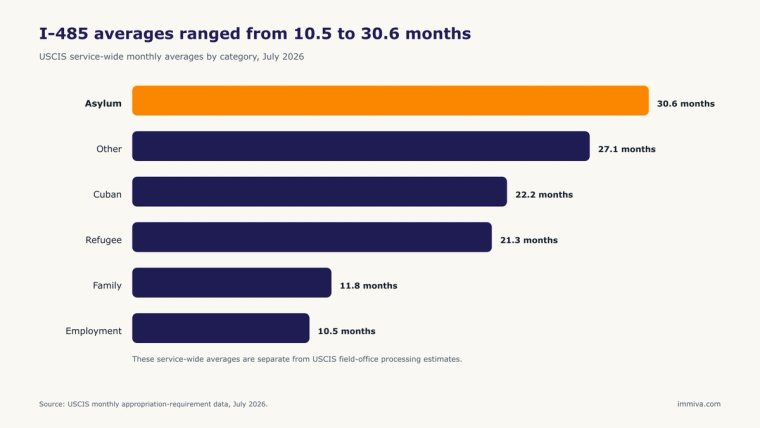
The wait for an I-485 decision varies by category. In its July 2026 monthly report, USCIS reported service-wide average processing times of 11.8 months for family cases and 10.5 months for employment cases. The asylum category had an average of 30.6 months. These figures describe processing across each reported category. For an estimate tied to your case, check the current processing-times tool using your form, category, and office.
A 2026 USCIS policy memo also gave officers more room to deny adjustment of status even when you meet the requirements. A clean, well-documented filing now counts for as much as your spot in the queue. Immiva's I-485 preparation runs a free pre-filing audit so the packet leaves clean the first time.
This guide uses the July 2026 monthly report from USCIS and Form I-485 Quarterly Performance Data for FY2026 Q2, covering January 1 through March 31, 2026. The monthly report gives service-wide average processing times. The quarterly workbook records receipts, approvals, denials, and pending cases by reporting bucket and location; it does not publish a processing-time median. Our separate article on USCIS backlog in 2025 covers that earlier period.
Last updated: September 9, 2026. Monthly figures cover July 2026. Quarterly figures cover FY2026 Q2, January 1 through March 31, 2026.
I-485 average processing times by category: July 2026
The chart shows the July 2026 service-wide averages for the six I-485 categories in the monthly report. Employment had the lowest reported average at 10.5 months; asylum had the highest at 30.6 months. These monthly averages use a different measure from the live tool's time to complete 80% of cases.
To compare offices, use the current USCIS processing-times tool and select the form, category, and office that apply to your case. Quarterly pending counts show the workload at a location. They cannot establish which office will decide your case fastest. For eligibility and filing details specific to employment-based adjustments, see our separate guide.
The July monthly report lists asylum, Cuban, and refugee adjustments separately. Their average processing times were 30.6, 22.2, and 21.3 months, respectively. Each category also had reported approvals that month. The data alone does not establish why the averages differ or when a pending case will be decided.
How to read USCIS processing-time figures
USCIS's processing times tool shows the time it took to complete 80% of cases over the prior six months for the selected form, category, and office. That leaves 20% of completed cases that took longer. The figure describes past completions and cannot promise a decision date for your application.
Keep the reporting period and measure attached to each figure you compare. The historic processing times table is a separate source for historical figures. A median, a monthly average, and the live tool's 80th-percentile figure answer different questions, so a difference between them does not by itself show that processing sped up or slowed down.
I-485 processing time by category
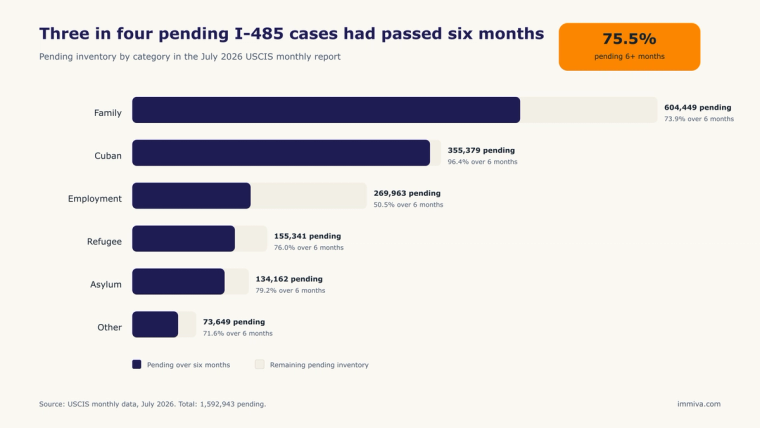
The monthly report uses six categories: asylum, Cuban, employment, family, other, and refugee. The quarterly workbook uses four broad reporting buckets: family, employment-based received at service center, humanitarian, and other. Across the six monthly categories in July 2026, 1,592,943 applications were pending. Of those, 1,202,363, or 75.5%, had been pending over six months.
Family-based I-485
The July 2026 family category had an average processing time of 11.8 months and 604,449 pending applications, including 446,387 pending over six months. During the month, USCIS reported 29,317 receipts, 28,271 approvals, and 6,039 denials. Family was the largest of the six monthly categories by pending inventory. If you also need the timeline for the underlying petition, see our I-130 processing time guide.
For FY2026 Q2, the quarterly family bucket recorded 127,189 receipts, 71,514 approvals, and 11,689 denials, with 579,684 cases pending at quarter-end. Pending inventory was 8.1% higher than the 536,170 reported for Q1. Use the live processing-times tool to check the current figure for your family category and office; the quarterly workbook does not give an office-level processing-time median.
Employment-based I-485
The July 2026 employment category had an average processing time of 10.5 months. USCIS reported 14,109 receipts, 12,927 approvals, and 1,169 denials that month. Pending inventory stood at 269,963, including 136,226 applications pending over six months.
Visa availability is a separate part of an employment-based case. Our guide to how the Visa Bulletin works explains the cutoffs. The April 2026 Visa Bulletin analysis and May 2026 analysis cover those specific months; check the current bulletin and the filing chart designated by USCIS before relying on a cutoff.
The quarterly bucket labeled employment-based received at service center recorded 47,514 receipts, 41,979 approvals, and 2,717 denials in FY2026 Q2. It had 215,177 pending cases at quarter-end, up 2.2% from 210,629 in Q1. These counts do not establish a processing-time ranking between service centers.
Humanitarian-based I-485
The quarterly humanitarian bucket recorded 50,955 receipts, 1,595 approvals, and 283 denials in FY2026 Q2. Pending inventory reached 587,337, up 8.9% from 539,439 in Q1. The monthly report gives separate figures for asylum, Cuban, and refugee adjustments, allowing a closer look at each reported category.
In July 2026, the asylum category had an average processing time of 30.6 months, with 5,174 receipts, 827 approvals, and 128 denials. Of its 134,162 pending applications, 106,277 were pending over six months. The Cuban category averaged 22.2 months and recorded 1,355 receipts, 308 approvals, and 318 denials. It had 355,379 pending applications, including 342,636 pending over six months.
The refugee category averaged 21.3 months in July 2026. USCIS reported 3,300 receipts, 60 approvals, and 15 denials, with 155,341 applications pending. Of those, 118,087 were pending over six months. For a specific humanitarian filing category, including a T- or U-visa-based adjustment, check the current processing-times tool for the applicable category and location.
Other I-485 adjustments
The monthly other category averaged 27.1 months in July 2026. It recorded 4,353 receipts, 699 approvals, and 192 denials, with 73,649 applications pending, including 52,750 pending over six months. The quarterly other bucket recorded 11,533 receipts, 2,740 approvals, and 754 denials in FY2026 Q2. Its quarter-end pending total of 55,012 was 24.9% higher than the 44,048 reported for Q1. These are broad reporting categories; use the filing category that applies to you when checking an individual processing-time estimate.
How to check your service center or field office
The quarterly workbook reports I-485 workload by field office or service-center location. Start with your USCIS notices to identify the office handling your case, then select the applicable form, category, and location in the live processing-times tool.
Check the tool when you need an office comparison. Keep the form and category the same across the offices you compare, and record the date you checked. A figure for a different category does not describe your application.
An office with more pending cases has a larger reported inventory. That count alone cannot tell you how quickly it completes cases or how long your application will wait for an interview.
The FY2026 Q2 workbook does not show that Texas or Nebraska is faster for employment-based I-485s. It reports application counts by location, without processing-time medians or evidence that interview-waiver rates explain an office's speed.
Your USCIS notice gives the date and location of a biometrics appointment. An interview, if required, will have its own notice. Check Form I-765 and Form I-131 separately in the live processing-times tool because an I-485 average does not set their timelines. If you need to reschedule biometrics, our step-by-step guide to that process explains what to do.
FY2026 Q2: how the pending inventory changed
From January 1 through March 31, 2026, USCIS recorded 237,191 I-485 receipts, 117,828 approvals, and 15,443 denials across the four quarterly reporting buckets. Total pending inventory was 1,437,210 at quarter-end, up 8.0% from 1,330,286 at the end of FY2026 Q1.
Pending inventory increased in all four quarterly buckets. From Q1 to Q2, family pending rose 8.1%, employment-based received at service center rose 2.2%, humanitarian rose 8.9%, and other rose 24.9%. These changes describe the size of each inventory; they do not establish the cause of the increase.
Do not calculate the next pending total by simply adding receipts and subtracting approvals and denials. USCIS explains that system updates and post-adjudicative outcomes can change the counts. Cases approved, denied, or still pending during the quarter may also have been received in an earlier period.
The FY2026 Q2 pending total was also 15.5% above the 1,243,917 reported at the end of FY2025 Q4. That comparison describes inventory growth between two quarter-end snapshots. The July monthly total covers a later reporting period and uses six categories, so keep it labeled separately from the quarterly figures.
Quarterly approvals are useful for tracking reported activity. Dividing them by receipts does not give your chance of approval, because the counts include applications from different filing periods. The workbook also cannot tell you when the queue will shrink or when your own case will finish.
2025 to 2026 policy changes reshaping I-485 processing
Five policy changes in the past year have altered how long your I-485 takes and what happens to you during the wait.
Automatic EAD extensions ended for renewals filed on or after October 30, 2025. Extensions already granted on earlier filings remain valid, but a renewal filed today gets no grace period while the new card is pending.
USCIS briefly increased the maximum EAD validity period to up to 5 years for certain categories, including adjustment applicants under INA 245. Policy alert PA-2025-27 (December 4, 2025) reversed course and capped new adjustment-based EADs at 18 months.
I-693 validity changed on June 11, 2025. USCIS clarified that a Form I-693 signed on or after Nov. 1, 2023, is valid only while the application it was submitted with remains pending. If that underlying application is withdrawn or denied, the I-693 is no longer valid for a future filing. That change does not mean a still-pending I-485 automatically needs a new medical exam solely because time has passed.
Proclamations 10949 and 10998 and the companion USCIS memos. Proclamation 10949 (June 4, 2025) and Proclamation 10998 (December 16, 2025, effective January 1, 2026) impose entry restrictions on 19 full-ban countries and 20 partial-ban countries. The USCIS memos PM-602-0192 and PM-602-0193 translated those restrictions into adjudicative holds on I-485, I-765, I-131, I-751, and I-589 for nationals of affected countries. A federal court vacated the USCIS benefit-hold policies (PM-602-0192, PM-602-0194, and PA-2025-26) on June 5, 2026, so USCIS treats them as not in effect agency-wide and is resuming those adjudications, though the government may appeal. The separate State Department pause on immigrant-visa issuance for 75 countries and the underlying travel-ban proclamations stay in force at the consular stage. For context on the broader landscape, see our coverage of the Trump travel ban and who it affects and the State Department pause on immigrant visa processing for 75 countries.
CSPA reversion (August 15, 2025). USCIS reverted Child Status Protection Act age calculation from the Dates for Filing chart back to the Final Action Dates chart. That narrows the window in which a derivative child's age "freezes" and creates fresh aging-out risk for F2A and EB derivative beneficiaries approaching 21.
Since October 28, 2025, USCIS accepts only electronic payments for paper filings: Form G-1450 for credit or debit card payments, or Form G-1650 for ACH debit from a U.S. bank account. Personal checks, cashier's checks, and money orders are no longer accepted unless you qualify for one of the limited exemptions listed on Form G-1651.
Visa Bulletin coordination: when can you actually file?
Processing time is only half the wait. The other half is waiting for your priority date to become current. For family-based F1, F2A, F2B, F3, and F4 categories, and for all employment-based categories, filing I-485 requires both an immediately available visa number and a current priority date.
USCIS tells you each month which chart you can use, the Final Action Dates chart or the Dates for Filing chart, on its adjustment of status filing charts page. For April 2026, EB-2 India jumped ten months in a single bulletin, and EB-2 Rest of World, Mexico, and the Philippines became current. Those are the largest one-month movements in several years.
The advance is real but somewhat artificial. Proclamations 10949 and 10998 have reduced ROW demand at consular processing posts, freeing visa numbers earlier in the fiscal year than normal. DOS has explicitly warned applicants that retrogression later in FY2026 is a strong possibility. If your priority date is current or near-current, filing sooner rather than later is usually the right move.
One persistent myth worth killing: your priority date becoming current does not speed up an I-485 that's already pending. It only unlocks approval. USCIS cannot approve a case without a visa number available at the moment of decision. If your date retrogresses while you're pending, USCIS will hold your case until it becomes current again.
Companion applications: EAD and Advance Parole
Most I-485 applicants file Form I-765 (work permit, category C09) and Form I-131 (Advance Parole) concurrently. The companion filing fees are $260 for I-765 and $630 for I-131, on top of the $1,440 I-485 fee for applicants 14 and older.
Check the current processing-times tool separately for Form I-765 under your eligibility category and Form I-131 for Advance Parole. Their timelines can differ from each other and from your I-485. Once you have the I-765 receipt, you can check your EAD application status while you wait.
The renewal math has gotten tighter. With EAD validity cut to 18 months (PA-2025-27) and the 540-day automatic extension removed (October 30, 2025 IFR), a typical I-485 applicant now files an EAD renewal while the original EAD still has 180+ days left. If you wait too long, you stop working. File 6 months ahead of expiration, not later.
Advance Parole travel while I-485 is pending is still available for most filers, but travel on AP after leaving the country requires the I-131 to have been approved before departure. Traveling without an approved AP (unless you hold a separate valid status like H-1B or L-1 with appropriate entry) is treated as abandonment of your I-485.
What to do if your I-485 is past normal processing time
Use the current USCIS processing-times tool and its case-inquiry guidance to check whether you can ask about your pending application. Passing a monthly average or the posted 80th-percentile figure does not by itself establish eligibility for every escalation option. Our I-485 expedite request guide explains the available routes and what each requires.
If your concern is the EAD or AP rather than the I-485 itself, USCIS accepts expedite requests for those based on severe financial loss, humanitarian reasons, or DHS interest. The I-485 itself is rarely expedited because premium processing is not available for adjustment of status, and the standard expedite criteria are narrow.
Top misconceptions about I-485 processing time
Check which form, reporting period, and measure a timing claim refers to before using it to plan around your case.
- The posted processing time cannot predict your decision date. The live tool reports the time to complete 80% of cases over the prior six months for the selected form, category, and office. Some completed cases took longer.
- "Concurrent filing makes my I-485 decision faster." Concurrent filing (filing I-485 at the same time as the I-130 or I-140) only eliminates the gap between I-130/I-140 approval and I-485 filing. The I-485 adjudication time itself is the same.
- EAD approval does not tell you how soon your I-485 will be decided. The work-permit application has a separate processing timeline. Track each application using its own receipt information.
- "A Congressional inquiry will speed up my case." Congressional inquiries typically return "undergoing normal processing" unless the case is genuinely outside posted times and USCIS cannot cite a specific reason for the delay.
- "I-140 premium processing will speed up my I-485." It only speeds up the I-140. Once the I-140 is approved, the I-485 queue position is unaffected. Premium processing is not available for I-485.
- "EAD renewals still auto-extend for 540 days." False for renewals filed on or after October 30, 2025. The interim final rule ended automatic extensions going forward; only extensions already granted on earlier filings remain valid.
- "The 2023 CSPA rule still applies." USCIS reverted on August 15, 2025 to Final Action Dates for CSPA calculation. F2A and EB derivatives near 21 should recalculate immediately.
- Quarterly application counts cannot establish whether Texas or Nebraska processes employment-based I-485s faster. Check the live tool for the same form and category at each applicable location.
Check the processing time for your case
Select Form I-485, your filing category, and the applicable office in the current USCIS processing-times tool. Note the date you checked and the figure it shows. That gives you a relevant reference for tracking your application alongside its case status and notices.
If the wait is affecting work or travel plans, check your I-765 or I-131 separately. Their decisions follow their own timelines, and an I-485 category average does not tell you when those documents will arrive.
This September 9, 2026 update uses monthly data through July 2026 and quarterly data through March 31, 2026. Check the live tool again before relying on an office estimate or submitting a case inquiry.