

For Form I-130, Petition for Alien Relative, USCIS reported a 12.5-month median for immediate relatives and a 39.4-month median for all other relatives in FY2026 Q2. These figures describe completed petitions. Your case can take longer or finish sooner. If you are preparing to file, Immiva's I-130 preparation explains the service available for your petition.
The latest quarterly figures cover January 1 to March 31, 2026 and were checked on September 9, 2026. USCIS also reports approved petitions awaiting visa availability. That separate FY2026 Q2 release uses the March 2026 Visa Bulletin to calculate which approved petitions were waiting for a visa number.
Current I-130 processing times: USCIS FY2026 Q2
USCIS's quarterly report gives service-wide medians for two groups: immediate relatives and all other relatives. It does not publish a separate current median for every family relationship. Use the USCIS Processing Times Tool to check the estimate for the case category and office shown for your petition.
The table pairs each group's median for completed cases with the number of petitions still pending at quarter end. A median is the middle value: half of the completed petitions took less time and half took more.
| USCIS reporting group | Relationships included | FY2026 Q2 median | Pending at quarter end | Visa wait after approval |
|---|---|---|---|---|
| Immediate relatives | Spouses and unmarried children under 21 of U.S. citizens; parents of U.S. citizens age 21 or older | 12.5 months | 761,638 | No annual numerical limit; remaining processing still takes time |
| All other relatives | Family-preference categories F1, F2A, F2B, F3, and F4 | 39.4 months | 1,597,832 | A wait for visa availability can continue after approval |
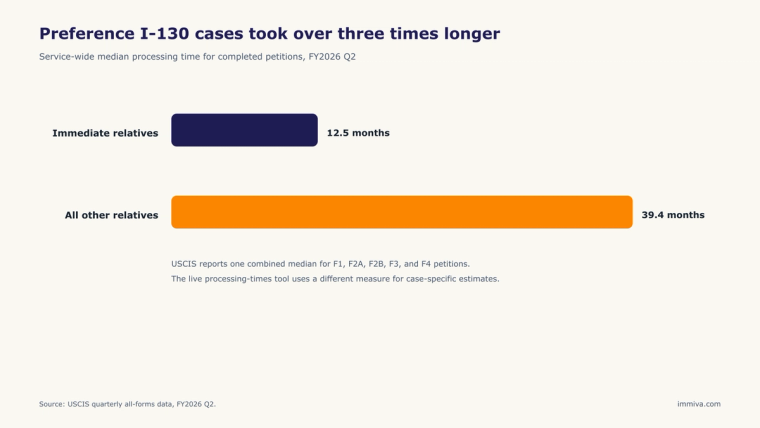
USCIS FY2026 Q2 I-130 medians: 12.5 months for immediate relatives and 39.4 months for all other relatives. These figures cover petitions completed during the quarter. Source: USCIS quarterly all-forms data.
I-130 processing time for immediate relatives
Immediate relatives include spouses and unmarried children under 21 of U.S. citizens, and parents of U.S. citizens who are at least 21. This group is not subject to annual numerical visa limits.
The FY2026 Q2 median was 12.5 months for completed immediate-relative petitions. The quarterly report does not split this figure into spouse and parent cases, or give separate medians for adjustment of status and consular processing. For the estimate that applies to your petition, check the USCIS Processing Times Tool.
When comparing your case with this group, check the petitioner's citizenship and the family relationship:
- Parents of U.S. citizens are immediate relatives when the petitioning citizen is at least 21 years old. The USCIS Policy Manual, Volume 6, Part B explains this category.
- A spouse's petition can move from F2A to the immediate-relative category when the petitioner becomes a U.S. citizen. That removes the annual visa-limit wait for the spouse; USCIS must still decide the petition.
- I-130 approval establishes the qualifying family relationship. The beneficiary still needs approval through adjustment of status or consular processing to receive permanent residence.
How adjustment of status and consular processing affect the timeline
The quarterly I-130 median cannot tell you which route will finish sooner. Adjustment of status has its own application processing time, even when someone is eligible to file Form I-485 with the I-130.
Consular cases also need National Visa Center processing and an immigrant visa decision. Those steps are outside the I-130 petition median.
I-130 processing time for green card holders' spouses and children
If you are a lawful permanent resident petitioning for your spouse, the petition falls under F2A. This category also covers unmarried children under 21 of permanent residents. USCIS includes F2A in its all-other-relative reporting group.
The all-other-relative median was 39.4 months in FY2026 Q2. That figure combines several family-preference categories and is not an F2A-specific median. Check the USCIS Processing Times Tool for the current estimate that applies to your petition.
The March 2026 Visa Bulletin is a historical reference used in the quarterly visa-availability calculation. When reading a cutoff, do not treat a priority date on or before that date as a promise of an interview. Check the current bulletin's exact cutoff rules for your category and country.
F2B covers unmarried adult children of permanent residents. The quarterly report includes these petitions in the same all-other-relative group. It provides no separate F2B median, so the 39.4-month figure cannot predict an individual F2B wait.
If the petitioner becomes a U.S. citizen
Naturalization can change a spouse's petition from F2A to the immediate-relative category. The change removes the spouse's wait under annual visa limits, but it does not set a USCIS approval date.
For naturalization requirements, read our complete guide to applying for U.S. citizenship. The separate 3-year citizenship rule for spouses guide explains that route for eligible spouses of U.S. citizens.
I-130 processing time for adult children and siblings
F1, F3, and F4 petitions are part of USCIS's all-other-relative group. The report's 39.4-month median covers this combined group. Each preference category can also have a visa-availability wait after petition approval.
F1: unmarried adult children of U.S. citizens
USCIS does not give a separate F1 median in the quarterly report. After approval, compare the petition's priority date with the current Visa Bulletin to check visa availability. The petition median does not include that later wait.
F3: married sons and daughters of U.S. citizens
F3 is also included in the all-other-relative median. Its annual visa limits can leave an approved petition waiting for a visa number, so the quarterly processing figure does not show the total time to permanent residence.
F4: Brothers/sisters of U.S. citizens
F4 accounted for 727,405 approved petitions awaiting visa availability in USCIS's FY2026 Q2 release, or 70.6% of the total across preference categories. The release uses the March 2026 Visa Bulletin for that calculation.
That count describes approved petitions waiting for visa availability. It does not measure how long USCIS takes to decide an F4 petition or predict when a newly filed case will receive a visa.
Our green card backlog guide explains visa queues beyond I-130 processing. Use the Visa Bulletin complete guide for instructions on reading the priority-date tables.
What the I-130 processing time leaves out
An I-130 decision covers the family petition. Time spent on visa availability and the remaining green card process can extend the overall wait.
USCIS petition processing ends with a decision on the I-130. The 12.5-month and 39.4-month medians measure this part of the process for the two reporting groups.
Approved consular cases move to the National Visa Center. Check NVC Timeframes, State Department for its current case-creation and document-review information.
NVC processing includes collecting the required documents and fees. The USCIS I-130 median does not include the time NVC takes to complete its work.
Consular interview scheduling adds a separate wait that varies by post. A completed I-130 does not establish an interview date.
Visa issuance also requires a consular decision. For family-preference cases, a visa number must be available.
For adjustment of status, USCIS handles Form I-485 separately from the family petition. I-130 approval alone does not mean the green card application is approved.
The quarterly data cannot support a single total wait from I-130 filing to a green card. Check the petition estimate first, then the visa-availability and processing steps that apply to your case.
What the latest I-130 backlog data shows
From FY2025 Q2 to FY2026 Q2, the immediate-relative median fell from 15.7 to 12.5 months. The all-other-relative median rose from 35.3 to 39.4 months. The table shows both groups over those five quarters, alongside their pending petition counts.
| Quarter | Immediate-relative median | Other-relative median | Immediate pending | Other pending |
|---|---|---|---|---|
| FY2025 Q2 | 15.7 months | 35.3 months | 902,455 | 1,493,382 |
| FY2025 Q3 | 14.4 months | 36.5 months | 871,740 | 1,529,528 |
| FY2025 Q4 | 13.7 months | 38.0 months | 801,745 | 1,555,603 |
| FY2026 Q1 | 13.1 months | 38.0 months | 772,234 | 1,576,284 |
| FY2026 Q2 | 12.5 months | 39.4 months | 761,638 | 1,597,832 |
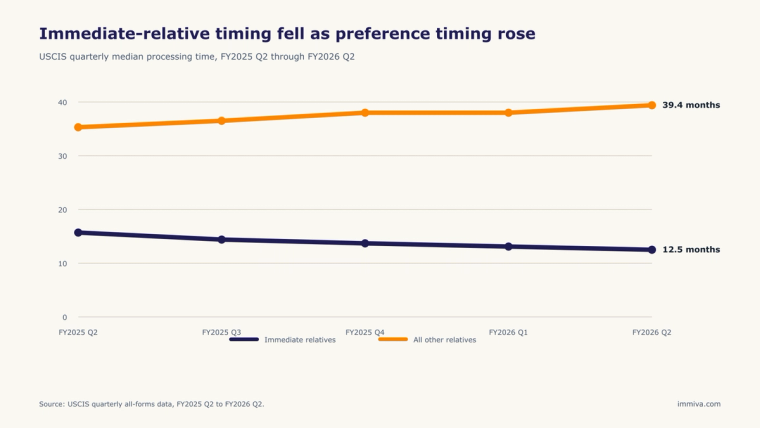
I-130 medians from FY2025 Q2 through FY2026 Q2. Immediate-relative processing fell from 15.7 to 12.5 months; all-other-relative processing rose from 35.3 to 39.4 months. Source: USCIS quarterly all-forms data.
Pending petitions and approved petitions awaiting visa availability measure different parts of the wait. The chart below covers the latter: USCIS had already approved these petitions, and they were waiting for a visa number under the release's calculation.

Approved I-130 petitions awaiting visa availability in the USCIS FY2026 Q2 release: F1, 69,752; F2A, 5,538; F2B, 129,792; F3, 97,326; and F4, 727,405. Total: 1,029,813. The calculation uses the March 2026 Visa Bulletin.
USCIS ended FY2026 Q2 with 2,359,470 I-130 petitions pending: 761,638 immediate-relative petitions and 1,597,832 all-other-relative petitions. Since FY2025 Q4, immediate-relative pending cases fell by 40,107 (5.0%), while other-relative pending cases rose by 42,229 (2.7%). The combined total stayed near 2.36 million. During FY2026 Q2, USCIS received 126,666 immediate-relative petitions, approved 132,960, and denied 17,243. For other relatives, it received 37,808 petitions, approved 13,402, and denied 10,182. These totals describe agency activity; they do not explain the delay in a particular case.
Filing checks before you submit an I-130
Check the current USCIS filing instructions before submitting a petition. Filing requirements can change between the time you prepare the form and the day you send it.
Check the accepted form edition
Use the official USCIS Form I-130 page to confirm the accepted edition on the day you file. If filing by mail, check that all pages belong to the accepted edition.
Confirm the payment instructions
Check the payment method USCIS accepts for your filing route. Online and paper filing instructions can differ. Follow the current instructions for the petition you are submitting.
How to check your I-130 wait and inquiry date
1. Check your USCIS account. Review the case status and any notices that ask you to respond.
2. Check inquiry eligibility. Open the USCIS processing-times tool, select the options that match your case, and enter the receipt date when prompted. Use the inquiry date the tool gives you today.
3. Submit a request when eligible. Follow USCIS's instructions for a case outside normal processing times and save the confirmation number. An inquiry does not guarantee an approval date.
4. Keep a record of follow-up. Save the dates and responses from your USCIS inquiries so you can explain what remains unresolved.
5. Review USCIS's response. Follow any instructions it gives and check the stated deadline before contacting the agency again.
If the delay remains unresolved, a qualified immigration attorney can assess the options for your case. A quarterly median alone does not establish which remedy is appropriate.
For instructions on checking your USCIS account and notices, use our status tracking guide.
Where to check I-130 filing costs
Confirm the current government fee before filing. A fee figure does not tell you how long USCIS will take to decide the petition.
Our I-130 filing fee 2026 guide covers filing costs and payment details.