
If your U.S. citizen or permanent resident spouse abused you and now refuses to cooperate on your Form I-751, you can file the waiver on your own. There is no filing fee for a Form I-751 battery or extreme cruelty waiver. USCIS confidentiality rules under 8 U.S.C. §1367 keep protected case information away from the abuser.
The I-751 abuse waiver lets a conditional permanent resident ask to have the conditions removed without a spouse's signature and without a filing fee. You can file before, during, or after the 90-day filing window, though if you are already in removal proceedings you need to file before a final removal order is issued. This is a statutory right, not a favor.
Your abuser cannot find out you filed
Read this part twice. Under 8 U.S.C. §1367, USCIS is legally barred from telling your abuser anything about your case. An officer cannot confirm a petition exists. They cannot share your address. They cannot answer a phone call from your spouse asking about you. Once you file the abuse waiver, USCIS assigns a new receipt number and routes the case through its safe-address process. A DHS officer who breaks that rule faces a $5,000 civil penalty.
What that looks like in practice:
- USCIS will not send mail to a shared address unless you tell them to. You can list an attorney's office, a P.O. box, a domestic violence shelter, or a trusted friend's address as your safe mailing address.
- Your abuser has no legal standing to see your file, object to your filing, or block the case. If they try to sabotage the petition with their own "evidence," USCIS cannot deny you on that basis alone.
- USCIS has a dedicated change-of-address procedure for I-751 abuse waiver cases that keeps your location out of the regular system.
Who qualifies for the I-751 abuse waiver
You qualify if all four of these are true, per INA §216(c)(4)(C) and 8 CFR §216.5:
- You hold a 2-year conditional green card obtained through marriage to a U.S. citizen or lawful permanent resident.
- The marriage was entered into in good faith, not to get around immigration law.
- You, or your child, were battered or subjected to extreme cruelty by your spouse (or by your parent, if filing as a child).
- You were not at fault in failing to file the joint petition.
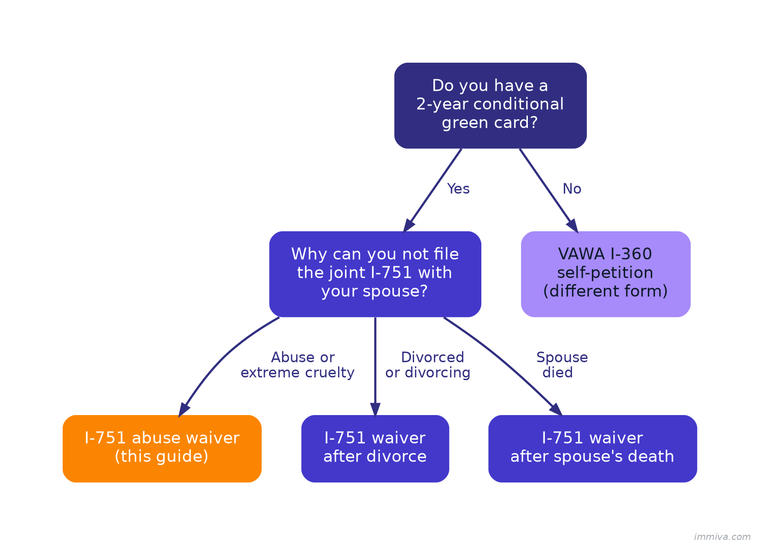
Your current marital status does not matter. Per 8 CFR §216.5(e)(3)(ii), you can be married, separated, or divorced, and you can still be living with your abuser. Our I-751 joint filing vs. waiver breakdown walks through every option side by side, and the decision tree below shows where the abuse waiver sits alongside the divorce waiver and the widow(er) filing (technically an individual filing request, not a waiver).
What counts as "battery or extreme cruelty"
Wider than most people assume. Per 8 CFR §216.5(e)(3)(i), "extreme cruelty" is not limited to physical violence. USCIS includes:
- Physical violence, assault, and forced detention
- Sexual abuse, exploitation, or rape
- Psychological abuse and coercive control
- Threats to have you deported or to cancel your immigration paperwork
- Financial abuse, including withholding money, controlling your accounts, or preventing you from working
- Isolation from family, friends, language classes, or your support network
- Verbal degradation, humiliation, constant surveillance of your phone or whereabouts
You do not need bruises or hospital visits. Emotional and financial abuse qualify under the regulation and USCIS policy.
The evidence rule every survivor should understand
USCIS applies what the statute calls the "any credible evidence" standard (INA §216(c)(4), concluding provisions). An officer cannot deny your case just because you do not have a police report or a protective order. They have to weigh everything you submit in the totality of the circumstances. You carry the burden of proof, but the bar is preponderance of the evidence, meaning "more likely than not."
In plain terms: if you never called the police, you can still win this case. Many survivors never did, and USCIS knows it.
Evidence, roughly in order of weight:
- Official records. Police reports, protective orders, court filings, medical records, photos of injuries.
- Professional evaluation. If you are claiming extreme mental cruelty, 8 CFR §216.5(e)(3)(vii) requires an evaluation from a licensed clinical social worker, psychologist, or psychiatrist, including their name, address, license number, and licensing authority.
- Your personal declaration. A detailed, first-person account in your own words. This carries real weight when it is specific, chronological, and consistent with your other evidence.
- Shelter records, advocacy letters, and counselor or clergy statements.
- Text messages, voicemails, emails, photos, and audio recordings. Save screenshots somewhere your abuser cannot reach.
- Witness affidavits from anyone who saw the abuse or what came after it.
You still have to show the marriage itself was real. Joint tax returns, a shared lease, photos together, insurance policies, and affidavits from people who knew you as a couple all help. Our I-751 document checklist runs through every category of bona fide marriage evidence in detail.
How to file the I-751 abuse waiver
Filing the abuse waiver looks a lot like a standard I-751, with a handful of differences worth flagging:
- Filing fee: $0. Since April 1, 2024, abuse waiver filers are fully fee-exempt under 8 CFR §106.2(a)(43). There is no biometrics fee either.
- Form edition: 04/01/2024. Older editions are rejected.
- On the form: Part 3, check Box 1.e (conditional resident spouse) or Box 1.f (child). Do not check the joint filing box.
- Filing method: you can file by mail or online. USCIS lists a direct filing address for mailed Form I-751 submissions, and online filing is also available through a USCIS online account. Either way, the abuse waiver itself carries no filing fee.
- Timing: waiver filers can file before, during, or after the 90-day window tied to card expiration, and filing after the card expires does not automatically disqualify you. But if you are in removal proceedings, you have to file before a final removal order is issued.
- Status extension: your receipt notice (Form I-797C) extends your conditional status for 48 months past your card's expiration date.
- Biometrics: if USCIS needs biometrics for your case, they will schedule an appointment and send you the notice.
- Interview: sometimes scheduled, sometimes waived when the evidence is strong. An attorney or accredited representative can come with you.
If you are also divorced from your abuser, check both the abuse box and the divorce box on the same form.
How long the abuse waiver takes
USCIS does not publish separate processing times for abuse-waiver cases. I-751 cases overall take about 26 months as of early 2026, and our I-751 processing time guide tracks the current numbers. You can also check USCIS's Form I-751 processing-times tool for the office handling your case. Timing varies a lot from one case to the next, and premium processing is not available for Form I-751.
If USCIS sends a Request for Evidence, do not panic. Our I-751 RFE response guide walks through how to respond.
A benefit most guides never mention
If your abuser was a U.S. citizen and your abuse waiver is approved, you can apply for citizenship three years after you became a permanent resident under the 3-year rule for spouses of U.S. citizens, even though the marriage is over. You can also file N-400 while your I-751 is still pending once the three years are up. Hardly any survivors hear about this.
Where to get free help right now
You do not have to do this alone.
- National Domestic Violence Hotline: 1-800-799-7233, or text START to 88788. Confidential, 24/7, interpreters available.
- Tahirih Justice Center, ASISTA, NIWAP, and WomensLaw.org offer free legal information and referrals for immigrant survivors.
- Immigration Advocates Network legal directory lists vetted free and low-cost immigration legal help by ZIP code.
You are not required to have a lawyer, but this is one of those cases where having one makes a real difference. Plenty of pro bono programs exist for exactly these filings.
Frequently Asked Questions
No. 8 U.S.C. §1367 bars DHS from releasing any information about your case, including even confirming that it exists. Violations carry a $5,000 civil penalty.
No. The "any credible evidence" standard means USCIS has to consider whatever you can provide. Most survivors do not have police reports, and USCIS is not allowed to deny a case simply because there isn't one.
You can still file. Waiver filers have no deadline, and the receipt notice extends your status for 48 months once USCIS accepts the filing.
Yes. Children who got conditional resident status through the same marriage can be included as derivatives on your I-751. Our main I-751 pillar guide explains how derivative filings work.
The I-751 waiver is not your path. You likely qualify for a VAWA self-petition on Form I-360, which is meant for abused spouses who never received a green card through their abuser. An advocate from WomensLaw.org or a nonprofit immigration legal program can help you confirm which form applies to you.
Yes. The 48-month extension keeps your work authorization and status valid. Travel is possible but comes with risks, which our I-751 pillar guide covers.