
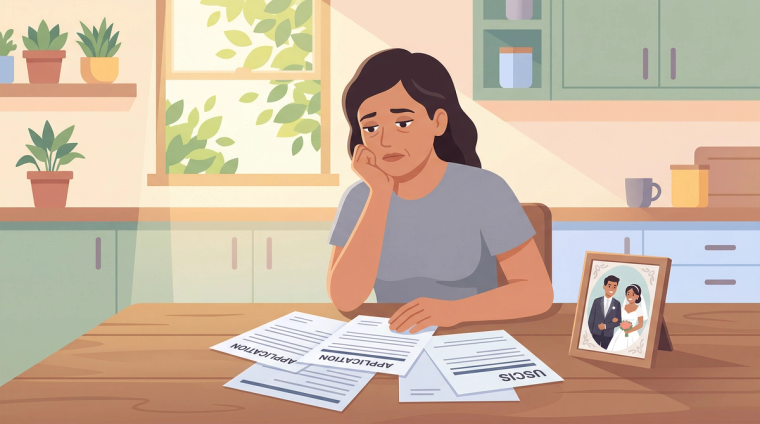
If your U.S. citizen spouse has passed away and you hold a conditional green card, you can still remove those conditions and keep your permanent resident status.
Losing a spouse is hard enough without worrying about your immigration status. Federal law accounts for your situation, and the approval standard for this type of filing is stronger than most other I-751 categories.
This guide goes through how to file Form I-751 after the death of your spouse, what evidence to include, and what to expect.
Your green card is not at risk
Many widowed conditional residents assume their green card will be revoked. It won't be.
When your U.S. citizen spouse dies, you don't lose your conditional permanent resident status. You still have the right to file Form I-751 to remove conditions on your green card. And unlike some other I-751 categories, your filing falls under what USCIS calls an "individual filing request," not a waiver (USCIS Policy Manual, Vol. 6, Part I, Ch. 4).
Why does that distinction matter? Because individual filing requests are non-discretionary. If you prove the marriage was entered in good faith and provide a death certificate, USCIS must approve your petition. There is no subjective judgment call the way there is with divorce-based or hardship waivers (INA § 216, 8 U.S.C. § 1186a).
If you're unsure whether you qualify to file, check your I-751 eligibility in under two minutes.
Three scenarios based on when your spouse died
Your next steps depend on where you are in the I-751 process. USCIS addresses three situations in its Policy Manual:
Scenario 1: Your spouse died before you filed the I-751.
File a new I-751 on your own. On the form, check the box in Part 3, Item 1.c ("My spouse is deceased"). Include the death certificate and evidence that your marriage was bona fide. You do not need to wait for the standard 90-day filing window, but you should file before your conditional permanent resident status expires.
Scenario 2: Your spouse died after you already filed a joint I-751.
Notify USCIS in writing and provide a copy of the death certificate. USCIS will amend the pending petition from a joint filing to an individual filing request. You do not need to submit a new I-751.
Scenario 3: Your spouse signed the I-751 but you hadn't mailed it yet.
You cannot use the jointly signed form. File a new I-751 individually with the "My spouse is deceased" box checked.
For a broader overview of the joint filing vs. waiver decision, see our guide on I-751 joint filing vs. waiver options.
What you need to file
The I-751 form instructions list required documents for death-based filings. You'll need:
Required documents:
- Completed Form I-751 (current edition 04/01/24)
- Copies of the front and back of your Permanent Resident Card
- Your spouse's death certificate (civilly registered; if not in English, include a certified translation)
- Evidence that your marriage was entered in good faith
Bona fide marriage evidence is the most important part of your filing. Strong submissions include joint tax returns, joint bank account statements, a shared lease or mortgage, insurance policies naming each other as beneficiaries, birth certificates of children born during the marriage, photos together at different times, and affidavits from people who knew you as a couple. For a complete breakdown of what to submit, see our I-751 document checklist.
Filing fee: $750 by paper or $700 online. You can file Form I-751 by mail or through a USCIS online account. Biometrics costs are included. If you lost household income because of your spouse's death, you may qualify for a fee waiver using Form I-912. For details on payment methods, see our guide on how to pay USCIS filing fees.
What happens after you file
Once USCIS accepts your I-751, your conditional green card is automatically extended for 48 months beyond its expiration date (USCIS Policy Alert, January 2023). This keeps your permanent resident status and work authorization intact while the case processes.
Processing times vary by the office handling your case and change regularly. I-751 cases take about 26 months as of early 2026, and our I-751 processing time guide tracks the current numbers. You can also check USCIS's Form I-751 processing-times page for the latest estimate for your case. No premium processing is available for I-751.
During processing, USCIS may schedule a biometrics appointment and could issue a Request for Evidence (RFE) asking for more proof of your bona fide marriage. If you get an RFE, our guide on how to respond to an I-751 RFE covers what to do.
You can travel internationally while your I-751 is pending, but review the rules for traveling with a pending I-751 before booking any trips.
Impact on citizenship
If you were planning to apply for naturalization based on the 3-year marriage rule, that path closes when your spouse dies. The 3-year rule under INA § 319(a) requires that you be "living in marital union" with your U.S. citizen spouse at the time you file. Once your spouse has passed away, you fall back to the standard 5-year rule (INA § 316(a)).
You can still apply for citizenship using Form N-400 once you've held permanent resident status for five years. And yes, you can apply for citizenship while your I-751 is still pending.
I-360 vs. I-751: which do you need?
These two forms get confused a lot. If your U.S. citizen spouse died and you already have a conditional green card, you file Form I-751 to remove those conditions. That's what this guide covers.
If your U.S. citizen spouse died before you received a green card (for example, the I-130 was approved but your status wasn't yet adjusted), you may instead qualify for an I-360 widow/widower petition. The I-360 is a separate process for surviving spouses who were not yet permanent residents when their spouse died. The two forms serve different situations and are not interchangeable.