
Your green card status does not expire when your card does
The most important thing to understand: your permanent resident status and your permanent resident card are two different things.
Your green card (Form I-551) is a physical document that expires every 10 years. But your lawful permanent resident status does not expire just because the card does. USCIS confirms that lawful permanent resident status does not expire (unless you naturalize or your status is terminated), even if your Green Card expires.
So when USCIS reviews your N-400 application, they're checking whether you were lawfully admitted as a permanent resident (8 CFR § 316.2), not whether your physical card is still valid. An expired card does not affect your eligibility to apply for citizenship.
If you're not sure whether you meet the other requirements for citizenship, like physical presence or the residency timeline, check those first. But the expiration date on your card is not one of the barriers.
The December 2022 policy change that saves you time and money
Before December 12, 2022, applicants with expired green cards had to either file Form I-90 to renew their card (typically $540 at the time, including biometrics) or request temporary evidence of status (an ADIT stamp). Both options added cost and months of waiting.
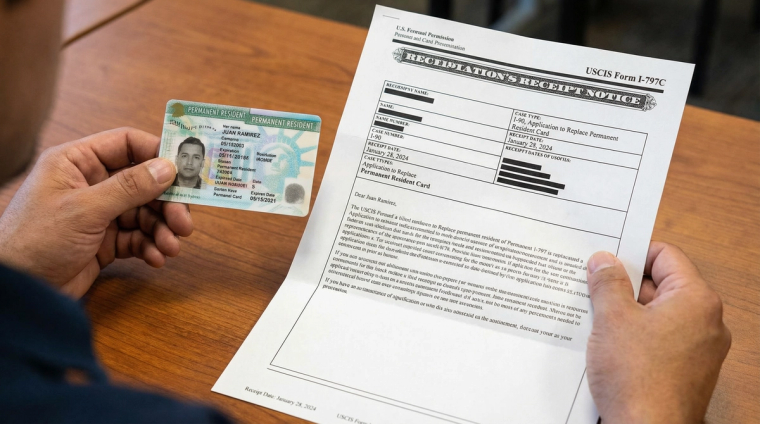
That changed with a USCIS policy update to the Policy Manual, Volume 12, Part D, Chapter 2. Now, when you properly file Form N-400, the receipt notice (Form I-797C) you receive automatically extends your green card for 24 months from the "Card Expires" date printed on your card.
Here's what this means in practice:
| Before Dec 2022 | After Dec 2022 | |
|---|---|---|
| Expired card + N-400 filed | Had to file I-90 or get ADIT stamp | Receipt notice auto-extends card 24 months |
| Extra cost to prove status | $540 (I-90) | $0 (included with N-400 filing) |
| Extra wait time | 6-12 months for I-90 | Immediate upon receiving receipt |
| Proof of status | ADIT stamp or new card | Expired card + N-400 receipt together |
This policy applies to anyone who files N-400 on or after December 12, 2022 (USCIS Policy Alert). If you filed before that date, the automatic extension does not apply to you.
How to use your N-400 receipt as proof of status
Once you receive your N-400 receipt notice, you'll need to carry it alongside your expired green card. Together, these two documents serve as valid proof of your lawful permanent resident status. You cannot use one without the other.
Here's where this combination works:
Employment verification. Your expired green card plus the N-400 receipt notice qualifies as a List A document for Form I-9 employment verification. Show both documents to your employer. If your employer isn't familiar with this policy, you can point them to the extension language printed directly on your receipt notice.
Driver's license renewal. Most state DMVs accept the expired card plus receipt as proof of immigration status. Some states may require additional documentation, so call your local DMV ahead of time.
Travel. Within the 24-month extension window shown on your N-400 receipt notice, you can generally use your expired green card plus the receipt notice as evidence of continued status to return to the United States. However, CBP notes it cannot confirm whether this documentation is sufficient to enter other countries, and some airlines may not be familiar with the extension language - so give yourself extra time at check-in. When you return to the U.S., show both documents to CBP.
Banking and government services. These documents together demonstrate your continued lawful status for banks, the Social Security Administration, and other institutions that require proof of immigration status.
What if your N-400 takes longer than 24 months?
Most applicants won't face this issue. N-400 processing times vary by field office and can change over time, so check the USCIS Processing Times tool for the most current estimate for your location. In many cases, the 24-month extension window is enough time for USCIS to finish the case.
But processing times vary by field office. If your case is assigned to a slower office or gets delayed for other reasons, your 24-month extension could expire before your case is decided.
If that happens, you have two options:
- Request temporary evidence of status (ADIT stamp). Contact the USCIS Contact Center at 800-375-5283 or request an appointment online. USCIS may schedule an in-person visit if needed, or it may issue temporary evidence by mail (for example, a Form I-94 with an ADIT stamp).
- File Form I-90. As a last resort, you can file an I-90 green card renewal to get a new physical card. As of the USCIS fee rule effective April 1, 2024, Form I-90 costs $415 if filed online or $465 if filed on paper. Processing times vary, so check the USCIS Processing Times tool for current estimates.
For more details on what happens during the waiting period, read our guide on N-400 processing times in 2026.
When you should renew your green card instead
Filing N-400 with an expired card works great if you're eligible for citizenship. But there are situations where renewing your green card with Form I-90 makes more sense:
You're not yet eligible for citizenship. If you haven't met the 5-year (or 3-year for spouses of U.S. citizens) residency requirement, you'll need a valid green card in the meantime. Check your eligibility with our free N-400 eligibility checker.
You lost your green card. The automatic extension only works if you have the physical expired card to show alongside your receipt. If your card is lost, stolen, or damaged, you must file Form I-90 to get a replacement (USCIS Form I-90).
You filed N-400 before December 12, 2022. The automatic extension policy only applies to N-400 applications filed on or after that date.
Your card expired more than 24 months ago and you need immediate proof. In this case, the extension window may not cover you. Filing I-90 or getting an ADIT stamp is the safer route.
Here's a quick cost comparison to help you decide:
| Form I-90 (Renewal) | Form N-400 (Citizenship) | |
|---|---|---|
| Online fee | $415 | $710 |
| Paper fee | $465 | $760 |
| Processing time | 6-12 months | Varies by field office |
| Result | New 10-year card | U.S. citizenship |
| Repeat? | Every 10 years | One time, permanent |
If you're eligible for citizenship, N-400 is almost always the better financial decision in the long run. You pay more upfront, but you'll never need to renew again. For a full breakdown of costs, see our N-400 fees guide. Processing times for both forms move around, so check our N-400 processing times guide for the current numbers.
Conditional green card holders: different rules apply
If you have a 2-year conditional green card (received through marriage to a U.S. citizen), the rules are different. You cannot renew a conditional green card with Form I-90. Instead, you must file Form I-751 to remove conditions on your residence.
For joint filers, the I-751 filing window opens 90 days before your conditional card expires (8 CFR § 216.4(a)(1)). Waiver filers can file at any time. If your conditional card has already expired and you haven't filed I-751, speak with an immigration attorney about your options.
Once you've filed I-751 and met the residency requirements, you can file N-400 for citizenship even while your I-751 is still pending.
Step by step: filing N-400 with an expired green card
Here's the process from start to finish:
1. Confirm you're eligible. You need at least 5 years as a permanent resident (3 years if married to a U.S. citizen), plus you must meet physical presence, continuous residence, and good moral character requirements. Use our free eligibility checker to verify.
2. Gather your documents. You'll need your expired green card, passport photos, and supporting documents. Review our guide on what to bring to your citizenship interview for the full list.
3. Complete Form N-400. The current edition is dated 01/2025. You can file online or on paper. Online filing costs $710; paper costs $760. Note: USCIS continued accepting paper checks and money orders until Oct. 28, 2025. After Oct. 28, 2025, USCIS generally accepts only ACH debit payments using Form G-1650 or credit card payments using Form G-1450 for paper-filed forms (unless an exception applies).
4. Receive your receipt notice. Your Form I-797C receipt will include language confirming that your green card is extended for 24 months from its expiration date. Keep this with your expired card at all times.
5. Attend your biometrics appointment. USCIS will schedule you for biometrics to collect your fingerprints. Bring your expired green card and receipt notice.
6. Prepare for and attend your interview. Review common N-400 interview questions and study the 128 civics questions for the 2025 civics test (20 questions, must answer 12 correctly). Bring your expired card and receipt to the interview.
7. Take the Oath of Allegiance. Once approved, you'll attend an oath ceremony and receive your Certificate of Naturalization. At that point, your green card status ends because you're now a U.S. citizen.