
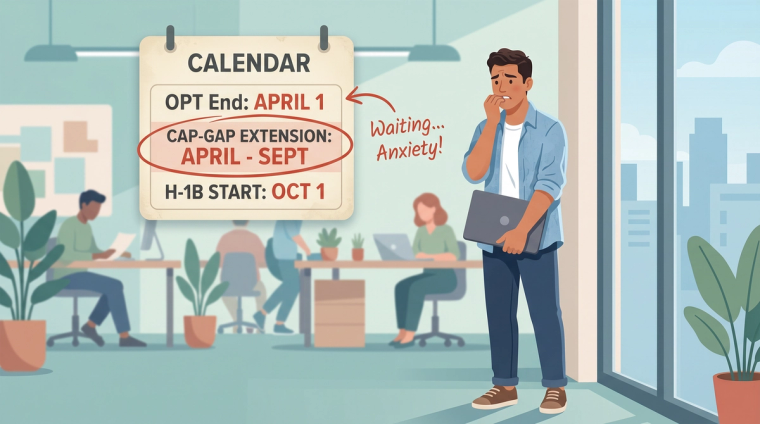
The 2025 rule changed the deadline: cap-gap now runs to April 1, not September 30. Here's how the OPT cap gap extension works in 2026, who qualifies, and what happens if your H-1B is still pending.
If your OPT EAD expires this summer and your H-1B was selected in the FY 2027 lottery, your work authorization does not end on October 1, 2026. It runs through April 1, 2027 if your H-1B is still pending. That date comes from the H-1B Modernization Final Rule, which took effect January 17, 2025. Most pages on Google still show the old September 30 cutoff, and some DSOs have not updated their templates either. The mechanics work the same way as before, but the timeline is much longer now, and a few 2025 and 2026 policy changes interact with it in ways almost no other guide covers. This post walks through them. For the wider OPT picture, see our OPT application guide.
What the cap gap extension actually does in 2026
Cap-gap is an automatic status and work-authorization extension. It exists because there is a gap between when most OPT EADs expire (usually some time after graduation) and when a cap-subject H-1B can take effect (October 1 of the new fiscal year at the earliest). The regulation at 8 CFR 214.2(f)(5)(vii)(A) automatically extends two things: your F-1 status, and any employment authorization granted under (c)(3)(i)(B) post-completion OPT or (c)(3)(i)(C) STEM OPT. F-2 dependents get the same status extension.
The extension runs until April 1 of the new fiscal year, or until the H-1B validity start date if that comes first. For an FY 2027 cap-subject petition filed in April 2026, cap-gap covers you through April 1, 2027 if your case is still pending on that date. The USCIS cap-gap page confirms this directly.
What cap-gap does NOT do: it does not issue a new EAD card, it does not update your I-94, and it does not give you a new visa stamp. For I-9 purposes, USCIS guidance is more specific than a single three-document formula. During cap-gap, the expired OPT EAD together with an endorsed cap-gap Form I-20 may be acceptable evidence, and once the Form I-797C receipt notice is issued, the expired EAD and receipt notice are also recognized in USCIS I-9 guidance. Do not assume all three documents are always required together under M-274.
Who qualifies for cap gap OPT to H-1B coverage
To get the automatic extension, all five of these must be true at the moment USCIS receipts your H-1B petition:
- You are in valid F-1 status (actively studying, on post-completion OPT, on STEM OPT, or within the post-completion grace period).
- Your employer timely filed a cap-subject I-129 during the April 1 to June 30 window.
- The petition requests change of status, not consular processing.
- The petition is nonfrivolous.
- You have not violated F-1 status.
If your employer files during your F-1 grace period, you get F-1 status extended but not work authorization. The USCIS Policy Manual, Volume 2, Part F, Chapter 5 is explicit on this point. Cap-exempt employers (universities, qualifying nonprofits) do not need cap-gap and cannot trigger it.
Your 2026 cap-gap calendar at a glance
The FY 2027 cap-gap calendar, from the March 2026 registration window through the April 1, 2027 endpoint if H-1B is still pending.
The cap-gap window for FY 2027 begins the day after your OPT EAD expires (assuming it expires before October 1, 2026) and runs until whichever comes first: the H-1B validity start date, or April 1, 2027. For background on how the cap process works, our FY 2026 H-1B cap recap walks through the registration and lottery mechanics.
Three 2026 updates competitors are getting wrong
The $100,000 H-1B payment is the big 2025 change to track. USCIS's September 21, 2025 H-1B FAQ says the payment is required with any new H-1B petition submitted after September 21, 2025, including cap-subject filings, and it separately says the proclamation does not change payments for H-1B renewals. The public FAQ does not give a general cap-gap or change-of-status exemption for F-1 students, so do not assume a cap-gap H-1B filing avoids this payment without case-specific, current guidance from the petitioning employer's counsel.
Cap-gap is governed by a different regulation than the general Form I-765 auto-extension rules, so cap-gap itself was not touched by any change to that framework. DHS had raised the renewal EAD auto-extension to up to 540 days in a December 2024 final rule, but an interim final rule effective October 30, 2025 (90 FR 48799) eliminated that renewal auto-extension for applications filed on or after that date. None of that reaches cap-gap or the STEM OPT 180-day extension, which sit under separate provisions and are unaffected.
Premium processing for Form I-129 H-1B is $2,965 for requests postmarked on or after March 1, 2026, up from $2,805. Worth knowing if you are weighing whether to file STEM OPT as a backup.
What happens if your H-1B is denied, withdrawn, or still pending on April 1
If your H-1B is denied, rejected, revoked, or withdrawn, cap-gap protection ends. Eligible students generally have a 60-day grace period from the date cap-gap status terminates or the program end date, whichever is later. A status violation, fraud, or misrepresentation finding can remove that protection. The postponed September 2026 fixed-admission rule does not create a 30-day grace period. If the employer withdraws the petition before the H-1B change of status takes effect and your original OPT has not expired, ask your DSO about a SEVIS data fix and confirm all conditions for any remaining OPT work authorization. USCIS explains the data-fix procedure on its cap-gap page.
If your H-1B is still pending on April 1, 2027, cap-gap ends at midnight. Your grace period begins, 60 days or 30 depending on how you were admitted. You stop working that day. If April is approaching with no decision in sight, premium processing the I-129 (the standard 15-business-day clock) is usually the right move. Tracking your case status early helps.
If your H-1B is approved for consular processing instead of change of status, cap-gap terminates on the approval date. You will need to leave the U.S. and visa-stamp before returning in H-1B status. The $100,000 fee can attach in this scenario.
International travel during pending cap-gap COS is risky. USCIS treats departure as abandonment of the change-of-status request. If your spouse is on H-1B and you are looking ahead to H-4 status, our H-4 EAD guide covers the dependent side.