
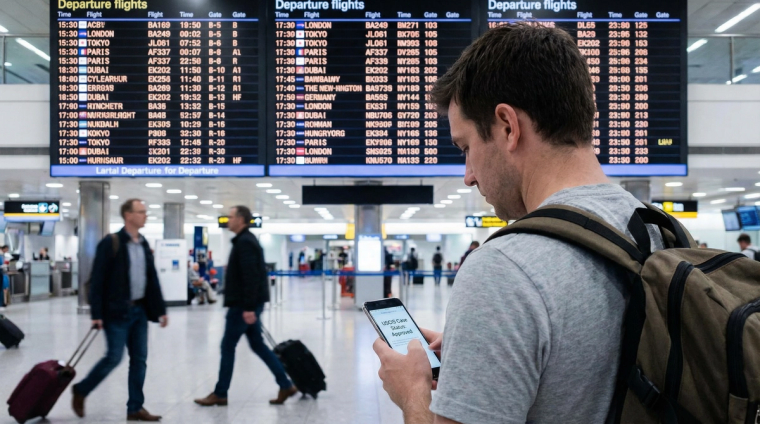
The short answer: yes, but plan carefully
USCIS confirms that permanent residents may travel internationally while their N-400 is pending. According to official guidance, you can travel to any country, including your home country, as long as no other legal issue prevents you from doing so (USCIS International Travel as LPR). For a full overview, see our complete N-400 guide.
But what trips people up: three things can derail your application even if your travel is technically allowed.
Domestic moves during a pending N-400 follow different rules. See our guide on moving states with N-400 pending.
- Breaking continuous residence with trips over 6 months
- Falling short on physical presence days in the U.S.
- Missing mandatory USCIS appointments while abroad
Understanding these three risks is the key to traveling safely during your pending case. If you're still preparing your application, our complete N-400 citizenship guide walks you through every step of the process.
How travel affects your continuous residence
The 6-month rule still matters once your N-400 is in motion. A single trip of 6 months or more during your statutory period creates a rebuttable presumption that you broke continuous residence. A trip of a year or more breaks it outright. Shorter trips don't break continuous residence on their own, but the days still count against your physical presence total.
For the full breakdown of how USCIS evaluates trips, what evidence overcomes the presumption, and the restart rule, see our continuous residence guide and physical presence guide.
The three appointments you cannot miss
Here's where travel during a pending N-400 gets risky. USCIS may schedule biometrics, a naturalization interview, and an oath ceremony during your case. Biometrics are not always required (USCIS may reuse previously captured fingerprints), but missing a scheduled biometrics appointment, interview, or oath ceremony can still lead to your case being denied, administratively closed, or treated as abandoned.
Biometrics appointment
Your biometrics appointment typically arrives 4 to 8 weeks after filing. At this appointment, USCIS collects your fingerprints, photo, and signature for background checks. For details on what happens and what to bring, see our complete biometrics guide.
If you miss it: Your application is considered abandoned and will be denied unless you request a reschedule before the appointment date.
Naturalization interview
Interview timing varies widely by field office, and notices can arrive much faster than posted estimates suggest. Our N-400 processing times guide tracks the current ranges. During the interview, a USCIS officer reviews your application, tests your English and civics knowledge, and makes a decision on your case. You can prepare with our civics test study guide with all 128 questions.
If you miss it: USCIS may deem your application abandoned if you fail to appear for the examination (interview) and fail to notify USCIS in writing of the reason for your non-appearance within 30 days, with a request to reschedule.
Oath ceremony
After passing your interview, you'll receive an oath ceremony notice within 1 to 4 weeks. Some field offices offer same-day oaths, but most schedule a separate ceremony.
If you miss it: Missing more than one oath ceremony creates a presumption that you've abandoned your application.
How to reschedule USCIS appointments
If you absolutely must travel and it conflicts with a scheduled appointment, you can request a reschedule. How:
Online (if eligible): Log into your USCIS online account at least 12 hours before your appointment. Navigate to your scheduled appointment and request a new date. This option isn't available if you've already rescheduled twice or if the appointment has passed.
By phone: Call the USCIS Contact Center at 800-375-5283 (TTY: 800-767-1833). Explain your situation and request a reschedule. Be prepared to provide your receipt number and explain your "good cause" for the change.
Good cause examples that USCIS lists include illness/medical appointment/hospitalization, inability to obtain leave from employment or caregiver responsibilities, significant life events (such as a wedding or funeral), previously planned travel, and late-delivered or undelivered biometric services appointment notices (USCIS guidance on biometrics rescheduling).
If you're managing your case status, learn how to check your application status to stay on top of any new appointments.
Travel at different stages of your application
After filing, before biometrics
This is the lowest-risk window for travel. You've submitted your application but haven't received any appointments yet. Monitor your USCIS online account daily and have someone check your mail. Biometrics notices typically arrive within 4-8 weeks.
Between biometrics and interview
This is the highest-risk period for travel. Interview notices can arrive much faster than processing time estimates suggest. If you must travel, keep trips short and have a plan to return quickly if an interview notice arrives.
Real example: One applicant planned a 6-week trip to the Philippines based on an 11-month processing estimate. Their interview notice arrived after just 2.5 months. They had to cut their trip short to avoid missing the appointment.
After interview, before oath ceremony
Many people overlook this window. After passing your interview, you're approved but not yet a citizen. You can still travel, but be aware of two issues:
First, you generally must return your green card (Permanent Resident Card) to USCIS when you check in for your oath ceremony. This can complicate international travel if you try to travel after you've surrendered your card and before you receive proof of citizenship.
Second, when you return for your oath ceremony, you'll answer questions on Form N-445 about any travel since your interview. Significant travel could raise questions.
For detailed guidance on what happens after filing, see our complete timeline guide.
Emergency travel: what to do
Family emergencies don't wait for convenient timing. If you must travel unexpectedly while your N-400 is pending, how to protect your case:
Before you leave:
- Check if any USCIS appointments are scheduled
- If an appointment conflicts, call USCIS immediately to reschedule
- Gather documentation of the emergency (medical records, death certificates, etc.)
- Set up mail forwarding or have someone check your mail daily
While abroad:
- Keep your trip as short as possible
- Collect evidence of your ongoing U.S. ties (remote work records, U.S. bill payments, family communications)
- Monitor your USCIS account for any updates
When you return:
- Be prepared to explain your trip at your interview
- Bring documentation of the emergency and your U.S. ties
- If your trip exceeded 6 months, prepare evidence to rebut the continuous residence presumption
Preserving residence with Form N-470
If your job takes you abroad for U.S. government work, qualifying U.S. employers in foreign trade, research institutions, or religious organizations, you may be able to preserve your continuous residence with Form N-470. It has to be filed before you've been outside the U.S. for a continuous year. See our continuous residence guide for the eligible categories and how to file.
Common misconceptions that could hurt your application
"I can't travel at all while my N-400 is pending."
False. Green card holders keep their travel rights during pending applications. The question is how much risk you're willing to accept.
"A Re-Entry Permit protects my continuous residence."
False. A Re-Entry Permit only protects your status as a permanent resident. It does nothing for your naturalization continuous residence requirement.
"Short trips don't count against me."
Partially false. While short trips don't trigger the continuous residence presumption, every day abroad counts against your physical presence total.
"Exactly 180 days abroad breaks my continuous residence."
False. The presumption applies to a single trip of more than 6 months, which USCIS generally treats as more than 180 days, and your departure and return days don't count as days outside the United States. Count carefully before assuming a trip put you over the line.
"I can reschedule appointments as many times as I need."
False. USCIS limits how often you can reschedule. Once an appointment has been rescheduled twice you generally lose the online rescheduling option, and missing an appointment without a timely request and good cause can get your case treated as abandoned or denied.
For more pitfalls to avoid, read about common N-400 mistakes that get applications denied.
Practical tips for safe travel during pending N-400
- Set up your USCIS online account if you haven't already. This lets you monitor your case status from anywhere.
- Use USPS Informed Delivery to see scans of incoming mail. USCIS appointment notices arrive by mail first.
- Have someone check your physical mail while you're away. Some notices are time-sensitive.
- Keep trips under 6 months whenever possible. This avoids the continuous residence presumption entirely.
- Document your U.S. ties before traveling. Take screenshots of your lease, mortgage statements, employment verification, and utility bills.
- Carry proof of your pending N-400. Bring your I-797 receipt notice when traveling internationally.
- Know your field office's processing speed. Check USCIS processing times for your specific location, but remember estimates are unreliable.
For information about application costs and payment options, see our guide on N-400 costs and fees and how to pay USCIS filing fees.
Traveling with an expired green card
An expired green card doesn't ground you. Since December 12, 2022, your N-400 receipt notice automatically extends your card for 24 months from its printed expiration date. Carry both documents when you travel, and see our guide to filing N-400 with an expired green card for the full rules.
Frequently Asked Questions
Yes, but this is the riskiest period for travel. Interview notices can arrive much faster than processing estimates suggest. Keep trips short, monitor your USCIS account daily, and be prepared to return quickly if needed.
There's no hard limit, but trips under 6 months are safest. Trips of 6 months to under 1 year create a rebuttable presumption of broken continuous residence. Trips of 1 year or more automatically break your continuous residence and restart the clock. Learn more in our continuous residence guide.
You have options. Contact USCIS immediately to reschedule. If you miss the interview without notifying USCIS within 30 days, your application may be considered abandoned. Having a valid reason (documented emergency) helps.
No. Only international travel affects your continuous residence and physical presence calculations. However, if you move to a different state, you may need to transfer your case to a new field office.
Yes, but proceed with caution. Your green card may have been taken during the interview. You'll also need to answer questions about post-interview travel on Form N-445 at your oath ceremony. Significant travel could raise questions about your intent.
Travel immediately if needed. Gather documentation of the emergency, notify USCIS if it conflicts with an appointment, and be prepared to explain the situation at your interview. Family emergencies qualify as "good cause" for rescheduling USCIS appointments.
Not automatically. Travel itself doesn't cause denial. Breaking continuous residence, failing to meet physical presence requirements, or missing appointments can lead to denial. Short trips with proper planning rarely cause problems.
No. You cannot file N-400 from abroad. You must be physically present in the United States when you submit your application. Check our step-by-step N-400 guide for complete filing requirements.
Yes. The officer will review your travel history for the statutory period (5 years or 3 years depending on your track) plus any travel since filing. Bring a list of all international trips with exact dates and destinations.
Create a USCIS online account at my.uscis.gov. You can check your case status, view documents, and receive notifications from anywhere with internet access. Set up email and text alerts for any updates.