

USCIS denied your I-130. What you do in the next 30 days, and which form you use to do it, decides whether the case can still be saved.
If your I-130 was denied, you have 30 days to act, and the form you file matters. Appeals go to the Board of Immigration Appeals on Form EOIR-29, not to the AAO on Form I-290B. This guide walks through what the denial notice actually means, the most common reasons USCIS issues one, and the four options you have to recover, including when refiling is smarter than appealing. For broader context on the petition itself, start with our complete guide to Form I-130.
What your denial notice actually says
Every I-130 denial notice is required by 8 CFR § 103.3(a)(1) to include three things: the specific reason for denial, the statute or regulation USCIS relied on, and your appeal rights. Read all three carefully. The denial letter will tell you whether to file the EOIR-29 (for an appeal) or I-290B (for a motion), the deadline, and where to send it.
A denial is different from a rejection, an RFE, and a NOID. A rejection means the form was returned for a technical defect before USCIS reviewed it, so you can simply refile. An RFE is a request for evidence that gives you 87 days to respond; it is not a denial. A NOID (Notice of Intent to Deny) signals USCIS is leaning toward denial and gives you a last chance to respond, usually within 30 days. A denial is the final decision, and it triggers the 30-day appeal clock.
The most common reasons USCIS denies an I-130
USCIS denial grounds are set out in 8 CFR § 204.2 and Volume 6, Part B, Chapter 5 of the USCIS Policy Manual. In practice, most denials fall into seven buckets:
- Insufficient bona fide marriage evidence. The single most frequent reason for spousal I-130 denials. USCIS expects joint financial records, shared housing proof, photos across time, and affidavits from people who know you both. Thin or inconsistent evidence is the most common failure.
- Failure to prove the qualifying relationship. For parents, children, or siblings, this usually means missing or unverifiable birth certificates, adoption decrees, or marriage certificates tying the family tree together.
- Failure to respond to an RFE or NOID. USCIS treats late responses as non-responses. Our I-130 RFE response guide walks through how to avoid this.
- Petitioner ineligibility. A common version: a lawful permanent resident files for a married child (only U.S. citizens can do that), or a U.S. citizen petitions for a parent before turning 21.
- Inconsistencies in documentation. Mismatched dates, addresses, or prior-marriage details that contradict what appears in USCIS or State Department records.
- Prior marriage not legally terminated. If a divorce decree is defective under the law of the state or country where it was issued, the new marriage is not valid for immigration purposes.
- INA § 204(c) marriage-fraud finding. The most serious category. This is a permanent bar that follows the beneficiary forever and cannot be cured by refiling.
Other, less frequent grounds include marriage during removal proceedings (INA § 204(g)), stepparent relationships formed after the child turned 18, adoption after the child turned 16, and Adam Walsh Act convictions by the petitioner.
Your four options after an I-130 denial
Once you receive a denial, you have four paths forward. The right one depends on why USCIS denied the petition and what you can fix.
1. Appeal to the Board of Immigration Appeals using Form EOIR-29. Use this when USCIS got the law or facts wrong. The BIA reviews appeals from DHS officer decisions de novo under 8 CFR § 1003.1(d)(3)(iii). The current filing fee is $1,030. Since May 26, 2026, EOIR-29 filings go to a USCIS lockbox in Phoenix or Dallas rather than the office that denied the petition; USCIS then forwards the appeal to the BIA. Only the petitioner, not the beneficiary, has standing to appeal (Matter of Sano, 19 I&N Dec. 299, BIA 1985).
2. File a motion to reopen on Form I-290B. Use this when you have new evidence that was not in the original file and that would change the outcome. Same 30-day deadline, $800 fee, and the same USCIS office reviews it. Authority: 8 CFR § 103.5.
3. File a motion to reconsider on Form I-290B. Use this when the denial was legally wrong based on the evidence USCIS already had. No new evidence needed; you argue USCIS misapplied the law. Same 30-day deadline and $800 fee.
4. Refile a new I-130. Often the fastest and cheapest path, especially if the relationship is genuine and the denial came from an evidence gap you can now fix. No deadline, no appeal, and the filing fee is $625 online or $675 on paper under the current USCIS fee schedule if you are eligible to file online. Form I-130 is generally available for online filing, but not if you are requesting a fee waiver or reduced fee, and certain special filing situations require paper filing. The trade-off: you lose your original priority date and start over.
The flowchart below is the decision framework most guides skip. Start at the top and answer each question honestly before you pick a form.
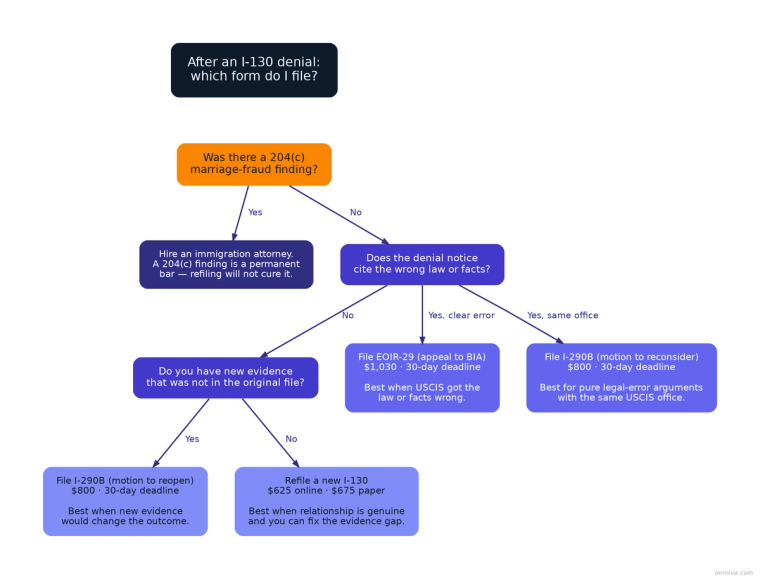
A step-by-step decision tree for choosing between an EOIR-29 appeal, an I-290B motion, and refiling a new I-130.
EOIR-29 vs I-290B, the distinction that could save your case
This is the single most confused procedural point in the I-130 space, and getting it wrong can permanently cost you your appeal rights. Multiple law-firm websites still tell readers to use Form I-290B to appeal an I-130 denial. USCIS's own I-290B form page says the opposite, in plain language: do not use I-290B to file an appeal of Form I-130, use Form EOIR-29 to appeal to the BIA.
Here is the split:
- Appeal an I-130 denial → Form EOIR-29, reviewed by the Board of Immigration Appeals, $1,030, 30 days.
- Motion to reopen or reconsider an I-130 denial → Form I-290B, reviewed by the same USCIS office that denied, $800, 30 days.
The regulatory basis is 8 CFR § 1003.1(b)(5), which places family-based immigrant-petition appeals under BIA jurisdiction. The AAO does not hear I-130 appeals. If you file the I-290B when you meant to appeal, the 30 days will run out and you lose the right to go to the BIA.
If you are unsure which path fits your situation, this is the moment to talk to an immigration attorney. The 30-day window is short and unforgiving.
The cost of each post-denial option
Before you pick a path, compare filing fees side by side. These are government fees only. Attorney fees run separately, typically $2,000 to $10,000 or more depending on complexity.
Government filing fees for the four I-130 post-denial options, from refiling a new petition to appealing to the BIA.
| Option | Form | Government fee |
|---|---|---|
| Refile a new petition | I-130 | $625 online, $675 paper |
| Motion to reopen | I-290B | $800 |
| Motion to reconsider | I-290B | $800 |
| Appeal to the BIA | EOIR-29 | $1,030 |
Timing differs by path. A motion decided at the same USCIS office is often faster than a BIA appeal, and refiling starts the I-130 processing clock over.
Will I-130 denial lead to deportation?
The answer changed meaningfully in 2025, and pre-2025 guidance no longer holds for every beneficiary.
Beneficiary living abroad: no deportation risk. An I-130 denial does not affect someone outside the U.S. other than blocking the visa path.
Beneficiary in the U.S. with valid nonimmigrant status: generally low risk. The denial itself does not end their status. If they have a concurrent I-485 pending, that will also be denied, but their underlying visa usually continues.
Undocumented beneficiary in the U.S.: real risk. USCIS issued a Notice to Appear policy memorandum on February 28, 2025, and later issued family-based policy guidance effective August 1, 2025, clarifying that USCIS may issue a Notice to Appear if the beneficiary is otherwise removable, because a family-based petition does not grant status or relief from removal. If the beneficiary is undocumented, this risk should heavily shape your strategy and usually warrants speaking with an immigration attorney before filing anything.
If separate country-specific entry restrictions or visa-processing restrictions apply to the beneficiary, the denial may raise additional issues and warrants legal review.
When denial is permanent: INA § 204(c) fraud findings
A simple denial is almost always recoverable. A 204(c) finding is not.
INA § 204(c) creates a permanent bar on visa petitions for any beneficiary who USCIS determines previously attempted or conspired to enter into a marriage for the purpose of evading immigration law. The Matter of Tawfik decision (20 I&N Dec. 166, BIA 1990) confirmed that the bar applies even if the current marriage is bona fide. Once the fraud finding attaches to the beneficiary, no future I-130 can be approved for that person. The evidence has to be substantial and probative, a higher bar than the preponderance standard used for ordinary petitions (Matter of P. Singh, 27 I&N Dec. 598, BIA 2019), and the finding carries no time limit (Matter of Jongbum Pak, 28 I&N Dec. 113, BIA 2020).
If your denial notice references 204(c), treat it as an urgent matter requiring counsel. The main avenues are to challenge the finding directly through the administrative process, including appeal to the BIA or an appropriate motion, and in some cases seek judicial review after the agency process. File a FOIA request for the full USCIS file before deciding. The underlying evidence of the prior fraud may be important to evaluating your options.