
If you just opened a letter from USCIS asking for additional evidence on your I-130 petition, take a breath. A Request for Evidence means USCIS needs more documentation before it can decide on your I-130 petition. An RFE is not a denial, but it doesn't guarantee approval either. In some cases, USCIS can deny a petition outright without issuing an RFE, when required initial evidence is missing or there's no legal basis for approval. Either way, it's a second chance. This covers everything from reading the notice to putting together your response package. If you haven't filed your I-130 yet, start with our complete I-130 guide instead.
What is an I-130 RFE?
A Request for Evidence is a formal notice from USCIS asking you to submit additional documentation for your I-130 petition to sponsor a family member for a green card. The officer reviewing your case couldn't approve it based on what you originally submitted, but they're not denying it either.
Under current USCIS policy, adjudicators can deny petitions outright in some cases without issuing an RFE first, particularly when required initial evidence is missing or there is no legal basis for approval (USCIS Policy Manual, Vol. 1, Part E, Ch. 6). Getting an RFE usually means USCIS sees enough merit in your case to want more before they decide.
RFE vs. NOID: know the difference
An RFE and a Notice of Intent to Deny (NOID) are not the same thing:
- RFE: USCIS needs more evidence to decide. You have up to 87 days to respond.
- NOID: USCIS is leaning toward denial and is giving you a final chance. You only have 30 days.
If you received a NOID instead of an RFE, your situation is more urgent. Consult an immigration attorney right away.
The 87-day deadline: no extensions
Your RFE notice will include a specific response deadline. Under 8 CFR § 103.2(b)(8)(iv), USCIS may allow up to 12 weeks (84 days) to respond to an RFE. If the RFE was served by ordinary mail, USCIS applies an additional 3 days under 8 CFR § 103.8(b) for mailing, meaning USCIS generally treats an RFE response as timely if received within 87 days after the RFE mailing date.
USCIS generally does not grant extensions for RFEs. The regulations state that additional time to respond may not be granted. USCIS policy guidance notes that officers may, in their discretion, treat a late response as timely when warranted by the circumstances, but counting on this is a bad idea.
Missing the deadline has serious consequences. If you fail to respond, USCIS may deny your petition as abandoned, deny it based on the existing record, or both. In some cases, if the beneficiary is in the U.S. and is otherwise removable, USCIS may issue a Notice to Appear under current NTA guidance, because an I-130 petition does not grant lawful status or protection from removal.
Don't wait until the last day. USCIS must receive your response by the deadline, not just have it postmarked. Mail delays, weather, and delivery problems are your responsibility. Aim to submit your response at least 10 to 14 days before the deadline.
If you're overseas: USCIS policy generally provides 14 extra days for mailing when the applicant lives outside the U.S. or an international field office issues the RFE, bringing the total to 98 days on an 84-day RFE response period.
The 5 most common reasons USCIS sends an I-130 RFE
Your RFE notice will spell out exactly what USCIS wants. Here are the ones that come up most often.
1. Insufficient bona fide marriage evidence
This is the most common RFE for spousal I-130 petitions. A marriage certificate proves you're legally married. It does not prove the marriage is genuine. USCIS wants evidence that your marriage was entered in good faith and not for immigration purposes (8 CFR § 204.2(a)(1)(iii)(B)). If you only submitted a marriage certificate and a few photos, expect this RFE. See the bona fide marriage evidence section below for exactly what to submit.
2. Missing prior marriage dissolution records
USCIS requires proof that all prior marriages of both spouses were legally terminated before the current marriage took place. If either you or your spouse was previously married, include divorce decrees, annulment orders, or death certificates for every prior marriage. Missing even one triggers an RFE.
3. Petitioner citizenship or LPR status proof
If you didn't provide sufficient documentation of your U.S. citizenship or lawful permanent resident status, USCIS will ask for it. Acceptable documents include a U.S. birth certificate, naturalization certificate, unexpired U.S. passport, FS-240, or Form I-551 (green card).
4. Translation or document quality issues
All foreign-language documents require a certified English translation with a statement of translator competence (8 CFR § 103.2(b)(3)). Poor photocopies, documents that don't appear from official sources, or missing translations are common RFE triggers.
5. Missing Form I-130A or photographs
For spousal petitions, Form I-130A (Supplemental Information for Spouse Beneficiary) is required. If the beneficiary is overseas, the form still must be submitted, but the spouse does not have to sign it. Missing or non-compliant passport-style photos are another quick-fix RFE.
How to respond to your I-130 RFE: step by step
Here's how to build a response that holds up.
Step 1: Read every line of the RFE notice
This sounds obvious, but many people skim the notice and miss specific requests. Your RFE will tell you exactly what USCIS wants. Some requests are general ("additional evidence of bona fide marriage") and some are very specific ("joint federal tax returns for tax years 2023 and 2024"). Read it carefully and make a checklist of every item requested.
Note your A-Number and receipt number on the notice. You'll need both for your response.
Step 2: Note your exact deadline
Find the response due date on the RFE notice. Mark it on your calendar and set reminders. Remember: the deadline is when USCIS must receive your response, not when you mail it. Count backward 10 to 14 days to get your actual mailing deadline.
Step 3: Gather ALL requested evidence plus supplemental documents
Submit more evidence than the RFE specifically asks for. USCIS must consider all evidence you submit, and a thick, well-organized response package shows you're taking this seriously. Prioritize what the RFE specifically requests, then add supporting documents on top.
Step 4: Write a cover letter
Your cover letter is what ties everything together for the officer. See the cover letter section below.
Step 5: Organize your response package
A well-organized package makes the officer's job easier:
- Place the original RFE notice (the barcode page) on top of your response
- Include your cover letter next
- Create a table of contents listing every exhibit
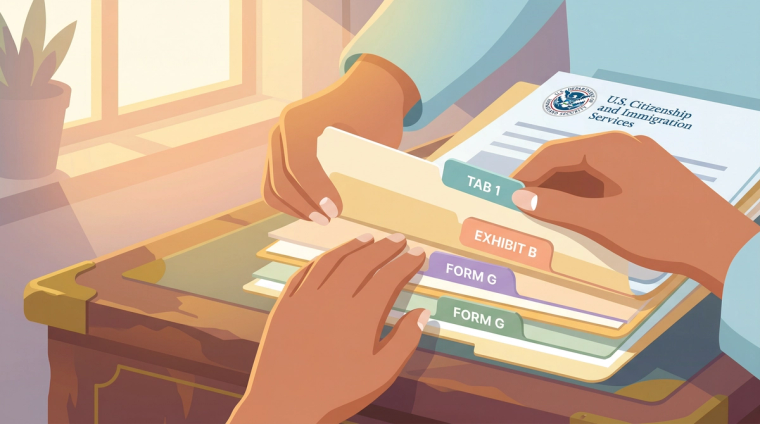
- Use tabs or dividers to separate evidence into labeled sections
- Mark documents as "Exhibit A," "Exhibit B," etc., and reference these labels in your cover letter
Step 6: Make copies of everything
Keep a complete copy of your entire response package. If USCIS claims they never received something, you'll have proof of what you sent.
Step 7: Mail with tracked shipping
Send your response to the address listed on the RFE notice (not the address where you originally filed). Use USPS Priority Mail, FedEx, or UPS with tracking and delivery confirmation. Save the tracking number and delivery confirmation screenshot.
Never send original documents unless the RFE specifically requests originals. Always send copies.
What your cover letter should include
Header: Your full name, the beneficiary's full name, receipt number, A-Number (if applicable), and the date.
Opening paragraph: State that you're responding to the RFE dated [date] for Form I-130, receipt number [number].
Point-by-point responses: For each item the RFE requested, write a brief paragraph explaining what evidence you're providing and which exhibit number corresponds to it. For example: "In response to USCIS's request for evidence of a bona fide marriage, please see Exhibit C (joint bank statements, January 2024 through December 2025), Exhibit D (joint tax returns for tax years 2023 and 2024), and Exhibit E (four notarized affidavits from friends and family)."
Closing paragraph: State the total number of exhibits enclosed and request that USCIS approve your I-130 petition.
Signature: Sign and date the letter. If your attorney writes a separate cover letter, they may sign it, but having an attorney doesn't mean you shouldn't sign your own response materials when appropriate.
Bona fide marriage evidence checklist for your RFE response
If your RFE asks for proof that your marriage is genuine, organize what you submit into these categories. The more categories you cover, the stronger your case. Our I-130 documents checklist lists what belongs in each category.
Financial union (highest weight): Joint bank account statements, joint credit card statements, shared insurance policies (health, auto, life, renters), joint federal tax returns filed as "Married Filing Jointly," beneficiary designations on retirement accounts or life insurance naming your spouse.
Cohabitation proof: Joint lease or mortgage documents, utility bills showing both names or the same address, driver's licenses at the same address, mail addressed to both spouses.
Photos and social proof: 10 to 20 dated and labeled photos spanning the entire relationship timeline (wedding, holidays, family events, vacations, everyday life). Include travel records showing trips together, event invitations, and holiday cards addressed to both spouses.
Affidavits: 2 to 4 notarized sworn statements from friends or family who know your relationship firsthand. Each affidavit should describe specific observations (not just "they seem happy"), and include the affiant's full name, date of birth, address, phone number, how they know you, and a copy of their government-issued ID.
Children: Birth certificates of children born to the marriage, school records listing both parents, medical records.
Communication records: Text message screenshots, call logs, video chat history, and social media posts showing your relationship.
Special guidance for newlyweds and long-distance couples: If you recently married or live in different countries, you may not have joint financial documents yet. That's fine. Provide alternative evidence: travel receipts showing visits to each other, money transfer records (Western Union, Remitly, Wise), communication records showing ongoing contact, and a brief letter explaining why you don't yet have joint accounts. Affidavits from people who witnessed your relationship in person carry extra weight in these situations.
Sample RFE response scenarios
Scenario 1: Bona fide marriage evidence RFE (newlywed/arranged marriage)
What the RFE said: "Submit evidence demonstrating that the marriage was entered into in good faith and not for the purpose of circumventing immigration laws."
What to submit: Affidavits from family members who witnessed the marriage and courtship, photos from the wedding and subsequent visits, proof of the petitioner spending time with the spouse abroad (travel records, visa stamps), money transfer records, phone and messaging records spanning the relationship, and a personal declaration describing how you met and why you married.
Scenario 2: Missing Divorce Decree
What the RFE said: "Submit evidence of legal termination of petitioner's prior marriage to [name]."
What to submit: The divorce decree from the relevant court. If you can't locate it, contact the court clerk's office in the jurisdiction where the divorce was granted. If the records are from another country, obtain a certified copy with a certified English translation. If the document is truly unavailable, submit a written explanation with secondary evidence (court records showing the case was filed, correspondence with the court, etc.).
Scenario 3: Translation or Document Quality
What the RFE said: "Submit a certified English translation of the marriage certificate."
What to submit: A new certified translation. The translator must include a statement certifying that they are competent to translate from the source language to English and that the translation is complete and accurate. Include the original foreign-language document alongside the translation.
What happens after you submit your RFE response
Once USCIS gets your response, the case goes back into the processing queue. Here's what to expect:
Timelines vary widely. Some petitioners report approval within 4 to 14 days for simple document RFEs. Bona fide marriage RFE responses typically take 30 to 60 days for a decision. USCIS officially estimates about 60 days for a written decision after receiving an RFE response, though some cases go 90 days or longer.
Your case status may not update for weeks. Applicants commonly report that the USCIS online tracker shows no change for 3 to 6 weeks after an RFE response arrives. That's not a sign something went wrong.
Possible outcomes after your response:
- Approval: USCIS approves the petition and forwards it to the National Visa Center (for consular processing) or proceeds with adjustment of status.
- Follow-up RFE: In some cases, USCIS issues a second RFE if your response raised new questions.
- Notice of Intent to Deny (NOID): If your response still isn't sufficient, you may receive a NOID, giving you one more chance before a final denial.
- Denial: In the worst case, your petition is denied. See our guide on I-130 denial reasons and how to respond for next steps.
You can check your case status online while you wait.
5 common mistakes that get I-130 RFE responses denied
1. Sending only what was asked for. The RFE lists the minimum. You should exceed it. If they asked for bona fide marriage evidence, don't send just one joint bank statement. Send everything you have across all evidence categories.
2. Missing the deadline. The deadline is when USCIS receives your package, not when you mail it. Mailing two days before the deadline is a gamble you shouldn't take. Mail at least 10 to 14 days early.
3. Not including the original RFE notice. Your response must include the original RFE notice (with the barcode) on top. Without it, USCIS may not be able to match your response to your case.
4. Sending documents in batches. You get one submission. If you mail a partial response and then try to send more evidence later, USCIS treats the first submission as your complete response and makes a decision on that alone.
5. Arguing instead of providing evidence. Some petitioners write long letters explaining why USCIS is wrong to ask for more evidence. This doesn't help. The officer needs documents, not arguments. Provide the evidence and let it speak for itself.
2025-2026 policy changes every I-130 petitioner should know
The rules have shifted significantly. A few specific updates worth knowing about:
PA-2025-12 (August 2025): Stricter marriage scrutiny. USCIS officers are now instructed to request more detailed evidence and scrutinize relationship timelines to detect fraud. USCIS may deny petitions without issuing RFEs in some cases. Notice to Appear risk has increased substantially.
PA-2025-23 (October 2025): Heightened bona fide marriage review. Officers now evaluate marriage bona fides at the petition stage, not just at the interview. That means more RFEs for marriage-based I-130 petitions and a higher evidence bar across the board.
Travel ban impacts (January 2026). Nationals of 39 countries face full or partial travel bans affecting immigrant visa processing. Even approved I-130 petitions may not result in visa issuance for affected nationalities. See our 2025 travel ban analysis for current details.
With stricter scrutiny at every stage, there's less room for a thin or disorganized response than there was a year ago.
When to hire an immigration lawyer for your RFE
Not every RFE requires legal help. If the RFE asks for straightforward documents you can easily provide (a missing translation, updated photos, a divorce decree), you can probably handle it yourself. Immiva can help you prepare your I-130 and organize your evidence without the cost of full legal representation.
Consider hiring an immigration attorney if:
- Your RFE involves complex bona fide marriage questions and you have limited evidence
- USCIS raised fraud concerns or mentioned INA § 204(c)
- Your case involves a prior removal order, criminal history, or immigration violations
- You received a NOID instead of (or following) an RFE
- Your beneficiary is from a travel-ban country