

If you're a U.S. citizen or green card holder who wants to bring a family member to live permanently in the United States, Form I-130 (officially the Petition for Alien Relative) is where the process begins. Filing it doesn't give your relative a green card. It tells USCIS that you have a qualifying family relationship with the person you're sponsoring.
Once the petition is approved, your relative can move forward with the actual visa or green card application, either by adjusting status inside the U.S. or going through consular processing abroad.
Below: who can file, which family members qualify, what documents you need, current fees, processing times, and the 2025 to 2026 policy changes.
What Is Form I-130?
Form I-130 is a petition filed by a U.S. citizen or lawful permanent resident (LPR) to establish that they have a qualifying family relationship with a foreign national beneficiary (INA § 204(a)).
Approval of the I-130 does not grant any immigration status. It's step one in a multi-step process, so think of it as registering your relationship with USCIS. After approval:
- Immediate relatives of U.S. citizens can move directly to the green card application, with no wait for a visa number
- Preference category beneficiaries must wait for a visa number to become available before proceeding
The full green card process requires additional forms. That usually means Form I-485 (Adjustment of Status) for people already in the U.S., or consular processing with the National Visa Center and a U.S. Embassy or Consulate abroad.
Who Can File Form I-130?
Form I-130 may be filed by U.S. citizens, lawful permanent residents, and certain U.S. nationals. The relationships they can petition for are different.
If You Are a U.S. Citizen
U.S. citizens can petition for a broader range of relatives and have access to the "immediate relative" category, which has no annual visa limits:
- Spouse (immediate relative)
- Unmarried children under 21 (immediate relative)
- Parents, if you are 21 or older (immediate relative)
- Unmarried adult sons or daughters (21+): Family First (F1) preference category
- Married sons or daughters: Family Third (F3) preference category
- Siblings: Family Fourth (F4) preference category, if you are 21 or older
If You Are a Lawful Permanent Resident
Green card holders have more limited options and no immediate relative category:
- Spouse: Family Second A (F2A) preference category
- Unmarried children under 21: Family Second A (F2A) preference category
- Unmarried adult sons or daughters (21+): Family Second B (F2B) preference category
Additional Petitioner Requirements
Regardless of who you're petitioning for, you must:
- Prove your citizenship or LPR status with primary evidence (U.S. passport, birth certificate, naturalization certificate, or green card)
- Be aware that domicile is not a Form I-130 filing requirement. It comes up later in the process with the Affidavit of Support (Form I-864).
- Be aware that INA § 204(c) can bar approval of a petition if the beneficiary previously entered into, attempted, or conspired to enter into a marriage to evade immigration laws.
If you became an LPR through a marriage within the past 5 years and now want to petition for a new spouse, USCIS requires "clear and convincing evidence" that your prior marriage was bona fide (INA § 204(a)(2)). This is a higher bar than the usual standard.
Immediate Relatives vs. Family Preference Categories
This distinction determines whether your relative can get a green card quickly or wait years, sometimes decades.
Immediate Relatives: No Visa Limits, No Waiting
Immediate relatives of U.S. citizens are exempt from the annual visa caps that apply to everyone else (INA § 201(b)). A visa number is always available the moment the I-130 is approved.
| Relationship | Visa Category |
|---|---|
| Spouse of U.S. citizen | IR-1 / CR-1 |
| Unmarried child under 21 of U.S. citizen | IR-2 |
| Parent of U.S. citizen (petitioner 21+) | IR-5 |
A note on CR-1 (Conditional Resident): if the marriage is less than 2 years old at the time of admission, the spouse receives conditional permanent residence under INA § 216. The conditions must be removed by filing Form I-751 in the 90 days before the 2-year green card expires.
Family Preference Categories: Annual Limits and Long Waits
All other family-based petitions fall into preference categories, each with a limited number of immigrant visas per year. The annual worldwide limit for all family-sponsored categories combined is 226,000 (INA § 203(a)).
| Category | Relationship | Current Wait (All Chargeability) |
|---|---|---|
| F1 | USC's unmarried adult sons/daughters (21+) | ~9.3 years |
| F2A | LPR's spouse or unmarried children under 21 | ~2 years |
| F2B | LPR's unmarried adult sons/daughters (21+) | ~9.3 years |
| F3 | USC's married sons/daughters | ~14.5 years |
| F4 | USC's siblings | ~18 years |
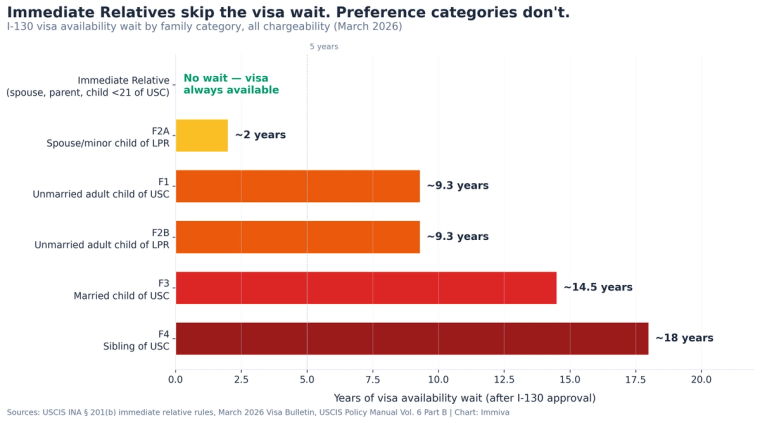
Immediate Relatives vs. Family Preference Categories: I-130 visa availability wait by family category (March 2026). Immediate Relatives have no visa wait; preference categories face backlogs ranging from ~2 years (F2A) to ~18 years (F4 siblings). Sources: USCIS, March 2026 Visa Bulletin.
What Is a Priority Date?
When you file Form I-130 for a preference category beneficiary, USCIS assigns a priority date, which is the date they received your petition. Your beneficiary can move forward with the green card process only when their priority date becomes "current" in the monthly Visa Bulletin published by the State Department.
For nationals of high-demand countries (Mexico, Philippines, India, China), the waits are significantly longer than the "all chargeability" estimates above. See the June 2026 Visa Bulletin analysis for current priority dates by country.
I-130 Filing Fee and Costs in 2026
The current filing fee has been in effect since April 1, 2024, the first increase since 2016 (USCIS Final Fee Rule):
- Online filing: $625
- Paper filing: $675
- Biometrics fee: $0, eliminated and folded into the main fee
Payment Methods
Since October 28, 2025, USCIS accepts only two payment methods for paper filings: credit, debit, or prepaid card with Form G-1450, or ACH bank transfer with Form G-1650. Checks and other mailed paper payments no longer work, and online filings pay through Pay.gov. Our guide on how to pay USCIS filing fees covers the full process.
Fee Waivers
There is no fee waiver for Form I-130, on paper or online. USCIS limits fee waivers to specific categories of filers, such as VAWA self-petitioners and T and U visa victims (8 CFR 106.3), and ordinary family petitioners do not qualify.
Full-Process Cost Estimate
The I-130 is just the first fee. The complete family-based green card process typically involves:
- Form I-485 (Adjustment of Status, if filing in the U.S.): $1,440 for adults
- Consular processing fees (if abroad): typically $120 Affidavit of Support fee (when required) plus a $325 immigrant visa application processing fee per applicant.
- Form I-864 (Affidavit of Support): no USCIS fee, but documentation prep takes time
- Form I-131 (advance parole travel document, if needed while the case is pending): $630 on paper, $580 online
Documents required for I-130 by relationship type
Every petition needs the same baseline: Form I-130 (Edition 04/01/24), proof of your U.S. citizenship or LPR status, evidence that any prior marriage on either side legally ended, and certified English translations of any foreign-language record. Past that, what you submit changes a lot depending on who you're filing for.
Spouse petitions are the heaviest by far. USCIS now expects substantial bona fide marriage evidence (joint financial records, shared housing proof, photos across time, third-party affidavits) submitted with the petition itself, plus Form I-130A from the beneficiary spouse. Parent petitions usually hinge on your birth certificate, and stepparents or adoptive parents add the marriage date or the age at adoption. Sibling petitions need both birth certificates showing at least one shared parent.
Our I-130 documents checklist by relationship type covers each category in depth, including secondary evidence options for cases where the civil records do not exist or cannot be obtained.
How to File Form I-130: Step by Step
Filing Online (Recommended)
- Go to my.uscis.gov and create or log in to your account
- Select "File a Form Online" and choose Form I-130
- Complete all sections and upload supporting documents as PDFs
- Pay the $625 fee through Pay.gov
- Submit and save your receipt number, which you'll use to track your case
Online filing saves $50 compared to paper. USCIS allows Form I-130 to be filed online even if the beneficiary is in the United States and will file Form I-485 by mail; however, USCIS will not accept a Form I-485 as supporting evidence inside an online I-130 filing, and same-package concurrent filing is handled on paper. Immiva's I-130 preparation covers either route and generates Form I-130A automatically for spouse petitions.
Filing by Mail
Mail your completed form, supporting documents, and payment to the appropriate USCIS lockbox. The correct address depends on your state of residence and whether you're filing concurrently with other forms. Always check the USCIS filing address page before mailing, because addresses change.
Remember: as of October 2025, only Form G-1450 (card payment) or Form G-1650 (ACH transfer) are accepted for paper filings.
Filing from Outside the United States
If you live abroad, you can file online through my.uscis.gov or mail your petition to USCIS's Elgin lockbox. Filing at a U.S. Embassy or Consulate is only permitted for immediate relatives in limited exceptional circumstances (USCIS Policy Manual, Vol. 6, Part B, Ch. 3).
Concurrent Filing: I-130 + I-485 Together
If your relative is already in the United States with a lawful entry on record and a visa number is currently available for their category, you may be able to file Form I-130 and Form I-485 together in the same package. Key rules:
- If you want to submit Form I-130 and Form I-485 together in one concurrent paper package, both forms should be filed on paper. USCIS also states that you may file Form I-130 online and then have the beneficiary file Form I-485 by mail with a copy of the I-130 receipt notice.
- The beneficiary must be in the U.S. with a valid lawful entry
- A visa number must be immediately available (immediate relatives always qualify; preference categories check the monthly Visa Bulletin)
- The beneficiary must not have an unlawful presence bar or prior order of removal
Concurrent filing is generally faster than the two-step approach. Adjustment of status cases currently average roughly 8 to 10 months from initial filing to approval.
I-130 processing times in 2026
USCIS adjudication alone now runs from under a year for some immediate relative cases to a decade or more in the slowest preference categories. Preference category beneficiaries then wait for a visa number in the Visa Bulletin on top of that. Concurrent I-130 + I-485 cases inside the U.S. tend to land in the 8 to 10 month range, while consular immediate relative cases average around 17 months.
There is no premium processing for Form I-130, and expedites are rarely granted outside narrow military, financial, or humanitarian situations. The full breakdown by relationship category, country of birth effects, and what to do when your case stalls is in our I-130 processing time guide.
What happens after I-130 is approved
Approval confirms the family relationship. It is not a green card. What comes next depends on where your beneficiary lives.
A beneficiary already in the U.S. who entered lawfully can usually file Form I-485 for adjustment of status, either right after I-130 approval (for immediate relatives) or once a visa number is current (for preference categories). A beneficiary abroad goes through consular processing: USCIS forwards the case to the National Visa Center, which collects fees, the DS-260, civil documents, and the I-864 Affidavit of Support before scheduling an embassy interview.
You will also need to meet the I-864 income requirement of 125% of the federal poverty guidelines for your household size, or bring in a joint sponsor who does.
Our step-by-step guide to what happens after I-130 approval walks through both routes, and the I-130 consular processing timeline breaks down the embassy path stage by stage.
Edge cases and special circumstances
A handful of fact patterns trip up petitioners regularly, and most have their own deeper guide:
Stepchildren and adopted children. The qualifying marriage must have happened before the child turned 18, and adoption must be finalized before age 16 with two years of legal custody and joint residence. Both rules are strict and have no waiver. See I-130 for stepchildren and adopted children for the full eligibility test.
Children born out of wedlock. A mother can always petition. A father needs proof of legitimation under the law of the relevant domicile, or documented evidence of a bona fide parent-child relationship established before the child turned 21.
Same-sex couples. After Obergefell v. Hodges (2015), same-sex marriages are treated identically for I-130 purposes if the marriage was valid where it was celebrated.
Petitioner death. The default rule is automatic revocation, but Section 204(l) relief, humanitarian reinstatement, and widow(er) self-petitioning under Form I-360 can keep the case alive. The full rules and timing are in what happens to I-130 if the petitioner dies.
CSPA and aging out. If a child turns 21 while the I-130 is pending, the Child Status Protection Act may preserve their classification by subtracting USCIS processing time from biological age. The calculation depends on category and visa availability.
Upgrading after naturalization. An LPR who filed an F2A petition and later naturalizes sees the case upgrade to immediate relative automatically, with the visa wait collapsed. Spouses can opt out only if the original category would somehow be faster, which is rare.
2025 to 2026 Policy Changes That Affect Your I-130
The family-based immigration landscape changed more in 2025 and 2026 than it had in the previous decade.
Travel Bans and Adjudication Holds
Proclamation 10949 (June 2025) initially suspended immigrant visa issuance for 19 countries. This was expanded to 39 countries in December 2025, effective January 1, 2026, with the categorical exception for immediate family members removed. USCIS Policy Memos PM-602-0192 and PM-602-0194 direct additional adjudication holds for I-130 petitions involving nationals of travel-ban countries, processed through a new centralized vetting center established December 5, 2025. A federal court struck those holds down on June 5, 2026, and USCIS is expected to resume adjudications while a likely appeal plays out.
For a current list of affected countries and what narrow exceptions remain, read our guide to the 2025 travel ban and its effects on families.
75-Country Immigrant Visa Pause
On January 21, 2026, the State Department issued an indefinite pause on immigrant visa issuance for nationals of 75 additional countries. Consular interviews continue, but no visas are actually being issued while the policy is in effect. Litigation is active (CLINIC v. Rubio, filed February 12, 2026). This affects only consular processing. Adjustment of status inside the United States is not affected. See the full breakdown of the 75-country visa processing pause.
Enhanced Vetting and Enforcement
As of August 19, 2025, USCIS screens all immigration benefit requests for social media activity, treating "anti-American" content as a negative discretionary factor. An expanded Notice to Appear policy (effective February 28, 2025) means that individuals found inadmissible during the I-130 review process may face removal proceedings, and an approved petition offers no protection from this.
Payment Method Changes (October 2025)
USCIS stopped accepting checks and all other mailed paper payments on October 28, 2025. If you're filing on paper, use Form G-1450 (credit/debit/prepaid card) or Form G-1650 (ACH bank transfer). Here's what changed when USCIS stopped accepting checks.
I-130 vs. K-1 fiance visa
If you are a U.S. citizen engaged to someone abroad, you can either marry first and file I-130 for a CR-1/IR-1 spousal visa, or file Form I-129F for a K-1 fiance visa. The K-1 usually gets your partner into the U.S. faster, but the total process (K-1 followed by adjustment of status, plus a separate work permit) tends to take longer and cost more overall once you add it all up. Couples who can marry abroad without major hardship usually do better on the I-130 path.
Our I-130 vs K-1 fiance visa comparison breaks down total time to a green card, current fees on each side, and the work-authorization gap that catches most K-1 couples by surprise.
Common mistakes and I-130 denial reasons
Most I-130 problems are documentation problems, not eligibility problems. The recurring patterns:
RFE triggers. Thin bona fide marriage evidence in spousal cases, missing Form I-130A, no proof that a prior marriage legally ended, unclear birth certificates, and missing certified translations are the most common reasons USCIS asks for more evidence. If you receive one, the I-130 RFE response guide walks through the 87-day deadline and how to put together a strong response package.
Outright denials. The qualifying relationship not actually qualifying (an LPR filing for a sibling, a stepchild relationship formed after age 18, an adoption after age 16), a prior INA § 204(c) marriage-fraud finding that creates a permanent bar, and the LPR five-year marriage rule are the categories that come up over and over. The full denial roster, what to file inside 30 days, and why so many guides give the wrong appeal form is in I-130 denied: common reasons and how to respond.